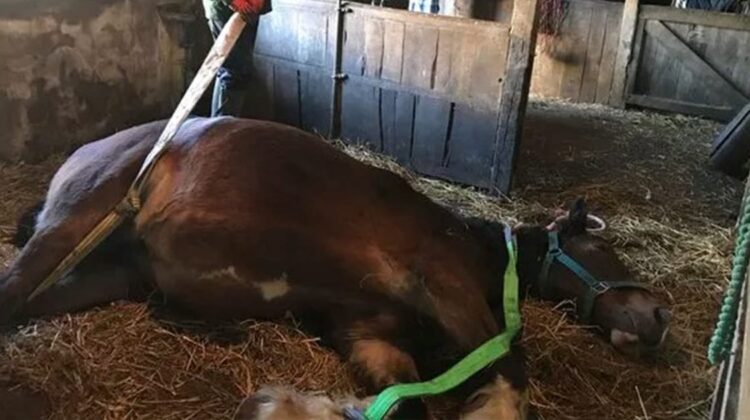
When emergencies strike, most people think first of dogs — animals renowned for sensing distress and acting with startling intuition. Rarely does the mind turn to horses.
Yet inside a quiet stable in Somerset, England, an extraordinary act of animal instinct unfolded — one that left seasoned horse owners stunned.
It was not a human intervention that saved a collapsing horse that day.
It was another horse.
A Sudden Medical Crisis
Beatrice, a 16-year-old Shire horse, had always been a powerful presence in the stable. As a member of one of Britain’s largest and strongest draft breeds, she weighed nearly a ton — a gentle giant built for endurance.
But one day, she was struck by equine colic.
Colic is a broad term describing severe abdominal pain in horses. It can arise from gas buildup, intestinal blockage, or twisted gut — and it is one of the most dangerous conditions a horse can face. Without rapid intervention, it can turn fatal.
As the pain intensified, Beatrice collapsed inside her stall.
For a horse, lying down for extended periods is not merely uncomfortable — it is life-threatening. Their massive body weight can compress blood vessels and restrict circulation. This can lead to a condition known as reperfusion injury, where reduced blood flow causes tissue damage and organ failure once circulation returns.
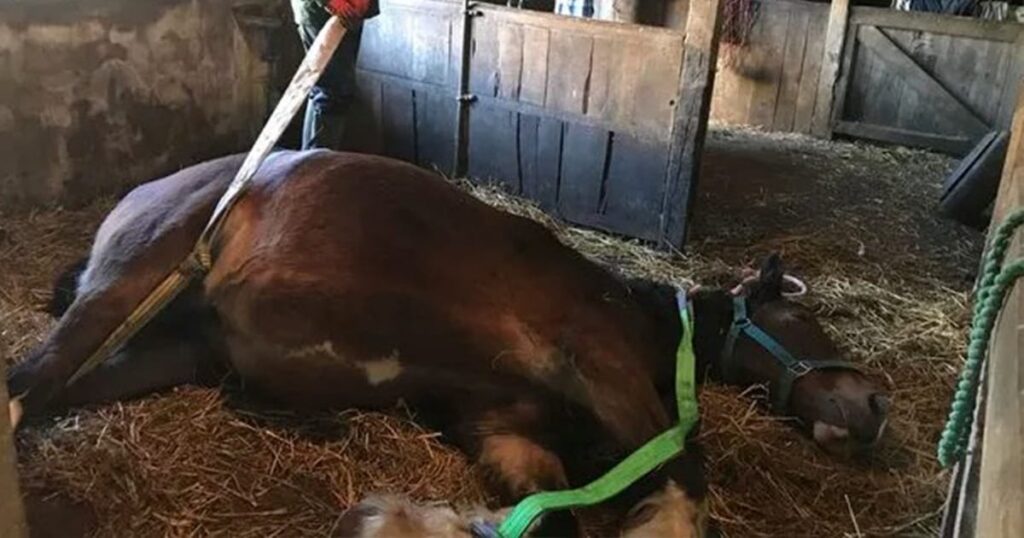
Time was running out.
A Race Against Gravity
Her owners, Donald MacIntyre and Jane Lipington, immediately understood the urgency. They summoned four additional farm workers, knowing they had only a narrow window to get Beatrice back on her feet.
Together, the team constructed an improvised pulley system using a tractor and heavy-duty straps. It was a six-hour effort — physically exhausting and emotionally draining.
But the one-tonne horse would not rise.
As Beatrice’s heart rate and blood pressure climbed to dangerous levels, her owners faced a heartbreaking possibility. They began discussing a deadline — a moment when euthanasia might become the only humane option.
Then, with just 20 minutes remaining before that decision would have to be made, something unexpected happened.
The Stallion Who Knew
Jane remembered that Beatrice’s longtime companion, an 11-year-old stallion named Beau, needed to be let out for his daily walk.
She opened his stable door.
Instead of heading toward the yard, Beau moved directly toward Beatrice’s stall.
Horses are deeply social animals. In the wild, herd bonds are essential for survival. They recognize distress, respond to changes in posture, breathing, and scent. Beau seemed to understand instantly that something was wrong.
He placed his head over the divider between their stalls and began nudging her. Then he nipped gently at her neck, grasped her halter area, and pulled upward — as if urging her to stand.
Moments later, Beatrice shifted.
She rolled slightly.
Then, in an astonishing turn, she pushed herself upright.
Beau had succeeded where six humans and heavy machinery had failed.
“We All Watched With Amazement”
Jane later described the moment:
“We all watched with amazement. He lifted her so that her chest and legs came up off the ground. With a little encouragement from us she got shakily to her feet and we quickly walked her out into the yard trying to stop her falling down.”
The timing was critical. Getting her upright restored circulation and prevented further internal damage.
In the days that followed, Beatrice recovered.
A Bond Forged Over Years
Beatrice and Beau had shared the same stable for four years. Like many horses that form close herd relationships, they had developed a quiet companionship — one built on proximity, shared routines, and mutual awareness.
Equine behaviorists have long documented that horses experience complex social bonds. They groom one another, stand guard while others rest, and display measurable stress when separated from trusted companions.
What happened in that Somerset stable was not magic.
It was instinct, connection, and perhaps something that looks very much like empathy.
A Reminder About Animal Emotion
The story, later shared widely — including coverage by The Telegraph — resonated far beyond one English farm.
For those who doubt that animals feel attachment, distress, or loyalty, Beau’s actions offer a powerful counterargument. He did not respond to commands. He was not trained for rescue. He simply reacted to the suffering of a companion.
And in doing so, he altered the outcome.
Inside a quiet stable in Somerset, a moment of instinctive compassion bridged the divide between species. As humans struggled against time and gravity, it was a fellow horse who understood what was needed. Beau’s intervention reminds us that empathy is not uniquely human — it is woven deeply into the social fabric of the animal world. Sometimes, salvation arrives not through force or machinery, but through the quiet determination of a friend.
Leave a Reply