
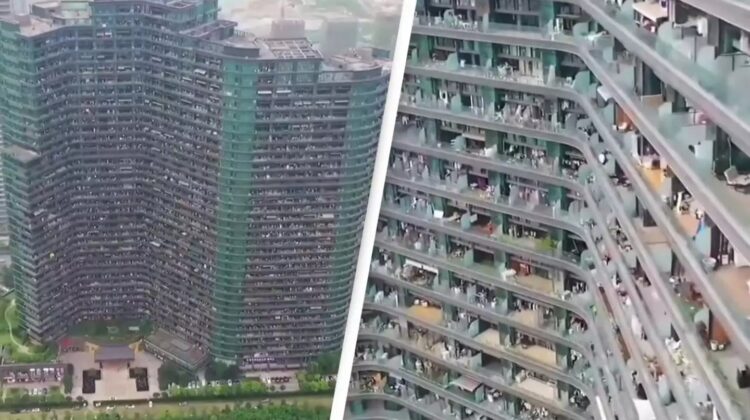
In the heart of Hangzhou’s financial district rises a structure so vast that it blurs the line between residential tower and self-contained city. The Regent International Apartment Complex, located in Qianjiang Century City, is widely described as one of the most densely populated residential buildings on Earth — home to an estimated 20,000 people within a single structure.
To put that into perspective: this is not a neighborhood. It is a vertical metropolis.
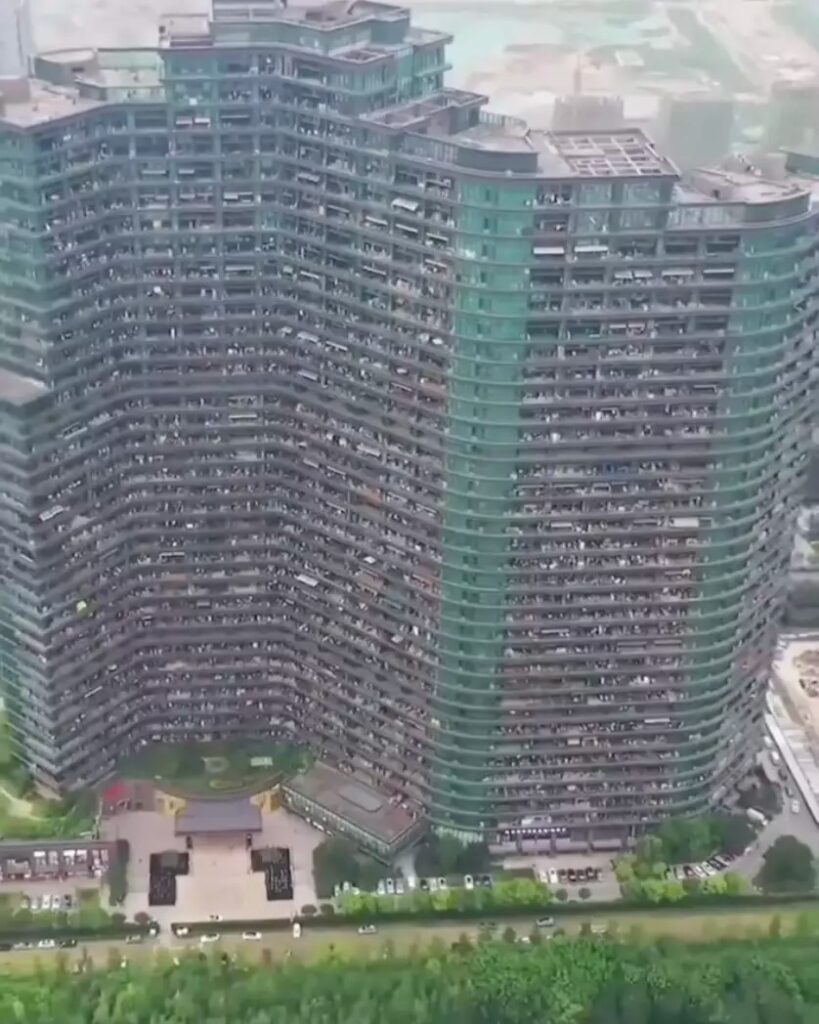
Standing approximately 675 feet tall and spanning 260,000 square meters, the S-shaped megastructure contains around 5,000 individual apartments. Designed with scale in mind, the building offers a range of living spaces — from compact studio units to multi-room apartments with balconies.
Yet what has captured global attention is not merely its height or capacity. It is the fact that life inside the complex can unfold almost entirely without stepping beyond its walls.
A Self-Contained Urban Ecosystem
Within Regent International, residents can live, work, dine, exercise, and socialize — all under one roof.
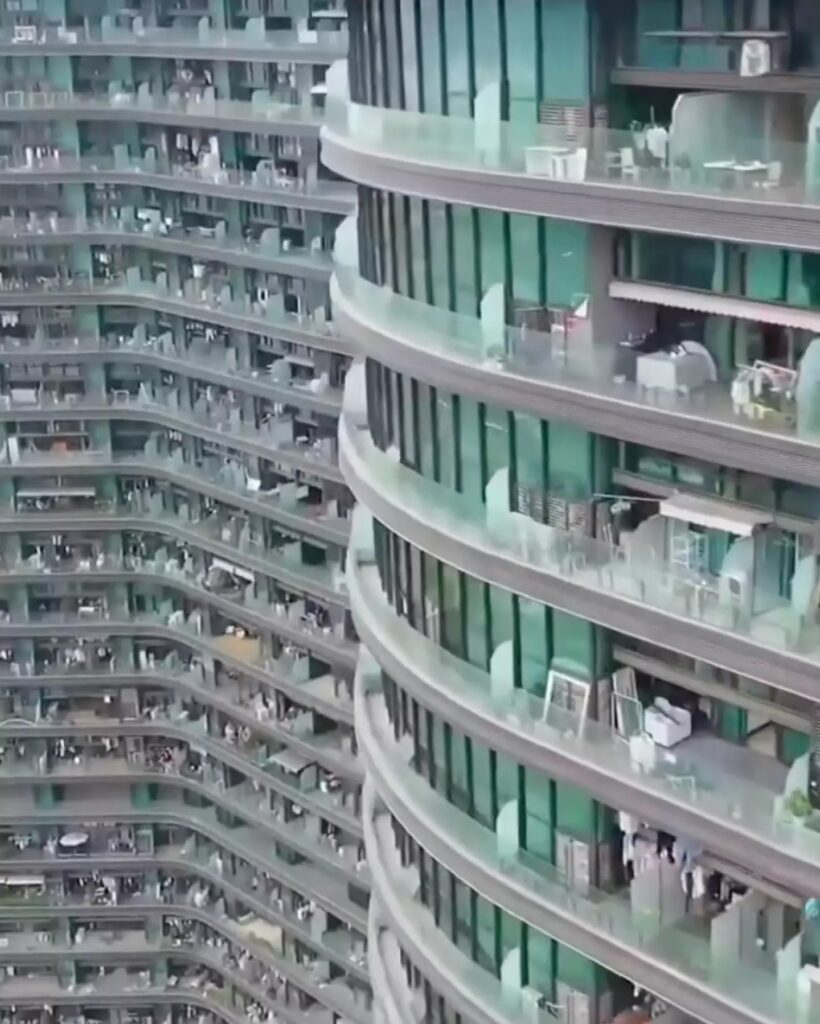
Depending on which section of the building one inhabits, the amenities resemble those of a small town. Inside, there are:
- A massive food court
- Barber shops and nail salons
- Medium-sized supermarkets
- Swimming pools
- Internet cafés
- Social and communal spaces
The concept reflects a broader urban trend: hyper-dense vertical living in rapidly expanding cities. In theory, occupants could meet nearly every daily need without exiting the complex.
It is this near-total self-sufficiency that has led some observers online to label the building “dystopian,” while others see it as an innovative response to modern urban housing pressures.
From Luxury Hotel Vision to Residential Giant
The building’s origins add another layer to its story.
Originally designed by architect Alicia Loo — chief designer of Singapore’s iconic Marina Bay Sands (often described as the world’s second seven-star hotel) — the structure was initially envisioned as a six-star hotel.
Instead, it evolved into a massive residential complex, now thriving as a vertical community housing thousands of students, recent graduates, and young professionals.
The transformation reflects the realities of modern urban economics, where housing demand can reshape even the most ambitious architectural plans.
Viral Fame and Visual Impact
The scale of Regent International has repeatedly gone viral on social media platforms, particularly TikTok. Drone footage shared by user @fatheristheone showcased the immense curvature and density of the building, drawing millions of views.
Seeing the structure from above reveals its true magnitude: a continuous sweep of windows and balconies, stacked layer upon layer — 20,000 lives unfolding behind glass and concrete.
The architecture itself becomes spectacle.
The Economics of Vertical Living
Perhaps even more striking than its size is its affordability — particularly when compared to global cities like New York.
According to local reports:
- Small studio apartments without windows rent for around 1,500 RMB per month (approximately $210).
- Larger apartments with balconies can cost about 4,000 RMB per month (roughly $570).
By comparison, the average monthly rent in New York exceeds $4,000, according to Apartments.com.
For many young professionals, Regent International represents an accessible entry point into city living — albeit at extreme density.
As global cities continue to expand and housing demands intensify, structures like Regent International raise critical questions about the future of urban life. Is vertical hyper-density a pragmatic solution to population growth and rising rental costs — or a glimpse into an isolating architectural future? Inside this single building, 20,000 individuals navigate careers, relationships, ambitions, and daily routines within one contained ecosystem. It is not merely an apartment complex. It is a living experiment in how humanity adapts when space becomes the world’s most valuable resource.
Leave a Reply