

Scientists have made one of the most astonishing discoveries in marine biology by confirming the age of a Greenland shark that has been swimming through Arctic waters since the early 17th century. Estimated to be around 392 years old, the shark was likely born around 1620–1627, making it the longest-living vertebrate ever documented.
This extraordinary finding was made possible through radiocarbon dating of eye tissue, specifically the proteins found in the lens of the shark’s eye. These tissues form before birth and remain unchanged throughout the animal’s life, offering a rare biological timestamp from centuries ago.
A Living Witness to Centuries of Change
Greenland sharks move slowly through the icy depths of the Arctic and North Atlantic, unseen and largely undisturbed while human civilizations rose, fell, and transformed above them. Their calm, almost ghost-like presence has earned them the nickname “sleeper sharks.”
This discovery goes far beyond scientific curiosity. It reshapes how we understand longevity, resilience, and life in extreme environments. The shark has silently witnessed hundreds of years of environmental and climatic change, serving as a living archive of Earth’s history.

How Scientists Determined the Shark’s Age
Researchers analyzed 28 Greenland sharks using radiocarbon dating of ocular proteins. One female shark emerged as the oldest, with an estimated lifespan approaching 400 years. Previously, the longevity record among vertebrates belonged to a 211-year-old bowhead whale.
“We knew we were dealing with a unique species,” said Julius Nielsen, lead author and marine scientist at the University of Copenhagen. “But we were truly astonished to learn just how ancient these sharks really are.”
The research benefited from an unexpected source: atmospheric nuclear testing in the 1950s and 1960s. These tests released radiocarbon into the atmosphere, which later entered marine food webs. Sharks born after this period show higher radiocarbon levels, allowing scientists to distinguish younger sharks from those born centuries earlier.
Slow Growth, Long Life
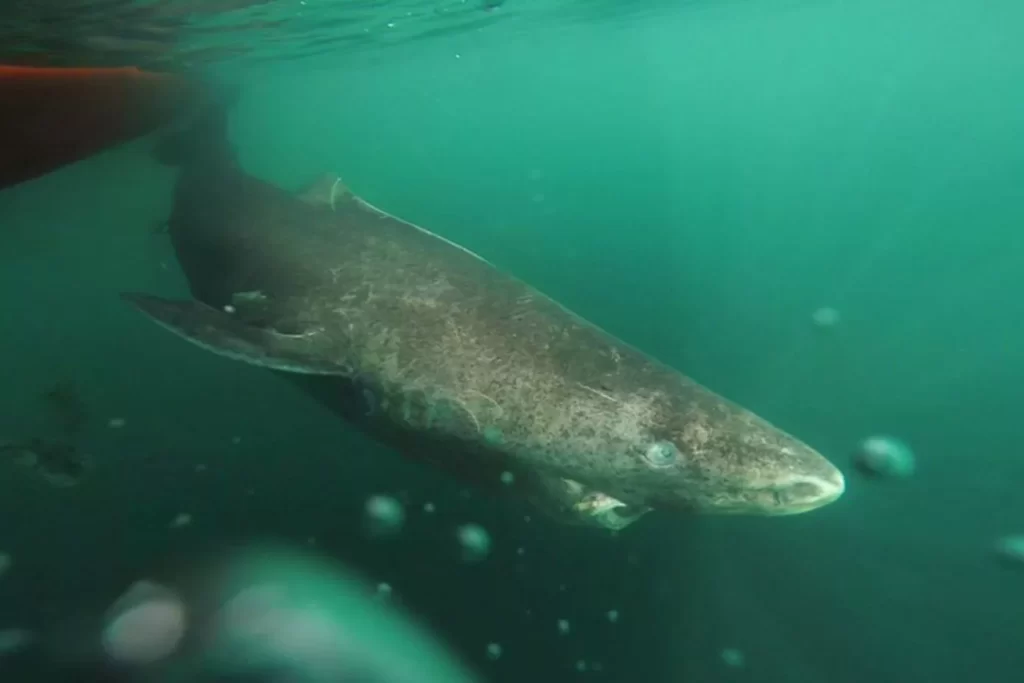
Greenland sharks are massive animals, reaching lengths of up to 5 meters, yet they grow at an incredibly slow rate — roughly 1 centimeter per year. Based on growth data, scientists estimate that these sharks do not reach sexual maturity until they are about 150 years old, when they reach approximately 4 meters in length.
Their extremely slow metabolism, combined with the cold, deep waters they inhabit, is believed to be the primary reason for their extraordinary lifespan. This slow pace of life minimizes cellular damage and energy expenditure over time.
Masters of the Arctic Depths
Despite their sluggish movement, Greenland sharks are effective scavengers and predators. Remains of seals have been found in their stomachs, leading scientists to believe they may prey on sleeping seals or feed on already deceased animals.
Their slow movement is not a weakness but an adaptation — a survival strategy perfectly suited to the harsh Arctic environment.
What This Discovery Means

The confirmed age range suggests Greenland sharks may live between 272 and 512 years, with around 390 years being the most likely lifespan. This discovery challenges existing ideas about aging, biology, and survival in extreme ecosystems.
More importantly, it highlights how little we still know about life beneath the ocean’s surface — and how many ancient stories remain hidden in the deep.
Final Reflection
The Greenland shark is not just the longest-living vertebrate known to science — it is a symbol of endurance, patience, and balance with nature. While humanity measures time in decades, this silent giant measures it in centuries.
Its existence reminds us that some of the most remarkable chapters of Earth’s story are unfolding quietly, far from human eyes, beneath layers of ice and darkness. Protecting these fragile marine environments ensures that such living witnesses to history can continue their slow journey through time.