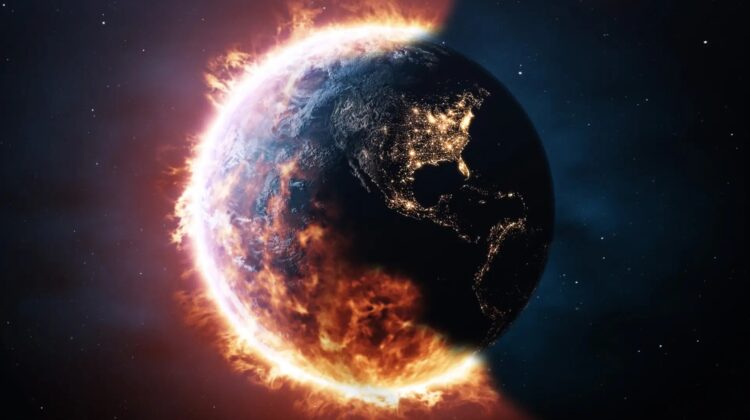
Every so often, an old scientific paper resurfaces online and takes on a life nobody intended for it. That’s exactly what’s happening with a decades-old calculation from a little-known Austrian-American physicist — one that pins a very specific date on the collapse of human civilization. And that date, according to the original math, falls in just a few weeks.
A Serious Scientist, Not a Prophet
Unlike the ancient calendar cycles and mystic predictions that usually fuel “end of the world” headlines, this one came from a working scientist using real data. In 1960, physicist and cybernetician Heinz von Foerster, together with colleagues Patricia Mora and Lawrence Amiot, published a paper in the journal Science titled, fittingly, “Doomsday: Friday, 13 November, A.D. 2026.”
Von Foerster wasn’t interested in prophecy. He was interested in numbers. Using historical population estimates stretching back nearly two thousand years, his team noticed something unusual: human population wasn’t just growing — it was growing in a way that kept accelerating, a pattern mathematicians call hyperbolic growth. Plotted forward, that curve didn’t just rise steeply. It shot toward a mathematical infinity at a specific, calculable point in time.
That point landed on a Friday in November, 2026.
What the Model Actually Said
Von Foerster’s warning wasn’t that a meteor would strike or the sun would go dark. His concern was structural: a population expanding faster and faster, indefinitely, would eventually collide with the physical limits of the planet — food, land, water, and space — long before any “infinite” population could actually exist. In his own words, adapted for a general audience at the time, humanity’s future generations wouldn’t starve so much as they’d simply run out of room.

The paper also floated an unusual proposed fix: some kind of global population-control mechanism to keep growth in check, decades before “sustainability” became a mainstream term. It’s a detail that, in hindsight, makes the paper feel less like a doomsday prophecy and more like an early, imperfect warning about the limits of unchecked growth.
Why November 13 Specifically?
Here’s the twist that gets lost every time this story goes viral: even von Foerster and his co-authors treated the exact date as something of an inside joke. The underlying equation wasn’t precise enough to predict a specific day — it pointed to “around 2026, give or take a few years.” Landing on a Friday the 13th was a flourish, not a forecast.
So, Is Anything Actually Happening in a Few Weeks?
Short answer: no credible scientist today treats November 13, 2026 as a real deadline for anything. The reason is simple — the core assumption behind the 1960 model didn’t hold up.
Global population has kept growing since 1960, from roughly 3 billion people to today’s estimated 8.3 billion. But the rate of that growth has done the opposite of what the hyperbolic model assumed: it’s slowed down substantially, thanks to falling birth rates, wider access to education (especially for women), family planning, and urbanization. Instead of an accelerating curve racing toward infinity, most demographers now expect global population to plateau and gradually decline later this century.
In other words, the math was internally sound — it just described a trend that, thankfully, didn’t hold.

A Cautionary Tale, Not a Countdown
Contemporary researchers still reference von Foerster’s paper — just not as a prophecy. It’s become something closer to a teaching tool: a vivid example of what happens when a real trend is extrapolated too far into the future without accounting for how humans actually respond to approaching limits — by innovating, adapting, and, in this case, simply having fewer children.
That doesn’t mean the underlying concerns in the paper are irrelevant. Resource limits, sustainability, food security, and the strain of a growing population on a finite planet remain very real, very present conversations — just not ones with a single circled date on the calendar.
Not the First “End of the World” That Didn’t Happen
Von Foerster’s paper isn’t alone in the pantheon of dates that came and went without incident. The most famous recent example is December 21, 2012, when the end of a cycle in the ancient Maya Long Count calendar was widely — and incorrectly — interpreted as an apocalypse warning. Maya scholars said at the time that the date simply marked the close of one calendar cycle and the start of another, the same way December 31 marks the end of a year rather than the end of time. When the date arrived, nothing happened, and the world kept turning — much as it’s expected to on November 13, 2026.
Frequently Asked Questions (FAQ)
1. Did a scientist really predict the world would end on November 13, 2026? A physicist named Heinz von Foerster and two co-authors published a 1960 paper in Science showing that, if human population kept growing at its then-current accelerating rate, the math pointed to a theoretical breaking point around that date. It was a mathematical extrapolation, not a literal prophecy.
2. Was the exact date, November 13, meant to be taken seriously? Not really. Von Foerster and his colleagues acknowledged the underlying equation wasn’t precise enough to pinpoint an exact day; landing on a Friday the 13th was largely a wry aside rather than a serious forecast.
3. Why didn’t the prediction come true? The model assumed population growth would keep accelerating indefinitely. In reality, global birth rates have slowed significantly since the 1960s due to factors like education, family planning, and urbanization, so the “runaway” growth the equation depended on never materialized.
4. Are scientists today worried about this date? No. Modern demographers and researchers treat the paper as a historical case study in the limits of extrapolating trends too far into the future, not as an active warning.
5. Is this similar to the 2012 Mayan calendar prediction? It’s often mentioned alongside it, but the two are different in nature — the Maya calendar case was a modern misreading of an ancient timekeeping system, while von Foerster’s paper was a genuine (if ultimately incorrect) piece of 1960s scientific modeling.
Leave a Reply