
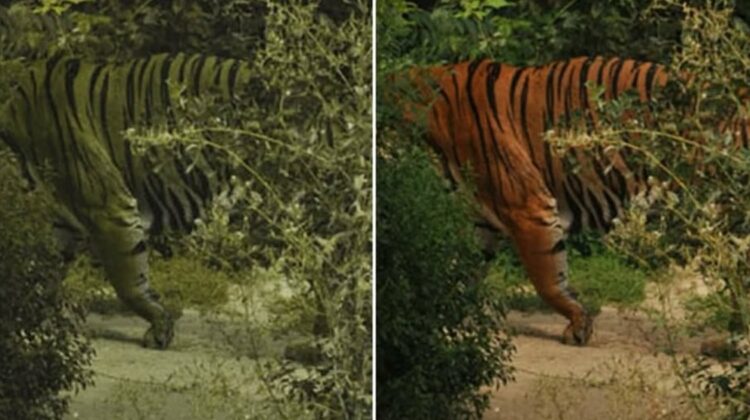
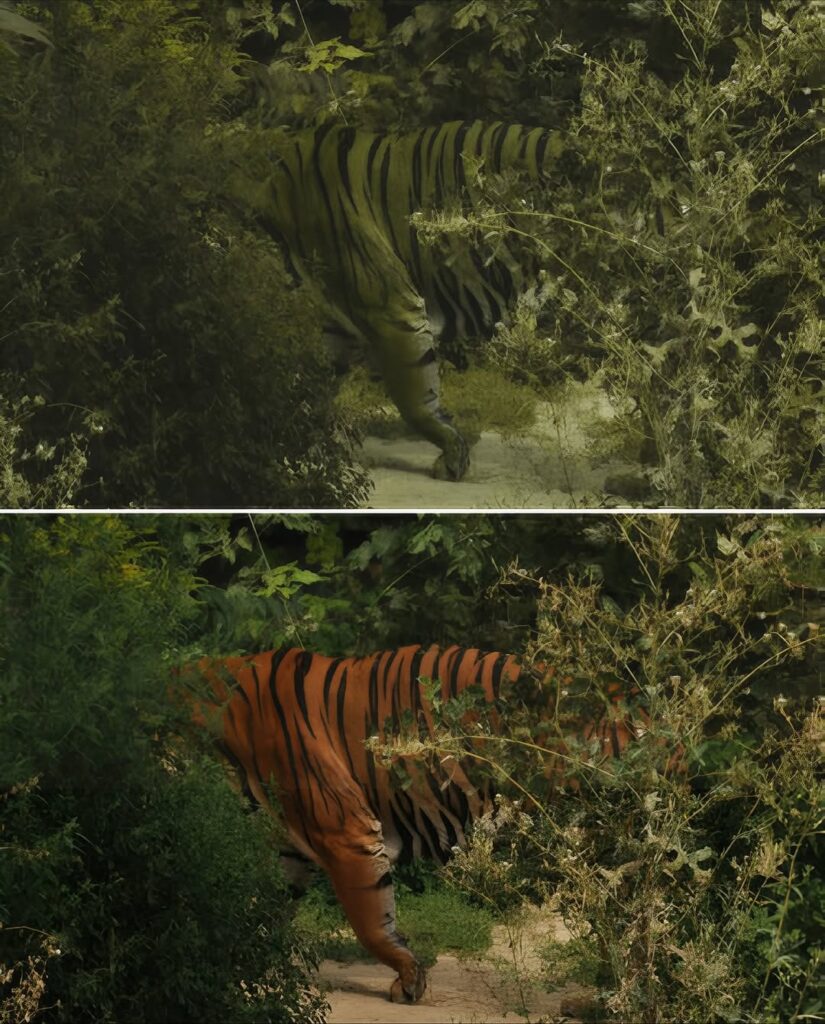
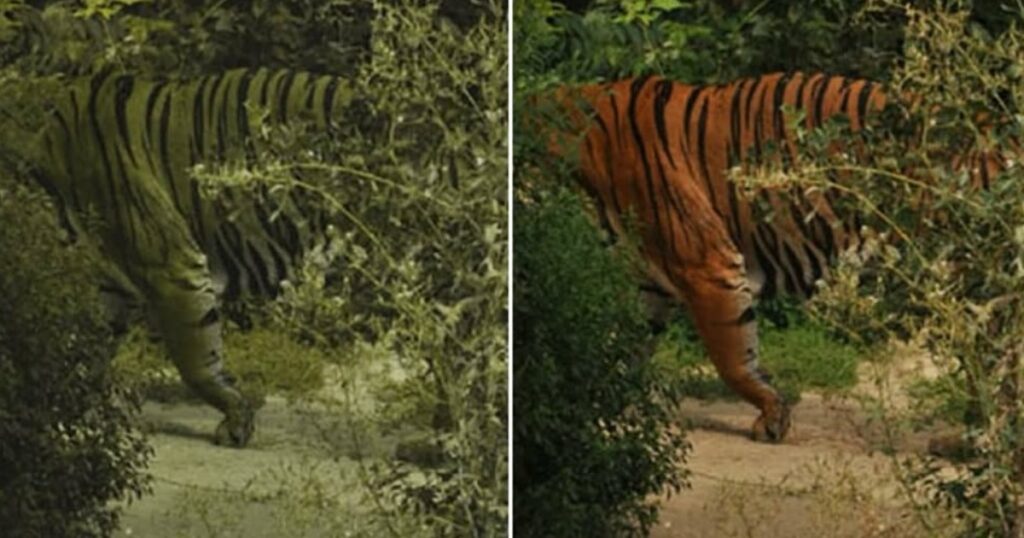
Tigers are among the most iconic and fascinating predators on the planet. Their striking orange-and-black coat has long captured human imagination, symbolizing both power and beauty. But the reality is that this color, so obvious to us, is not how their prey sees them. Deer and wild boars, two of the tiger’s main prey, are dichromatic. Unlike humans, who are trichromats and see three color channels (red, green, blue), these animals see only two. This means that what looks bright orange to humans actually appears as a shade of green or brown to them.
This difference in color perception is more than just an interesting fact — it is a vital evolutionary advantage. Tigers blend almost perfectly into the dense grasses and forest shadows of their habitats. Their black stripes further break up their outline, making them appear as nothing more than patches of light and shadow. To a human observer, the tiger’s orange coat is bold and obvious, but to a deer grazing nearby, the tiger is nearly invisible until it is within striking distance. This natural camouflage is one of the reasons tigers are such successful hunters.
Evolutionary Camouflage and Hunting Strategy
Over millions of years, evolution has refined the tiger’s appearance to maximize hunting efficiency. Camouflage allows tigers to conserve energy by getting as close as possible to their prey before the final attack. The combination of orange fur and black stripes is not random; it is a sophisticated natural design optimized for stealth. In fact, studies have shown that tigers’ hunting success rates increase significantly when they remain undetected until the last moment. This adaptation demonstrates how predators and prey evolve together in a continuous arms race, with each species influencing the development of the other.
The Science Behind Animal Vision
Understanding why tigers appear green to their prey also requires a closer look at animal vision. Dichromatic animals like deer and boars lack the red-sensitive cone in their eyes. Without this cone, they cannot distinguish between red and green hues. Consequently, the tiger’s orange coat, which is rich in red tones, blends seamlessly into the greenish-yellow landscape from the prey’s perspective. This visual trick of nature highlights how perception shapes survival strategies across species.
Implications for Conservation and Wildlife Photography
For wildlife photographers, conservationists, and ecologists, recognizing how tigers are camouflaged from their prey can offer new insights into tracking and observing these majestic creatures. Conservation programs often use knowledge of animal behavior and camouflage to protect tigers and monitor their populations. Understanding how prey sees the tiger helps in designing better conservation strategies, such as choosing locations for wildlife corridors or anti-poaching surveillance.
Discover Incredible Tiger Facts You Won’t Believe!
Did you know that a tiger’s stripes are as unique as human fingerprints? Every pattern tells a story, and some stripes even help scientists track individual tigers in the wild! Tigers can run up to 40 miles per hour, swim across rivers for hours, and silently sneak within just a few feet of their prey — all thanks to their incredible camouflage. Learn more about these majestic predators, see stunning photos of tigers in action, and uncover secrets of their hunting techniques that will leave you amazed. Click here to dive into the world of tigers and explore how these apex hunters dominate their environment.
Final Thoughts
Next time you see a tiger in a zoo, documentary, or in the wild, remember: what appears vivid to your eyes may be completely hidden from the animals around it. The orange coat you admire is, to its prey, a masterful disguise, a testament to evolution’s genius. From the forest floor to the tall grasses, tigers are a perfect example of how nature combines beauty, strategy, and survival in one awe-inspiring package.
Leave a Reply