
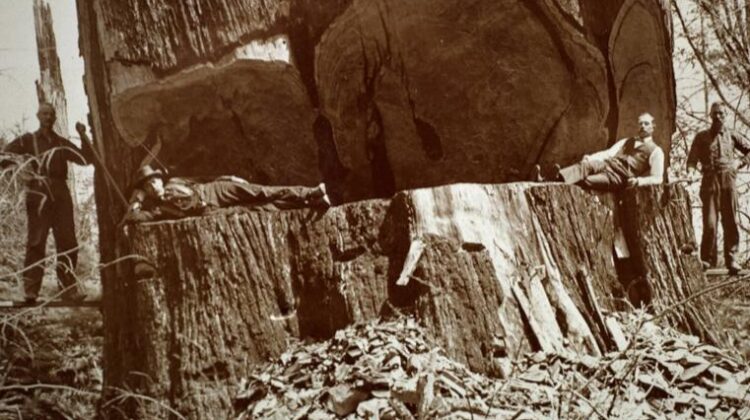
In the late 19th century, when the world was only beginning to realize how destructive human interference with nature could be, a tree stood in a corner of North America that seemed eternal. It was a giant sequoiadendron — a tree whose roots had witnessed centuries of changing eras, wars and discoveries, the rise and fall of civilizations. It had survived storms, fires, and harsh winters — but not the blade of man’s saw.
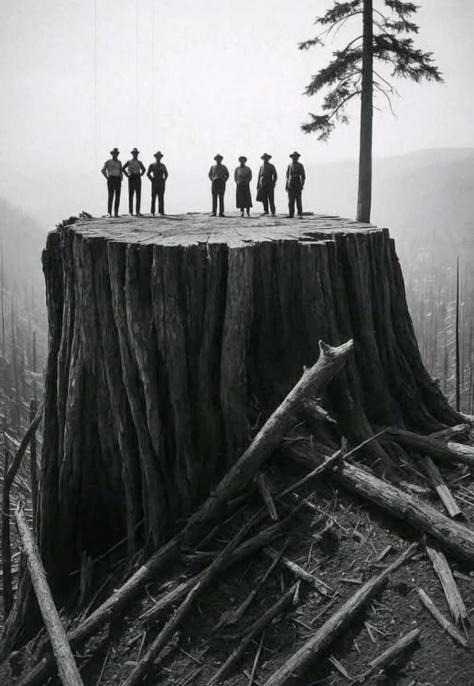
A photograph taken in 1899 captured a moment that symbolized both the majesty of nature and the tragedy of its loss. On the vast stump stood people who looked like tiny figures against what was once a living colossus. A thin trunk, left jutting from the middle, resembled a frail reminder of a life that could never be restored.
Trees That Outlasted Empires
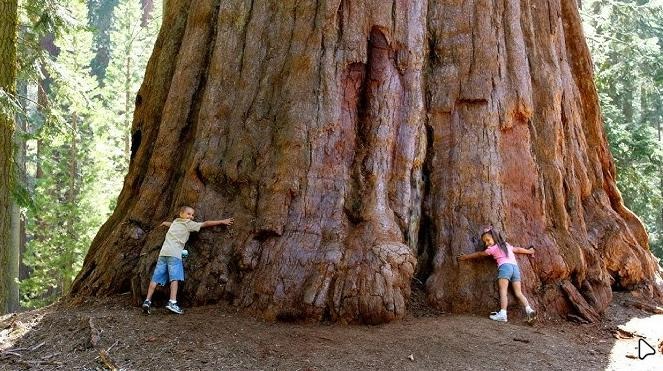
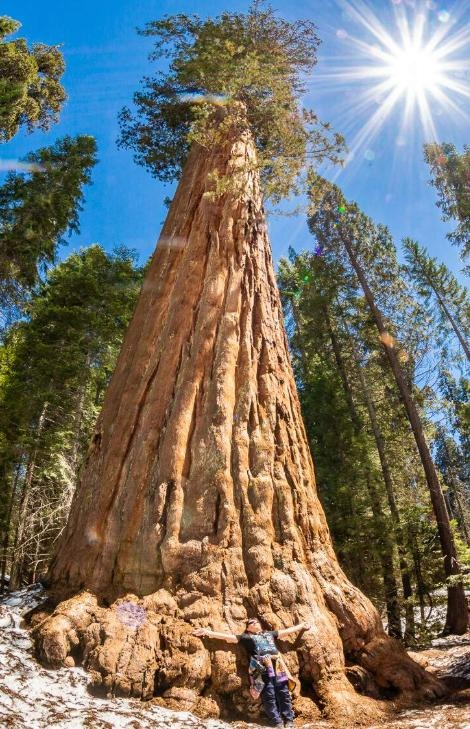
Giant sequoias and sequoiadendrons are among the oldest living organisms on Earth. They can live for more than 3,000 years and grow taller than 100 meters. Their trunks are so massive that even a chain of people holding hands can barely encircle them.
These trees are not just plants — they are living chronicles of the planet. They grew long before modern nations existed and stood as silent witnesses to thousands of years of Earth’s history. Their wood resists rot, insects, and fire, allowing them to live almost indefinitely under natural conditions.
Why Were They Cut Down?
In the 19th century, mass logging in North America became the norm. The expansion of railroads, cities, and agriculture demanded enormous amounts of timber. Sequoias, with their thick, straight trunks, seemed like the perfect building material.
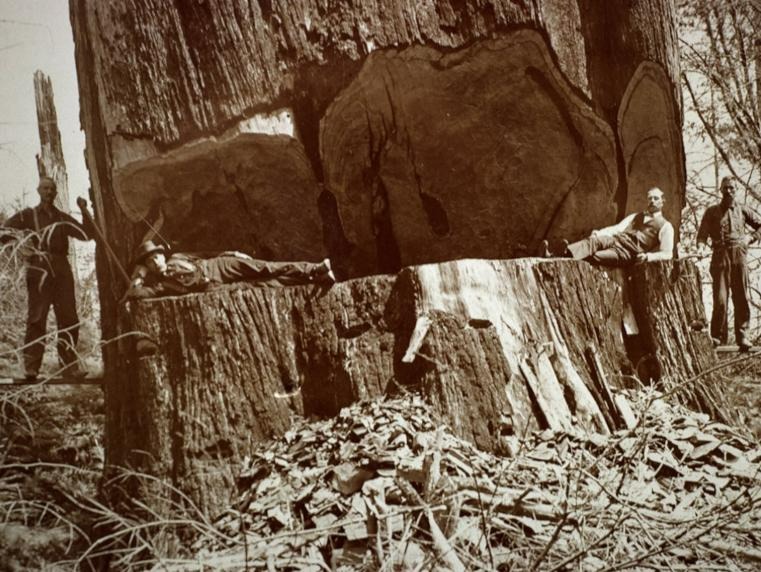
Few at the time considered that each of these giants was a unique living being that had taken centuries to reach such grandeur. To many loggers, they were simply “premium lumber.”
A Symbol of Loss
The 1899 photograph shows people standing on a stump several meters high. Their figures look minuscule, while the stump itself resembles the foundation of some ancient fortress. The image is a silent reproach to humanity, reminding us how quickly we can destroy what nature has taken millennia to create.
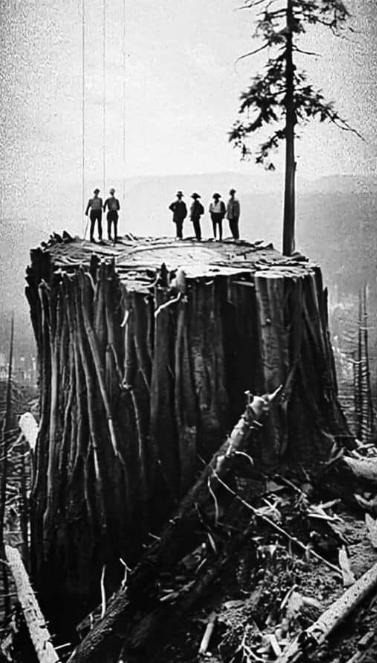
Today, such images inspire not awe but sorrow. We realize that what was lost was not merely a tree, but an entire world — an ecosystem of which it was the heart.
What Remains Today
Some giant sequoias were saved. Thanks to the efforts of conservationists, environmental organizations, and dedicated scientists, parts of these forests became national parks. In California, visitors can still see trees more than 2,000 years old.
Yet the scale of the destruction remains immense. Countless ancient and irreplaceable trees were felled forever. The photograph of the “Last Giant” endures as a reminder that nature must be protected, not merely exploited.
The Lesson We Must Learn
This story is not only about a tree — it is about human greed and short memory. It teaches us that the planet’s resources are finite, and the losses we inflict on nature are irreparable.
We live in an era when catastrophe can still be prevented. We can protect forests, create reserves, and restore what has been lost. But it requires will and the recognition that we are part of nature, not its masters.
Looking at that black-and-white photo from 1899, one cannot help but wonder: what will people say about us a century from now? Will they thank us for preserving what remains, or will they view our photographs as reminders of how we destroyed our world with our own hands?
Let the story of the “Last Giant” be not only a symbol of loss but also an inspiration to save what can still be saved. Every tree, every forest is not just part of the landscape, but a living history of our planet.
Leave a Reply