
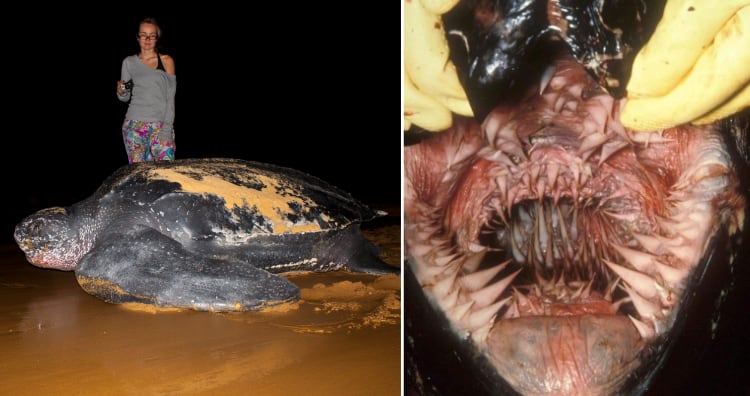
The leatherback sea turtle is the largest turtle in the world. However, compared to the beautiful, calm character of these gentle giants, the inside of a leatherback turtle’s mouth is scary. The turtle’s teeth are absolutely terrifying and resemble several stalactites. These teeth extend to its stomach. Continue to read to learn more about leatherback turtles.
Leatherback sea turtles are the largest turtles on the planet
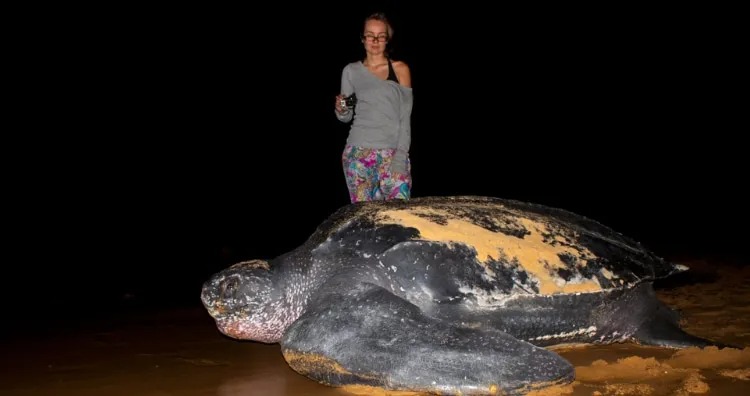
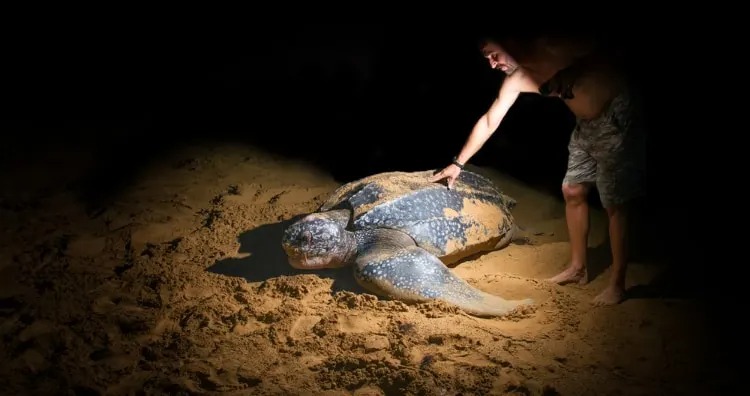
Of all marine turtle species, the leatherback is the most unique. Being the only surviving member of the Dermochelyidae family, leatherback turtles have the highest migratory distribution of any reptile globally. They can weigh up to 2,000 pounds and reach heights of over six feet.
The biology of the leatherback sea turtle has not altered in millions of years; in fact, they’ve looked the same since the time of the dinosaurs!
Leatherback sea turtles have the most unusual mouth.
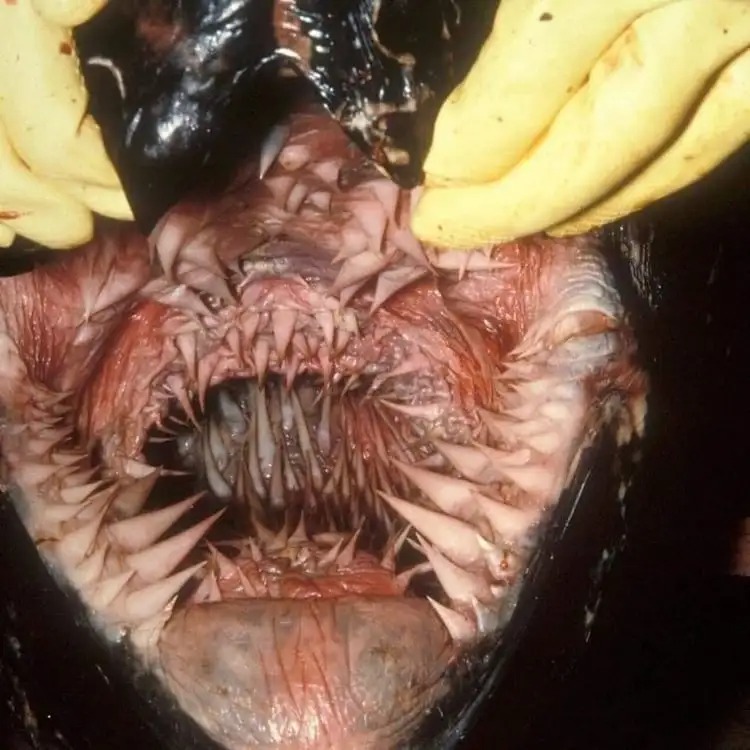
The leatherback sea turtle has one of the scariest mouths in the world. The turtle’s mouth, esophagus, and entire stomach are lined with hundreds of sharp, stalactite-like teeth, or “papillae.” Leatherback turtles are not flesh-eating carnivores since they only eat jellyfish. The sharp, backward-facing papillae help the turtle consume a huge number of slick jellyfish by preventing the jellyfish from floating out of the turtle’s mouth. An extended esophagus, which coils around the abdomen and back, also assists in processing the jellyfish. This implies that any type of jellyfish, including the enormous lion’s mane and smaller swarms, can be handled by the leatherback turtle.
Leatherback sea turtles consume up to 1,6000 calories of jellyfish a day.
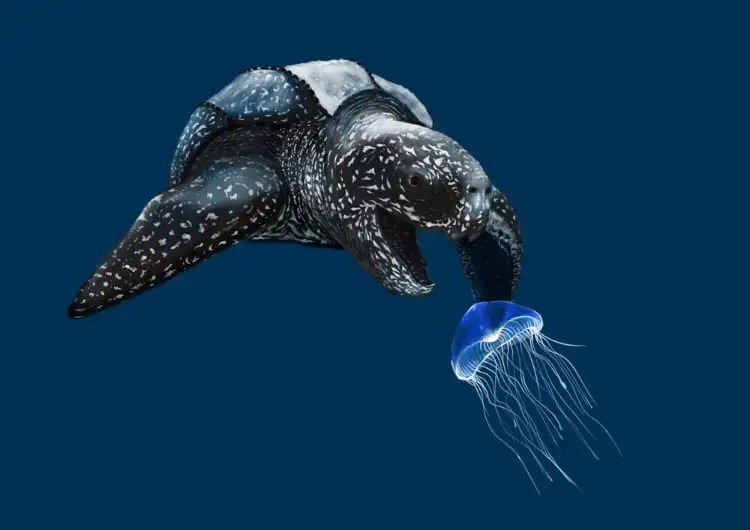
Even though jellyfish may not be a super-healthy meal, nothing is wasted. It is believed that during the summer, leatherback turtles consume 16,000 calories per day, or around 73% of their body weight.
As humans, some of us have been exposed to the poison that jellyfish inject into their victims when they sting them. However, as leatherback sea turtles are reptiles, their scales can shield them from that poison. The leatherback turtle’s papillae help in piercing and breaking down its prey after it has been ingested. Although these traits are a nightmare for jellyfish, consuming anything else would probably harm a leatherback turtle’s scissor-like mouth. For this reason, leatherbacks must actively hunt enormous numbers of jellyfish.
Furthermore, leatherback turtles can usually swallow dozens of jellyfish at once and only need 22 seconds to catch one, on average. It is not surprising that leatherbacks can consume 16,000 calories of jellyfish, given that they have a 100% rate of success when hunting jellyfish.
Below are some more facts about leatherback sea turtles.
1- Letherback turtles get their name from their thick skin that resembles rubbery leather.
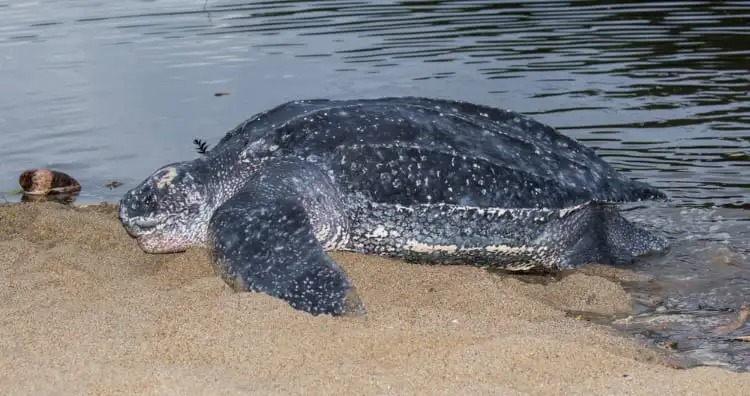
The term “leatherback” refers to the distinctive shell of this species, which is made up of a layer of thin, durable, rubbery skin that is strengthened by countless microscopic bone plates, giving it the appearance of being made of leather. The carapace, often known as the “shell,” is a big, flexible, oily body part that is typically black or dark grey with white or light-speckled patterns.
2- Leatherback turtles, unlike other turtles, do not have hard shells.
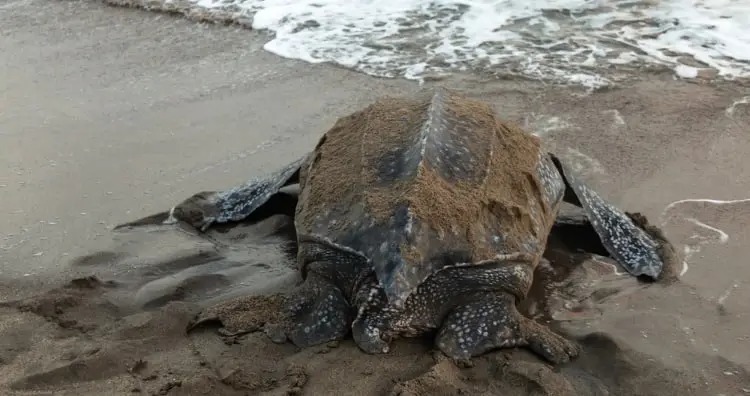
The Leatherback sea turtles are the only species of sea turtles that don’t have hard shells or scales. They have been in existence since the time of the dinosaurs and get their name from their tough, rubbery skin. The shell contains seven ridges that go from front to rear.
3- Leatherback sea turtles nest several times.

The leatherback turtle is the largest sea turtle and one of the biggest reptiles still alive. After more than 100 million years of existence, the leatherback turtle is now in danger of going extinct. Recent population estimates reveal that this species is rapidly disappearing across most of its range.
With some traveling an average of 3,700 miles one way, leatherback sea turtles make the most extensive migrations of any sea turtle between their breeding and feeding grounds. The majority of their lives are spent in the water; however, the females leave the water to lay eggs. Throughout the course of a nesting season, leatherbacks lay many clutches of about 100 eggs, usually at intervals of eight to 12 days. The leatherback hatchlings emerge from the nest after around two months of egg incubation.
4- Leatherback turtles are exceptional divers.
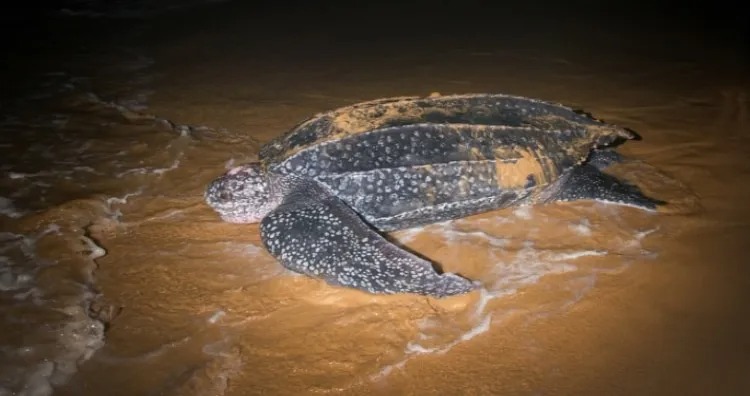
The Leatherback turtles are reported to dive to depths of approximately 4,000 feet (1,200 meters) while foraging. Additionally, they have an 85-minute underwater survival time. Leatherback turtles have impressive adaptations for deep and long dives. Large reserves of oxygen are stored in their blood and muscle, and they also have unique characteristics such as collapsible lungs (to prevent “the bends”), a pulmonary sphincter (during dives, to redirect blood flow away from the deflated lungs and back to the body), a flexible shell (to react to increased pressure at depth), and decelerated heart rate (to save energy and oxygen stores).
5- Leatherback turtles can swim approximately 10,000 miles a year.
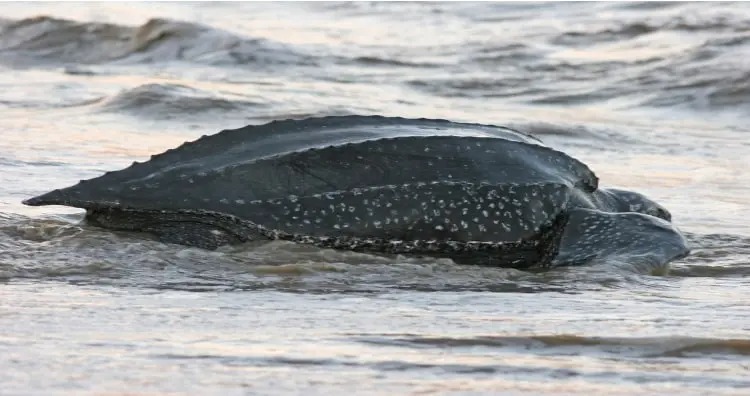
The most migratory species on the planet, leatherback sea turtles, can move up to 10,000 miles annually between feeding grounds in quest of jellyfish. From Caribbean beaches, they go up the US East Coast to Canada in the Atlantic. Many go across the Pacific Ocean from Southeast Asia (Malaysia and Indonesia) to California before ascending to the waters of Alaska.
6- Leatherback sea turtles are among the fastest reptiles, Capable of bursts up to 22 miles per hour in the water.
The Leatherback turtles are also the speediest non-avian reptiles. According to the 1992 Guinness Book of World Records, a leatherback turtle can move through water at a speed of 21.92 miles per hour or 35.28 kilometers per hour. They normally swim at a speed of 1.80 to 10.08 kph (1.12–6.26 mph).
7- The world’s biggest-ever recorded turtle was a leatherback turtle that washed up at Harlech Beach, Wales, in 1988.
The largest leatherback turtle ever discovered, measuring three meters (nine feet), washed ashore on Harlech Beach in Gwynedd in September 1988.
The National Museum Cardiff has that leatherback turtle on display. The turtle had tragically drowned after being entangled in fishing lines. When it passed away, it had almost 100 years left in it. The turtle, which measured about three meters (nine feet) in length and weighed 914 kilograms, grabbed attention from all over the world as the heaviest and largest turtle ever recorded (2,016 pounds).
So sad for it’s early demise via a discarded fishing line!
Agree, just awful!!
Amazing! Always been intrigued by this turtle, for its size. Never heard or read some much info about it, everything about it is so amazing to learn. Thank you! For all I’ve learned today