The world is on the brink of observing a stellar event that was potentially first chronicled in 1217: a nova explosion of T Coronae Borealis (T CrB), also known as the Blaze Star. This event is a rare and spectacular phenomenon involving a binary star system composed of a white dwarf and a red giant.
Understanding T Coronae Borealis
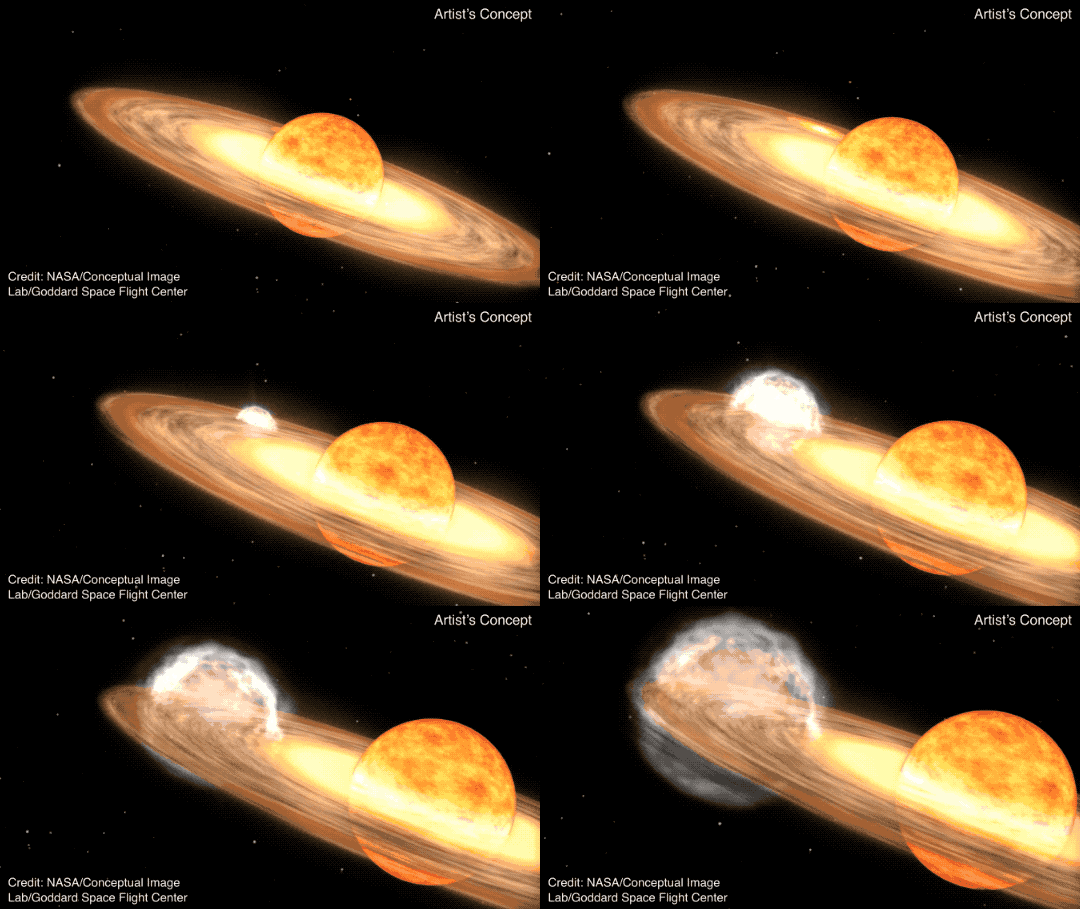
T Coronae Borealis, located 3,000 light-years away from Earth, is typically invisible without a telescope. The system consists of a white dwarf and a red giant. The white dwarf’s intense gravity gradually siphons material from the red giant, setting the stage for a remarkable astronomical event.
“The stars are close enough that as the red giant becomes unstable from its increasing temperature and pressure and begins ejecting its outer layers, the white dwarf collects that matter onto its surface,” NASA explains. “The shallow dense atmosphere of the white dwarf eventually heats enough to cause a runaway thermonuclear reaction – which produces the nova we see from Earth.”
Historical Observations
This nova explosion recurs approximately every 80 years. Historical records indicate that such eruptions were observed in 1866 and 1946, when the star system brightened thousands of times over, making it visible to the naked eye and nearly as bright as Polaris, the North Star.
However, these may not have been the first recorded instances. In December 1787, Reverend Francis Wollaston documented a bright star in T Coronae Borealis’s position, suggesting it could be the Blaze Star going nova again.
Even earlier, a 13th-century account might describe this very event. Bradley Schaefer, Professor Emeritus at Louisiana State University’s Department of Physics & Astronomy, references an eyewitness report from 1217 by Abbott Burchard of Upsberg. Burchard described a “fast-rising stellar point-source (‘stella’) in Corona Borealis that ‘shone with great light,’ lasted for ‘many days,’ and was seen as a ‘wonderful sign.'”
Credit: NASA’s Goddard Space Flight Center
Schaefer argues that this account likely describes a previous eruption of T CrB, noting that Burchard used the term “stella” (star) rather than “comet,” which were considered ominous.
The Upcoming Nova
Prior to a nova, T Coronae Borealis experiences a rise in brightness followed by a pre-eruption dip. According to the American Association of Variable Star Observers (AAVSO), this dip began in March/April of this year. If the current pattern follows the 1945 timeline, the nova is expected to occur around 2024.4±0.3.
Astronomers predict the next eruption to happen between now and September. Observing the constellation Corona Borealis over the coming months might allow us to witness this extraordinary event, mirroring the experience of observers in 1217. And if you miss it, Comet C/2023 A3 will also be visible soon, providing another celestial spectacle.
Leave a Reply