
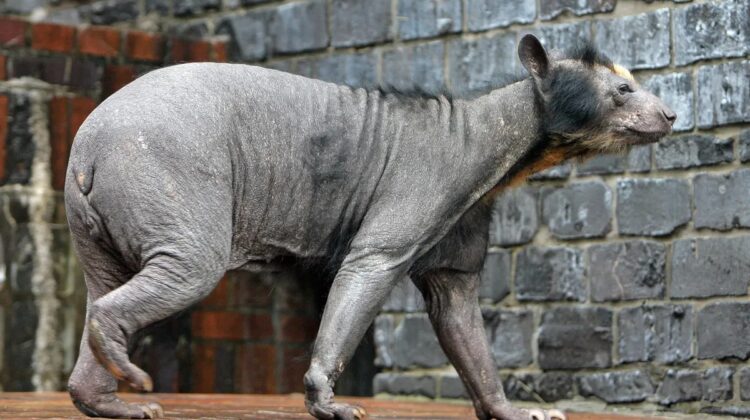
The image of the hairless bear was taken at a zoo in Leipzig, Germany, in November 2009.
The image of a hairless bear has been making the rounds online for years, often accompanied by bizarre headlines claiming it’s a “new species” that evolved in the radioactive ruins of Chernobyl. But the real story behind the hairless bear is far less strange—and far more heartbreaking.
This now-famous photo was taken at Leipzig Zoo in Germany in November 2009. The bear in the picture is not a mutant or a mystery animal. It’s Dolores, a female spectacled bear—also known as the South American bear or Andean short-faced bear—who was tragically suffering from severe hair loss.
What Does a Hairless Bear Look Like?
Back in 2009, news began to surface that three female spectacled bears at Leipzig Zoo were suffering from extreme baldness. Among them, Dolores stood out as the most severely affected. She had lost nearly all her fur, save for a thin patch on her head and upper back. The sight was shocking: a nearly naked bear with exposed, wrinkled skin, looking nothing like the thick-coated creatures we associate with the species.
What Happened to the Hairless Bear?
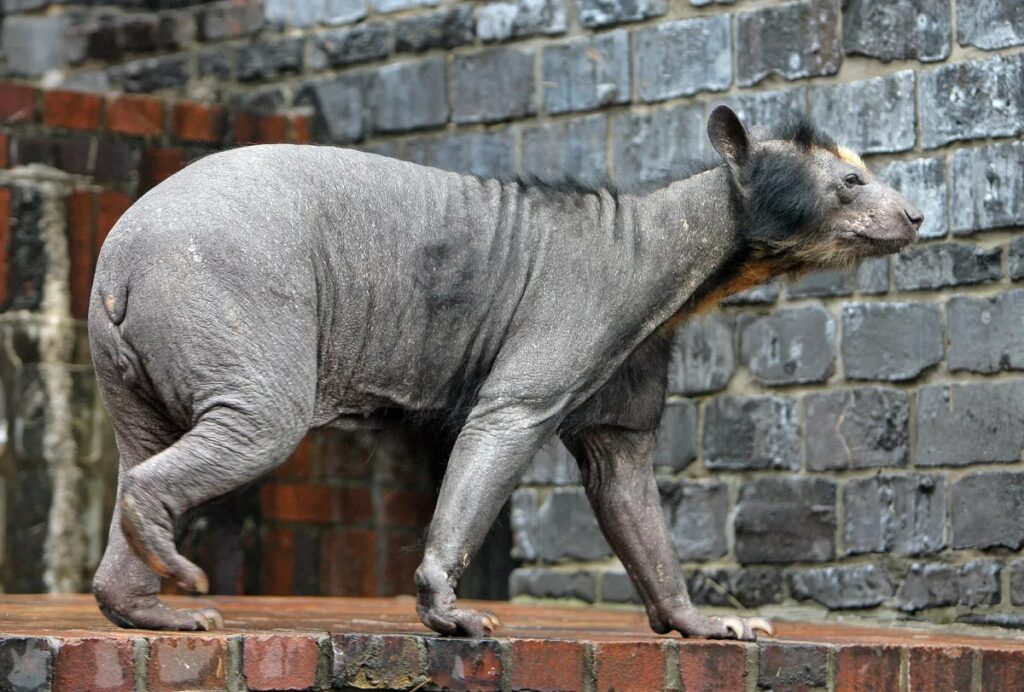
Image credit: dpa picture alliance archive / Alamy Stock Photo
Experts quickly turned their attention to what might be causing the condition. Many pointed to the stresses of captivity. Gerard Baars, director of the International Bear Foundation, explained to the BBC in 2009 that diet and climate could both be contributing factors.
“They are tropical animals that we have relocated to our climates,” Baars said. “The bears should be kept indoors and they should make an imitation of a tropical climate with hot temperatures, humidity, straw, and bedding on the floor.”
It turns out, Dolores was not alone. Other bears across European zoos were also showing signs of alopecia, a condition involving abnormal hair loss. Unfortunately, a definitive cause was never identified. Leipzig Zoo later confirmed that Dolores died in March 2011, and despite investigations, no breakthrough explained the condition that made her a viral phenomenon.
Spectacled Bear: A Vulnerable Species
The spectacled bear is the only bear species native to South America, inhabiting a narrow strip of the Andes Mountains through countries like Venezuela, Colombia, Ecuador, Peru, Bolivia, and Argentina. Despite being the inspiration for the lovable Paddington Bear, the real species faces a much grimmer reality.
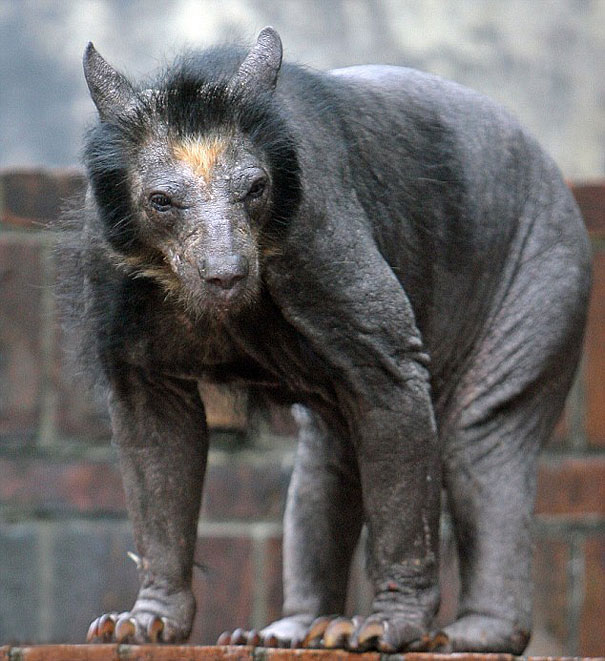
These bears are classified as vulnerable by the IUCN Red List, facing threats such as habitat destruction and poaching. In response, zoos across the world have taken them in for conservation purposes, hoping to preserve the species. But captivity brings its own problems.
Bears in Captivity: A Complex Issue
Bears, in general, are highly intelligent and solitary animals, requiring large territories and minimal contact with others. In many zoos, they are kept in small enclosures and often forced to live communally, leading to chronic stress and hormonal imbalances.
A 2019 study by San Diego Zoo looked into this issue and found that alopecia in Andean bears—like Dolores—is often linked to the unnatural conditions of long-term social housing. Surprisingly, the hair loss syndrome primarily affects female spectacled bears who are socially housed with other bears.
“Even though not all socially housed females were affected,” the researchers noted, “the only characteristics shared by all affected bears is that they were all females, socially housed with conspecifics.”
The study suggests that the baldness is just the surface symptom of endocrine or autoimmune disorders triggered by unnatural living conditions. Their solution? Allow female Andean bears to live alone, unless they show a clear desire to cohabitate—a rare occurrence for this solitary species.
A Tragic Symbol
The viral image of the hairless bear might provoke curiosity, disbelief, or even humor at first glance. But the real story is a sobering reminder of the ethical challenges in wildlife conservation. While efforts to protect vulnerable species like the spectacled bear are vital, they must be balanced with the individual animal’s well-being and natural behavior.
Dolores, the original hairless bear, is now gone, but her image continues to circulate—a poignant symbol of how even well-meaning interventions can cause unintended suffering.
Leave a Reply