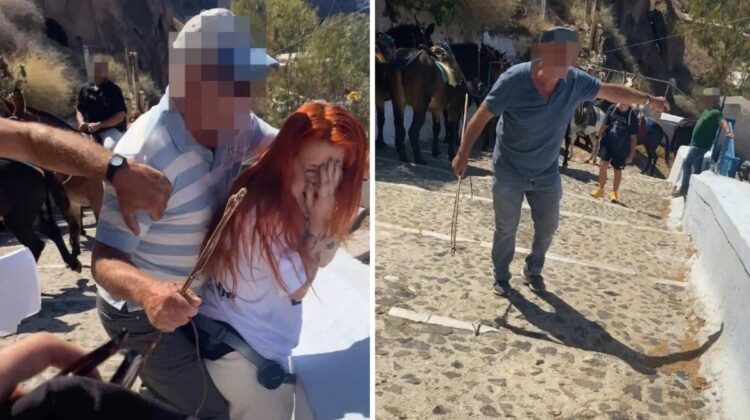
A protest meant to highlight the treatment of Santorini’s tourist-carrying donkeys turned violent on September 5, when a donkey handler struck a demonstrator in the face and shoved her against a wall — an attack caught on video and condemned by both the animal rights group involved and local authorities.
What the Video Shows
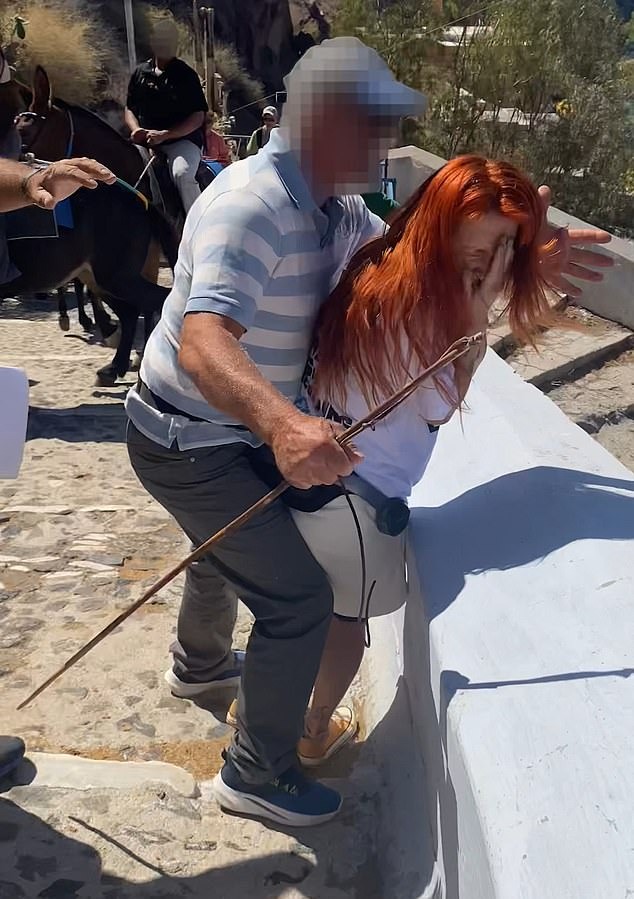
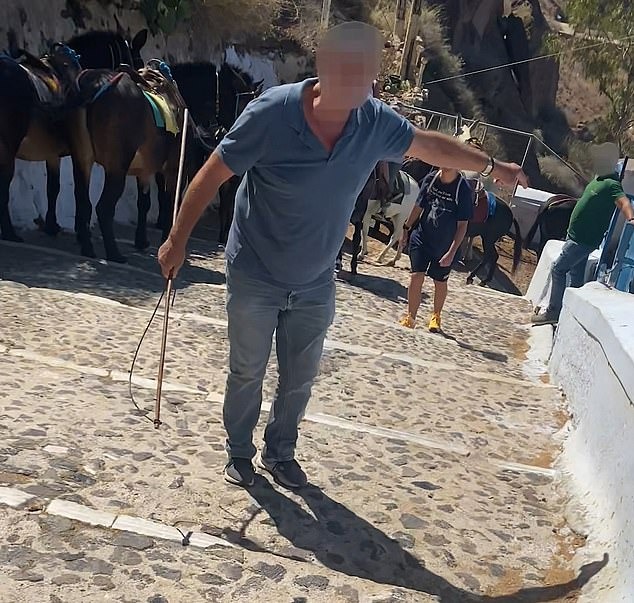
The incident took place on the Karavolades steps, the steep, roughly 500-step route connecting Santorini’s old port to the town of Fira, where donkeys and mules are used to carry tourists up the cliffside. Three PETA Germany supporters had gathered there as part of a demonstration when, according to PETA’s own statement, donkey handlers destroyed the activists’ protest signs, tried to stop them from filming, and physically forced them down the stairs.
Footage shows one handler, holding a stick, confronting the group before striking one activist in the face and pushing her against a wall. She’s heard screaming as she falls onto the stone steps, while other activists shout “Don’t touch her!” and bystanders rush to help.
What the Protest Was Actually About
The activists weren’t simply objecting to donkey rides in the abstract — they’d planned to demonstrate a specific alternative. According to PETA Germany, the group intended to show that the steps could be climbed without animals at all, using robotic exoskeletons, a device that assists human walking and load-bearing. PETA has since offered to help finance the purchase of such exoskeletons for the local mayor’s office and the Firá Port Authority if the donkey rides are discontinued.
“The donkeys and mules are treated as living taxis on Santorini and are constantly pushed to the brink of collapse,” said Dr. Yvonne Würz, a biologist and PETA Germany advisor, in the organization’s statement. PETA has also called for a full ban on tourist donkey rides and the transfer of the roughly 100 animals currently working the route to animal shelters.
The Official Response

The Municipality of Thera, which governs the area, issued a statement the following day: “We unequivocally condemn every form of violence, regardless of where it comes from or against whom it is directed,” according to GreekReporter, which noted the municipality said it was following the investigation closely. As of the most recent reporting, no arrests or formal charges had been publicly confirmed, though PETA Germany has said it intends to pursue criminal charges against the handlers involved and has asked witnesses to come forward.
The Underlying Welfare Concerns
Santorini’s donkey rides have drawn sustained criticism for years, with reports of animals developing spinal injuries, saddle sores, and exhaustion — concerns amplified after viral social media images showed visibly overweight tourists riding the animals. The Greek Ministry of Rural Development has published formal guidelines for protecting working horses, donkeys, and mules, covering exercise limits, rest periods, water access, shade, appropriate harnessing, and veterinary oversight — meaning the core issue, as one Greek outlet put it, isn’t whether donkeys can work at all, but under what conditions they’re required to.
A cable car has operated near the steps for years and reduced reliance on donkeys somewhat, but demand for donkey rides climbs again whenever cruise ships bring large crowds — Santorini can see up to 17,000 visitors a day during peak season. Thousands of people have signed petitions over the years calling for an outright ban on using donkeys to carry tourists.
Frequently Asked Questions
Has anyone been arrested for the attack? As of the most recent available reporting, no arrests or formal charges had been publicly confirmed, though local authorities said the investigation was ongoing and PETA Germany stated it intends to file criminal charges.
What alternative is PETA actually proposing? Robotic exoskeletons — wearable devices that assist with walking and load-bearing — which PETA says could let tourists and locals climb the steps without relying on animals, and which the organization has offered to help fund.
Are there official rules protecting Santorini’s working donkeys? Yes — Greece’s Ministry of Rural Development has published guidelines covering rest, water, shade, harnessing, and veterinary care for working equines, though enforcement and route-specific conditions remain a point of ongoing criticism.
Sources: PETA, GreekReporter, LBC, Keep Talking Greece, and Athens News, cited above.
Leave a Reply