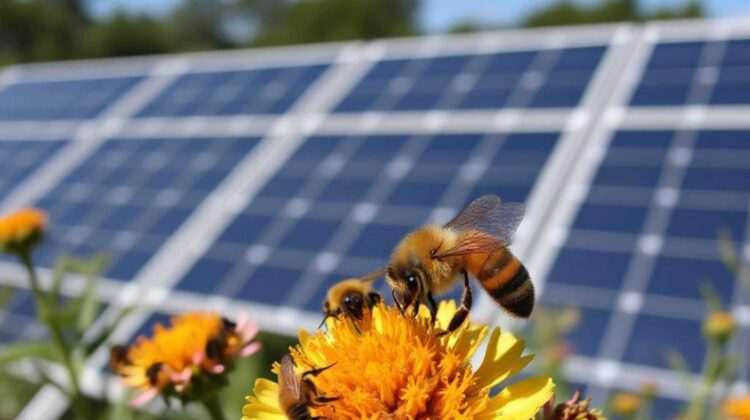
Solar panels and farmland are often framed as competitors for the same acres. A five-year study out of southern Minnesota suggests that framing misses something important: the ground underneath the panels doesn’t have to sit empty.
What the Researchers Did
Scientists from the U.S. Department of Energy’s Argonne National Laboratory and the National Renewable Energy Laboratory studied two solar sites in southern Minnesota — the Atwater and Eastwood solar farms, both operated by Enel Green Power North America, built in 2017 on land previously used for row crops. Atwater covers about 14 hectares and generates 4 megawatts; Eastwood covers roughly 17 hectares and generates 5.5 megawatts.
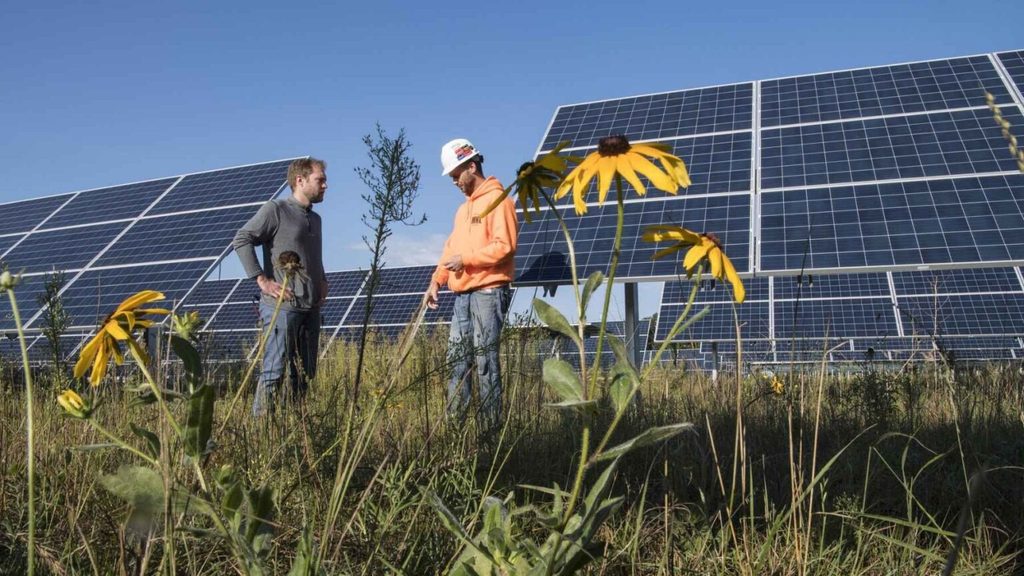
Rather than leaving the ground beneath the panels as gravel or turf — the industry default — crews seeded both sites with native prairie grasses and wildflowers in early 2018, with additional seed mixes trialed in select plots that same year. Because different species flowered at different times, the goal was continuous food availability for pollinators from spring through late summer. Maintenance crews mowed as needed and managed invasive weeds as the habitat matured.
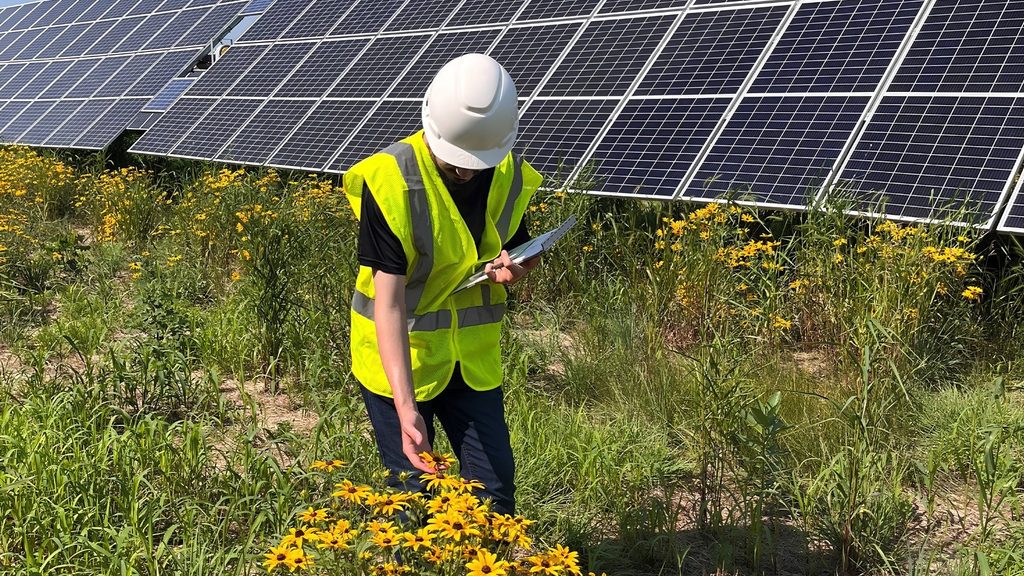
From August 2018 through August 2022, researchers conducted 358 separate surveys walking fixed transects at both sites, according to Argonne National Laboratory, recording flowering plants and insect activity each time.
What They Found
The results built gradually rather than appearing overnight. Over the five-year study period, the sites saw roughly seven times more flowering plant species and threefold growth in beneficial insect abundance, with overall insect diversity increasing by about 13% annually.
Beetles, flies, and moths were the most numerous insect groups by raw count, but native bees showed the most dramatic change of all — climbing more than 20-fold over the course of the study. Researchers logged 729 native bee observations in total, with more than 80% of them occurring after the habitat’s second year, underscoring how much patience this kind of restoration requires before it pays off. Sweat bees and furrow bees (family Halictidae) made up the bulk of native bee sightings, with bumblebees accounting for roughly a fifth of observations.
“The effort to obtain these data was considerable, returning to each site four times per summer to record pollinator counts,” said Heidi Hartmann, manager of Argonne’s Land Resources and Energy Policy Program and a co-author of the study, published in Environmental Research Letters. “Over time we saw the numbers and types of flowering plants increase as the habitat matured.”
The Benefits Didn’t Stop at the Fence Line
Starting in 2019, researchers also tracked bee activity in nearby soybean fields during the July bloom. Bee visits to soybean flowers near the restored solar habitat were roughly twice as frequent as visits recorded along roadsides, and about 2.5 times more frequent than visits deep inside soybean field interiors — activity levels comparable to soybean fields bordering federally protected Conservation Reserve Program grasslands, a benchmark conservation tool in American farm country.
The study didn’t measure soybean yield directly, so it isn’t evidence that neighboring farms harvested more beans as a result. What it does document is bee visitation itself — a widely used indicator of pollination activity, though not a direct measurement of crop output.
An Important Caveat
Not every acre performed identically. The experimental plots that produced the strongest biodiversity results had received additional seed varieties and different management than the rest of the sites — 61 extra plant species beyond the 66 already included in the standard seed mix used more broadly. Areas outside those plots were mowed more frequently and, in the final two years, grazed by sheep — variables that make it hard to assume every acre of a pollinator-friendly solar site will respond identically without similarly intensive management.
“This research highlights the relatively rapid insect community responses to habitat restoration at solar energy sites,” said Argonne landscape ecologist Lee Walston, another co-author. “It demonstrates that, if properly sited, habitat-friendly solar energy can be a feasible way to safeguard insect populations and can improve the pollination services in adjacent agricultural fields.”
Why This Matters for Solar Development Broadly
One estimate cited in the study suggests roughly 80% of future ground-mounted solar development in the United States could occur on agricultural land. That makes decisions about seed mixes, mowing schedules, and site design relevant to far more than a given project’s electricity output alone — they shape whether solar buildout quietly erodes insect habitat or actively restores it.
Minnesota’s results won’t automatically transfer to every climate or site design — the habitat took years to mature and required sustained management, and outcomes could differ in drier regions or at facilities with lower, more tightly spaced panel arrays. But the core finding stands: solar panels kept generating electricity throughout, while the land beneath them quietly rebuilt part of a local food web.
Frequently Asked Questions
Does adding pollinator habitat under solar panels reduce how much electricity they generate? No — the study found the vegetation restoration didn’t interfere with panel operation, since native grasses and wildflowers were selected and managed to stay low enough to avoid shading the panels.
How long does it take for a solar site to become effective pollinator habitat? Based on this study, meaningful results took several years — more than 80% of native bee observations occurred after the habitat’s second year, suggesting this is a long-term investment rather than an immediate fix.
Can this approach work at any solar farm, in any climate? Not necessarily — researchers cautioned that results depended on specific seed mixes and intensive management, and outcomes may differ in drier climates or at sites with different panel spacing and height.
Sources: Argonne National Laboratory, and Walston et al., “If you build it, will they come? Insect community responses to habitat establishment at solar energy facilities in Minnesota, USA,” Environmental Research Letters (2024), cited above.
Leave a Reply