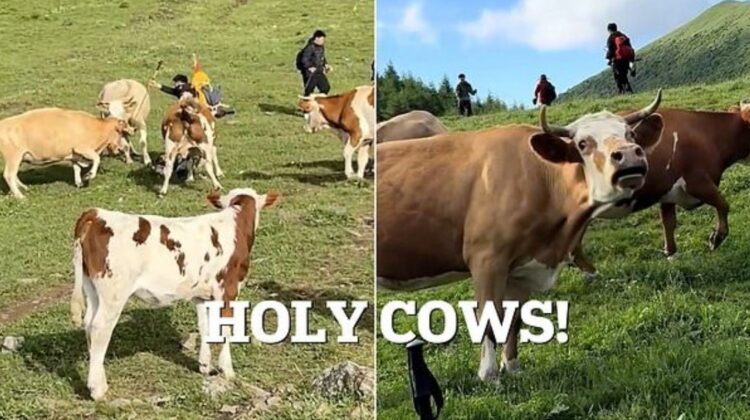
A hiker in China’s Wutai Mountain scenic area learned the hard way that cattle aren’t the passive animals they’re often assumed to be — and that lesson was caught on video.
What Happened
On July 16, in the Wutai Mountain scenic area of Xinzhou, Shanxi province, a tourist was trampled by a group of cows after reportedly provoking one of them. According to local management committee officials, the man had been feeding a cow beef jerky while posing for photos, then repeatedly struck the animal’s rear with his walking stick.
One cow responded by ramming him. As he fell to the ground, the rest of the herd joined in, trampling him while other hikers watched in shock. The animals eventually moved off on their own, and the injured man was rescued and treated for soft tissue contusions and minor rib fractures. Officials said his life was never in danger.
How Authorities Responded
Local management addressed the incident directly the following day: “One tourist fed the cow beef jerky and repeatedly struck its rear with a stick,” officials said. “This is a matter of personal behaviour. We will coordinate with the relevant departments to handle such incidents.”
This Happens More Often Than People Expect
Cattle attacks on hikers aren’t unique to China — they’re a recurring, sometimes fatal hazard in popular hiking regions worldwide. In the UK, a coroner’s inquest found that 72-year-old walker Malcolm Flynn was killed in 2020 after cows near Hadrian’s Wall charged him and his companion, trampling him after he was knocked to the ground. In Austria, an 85-year-old hiker died in a similar incident after cows charged him and his wife on a forest path. Even in the U.S., Boulder County, Colorado closed a popular trail in 2023 after cattle attacked two separate joggers in the same week, with rangers noting the cows were being unusually protective of nearby calves.
Why Cattle Attack
Despite their reputation as calm farm animals, cattle are large, powerful prey animals that can perceive sudden movement, loud noise, provocation, or the presence of dogs as a genuine threat. Cows with calves nearby are especially prone to defensive aggression — a pattern seen repeatedly across the incidents above. Wildlife and countryside safety guides consistently note that cattle can move far faster than most people expect, closing distance in seconds once they decide to charge.
How to Stay Safe Around Cattle on a Trail
Safety guidance from hiking and countryside organizations generally converges on a few key points:
- Never feed, touch, or provoke livestock, even ones that appear docile or used to tourists.
- Keep dogs on a leash and under close control, or avoid fields with cattle entirely if possible — dogs are one of the most common triggers for cattle aggression toward the humans nearby them.
- Give cows with calves a wide berth, since protective behavior around young is one of the most common causes of serious attacks.
- If cattle approach or act agitated, move away calmly toward the nearest exit, fence, or barrier rather than running, which can trigger a chase response.
- If you’re knocked down, try to get up and move to safety as quickly as possible rather than staying on the ground, since trampling injuries escalate the longer a person remains down.
Frequently Asked Questions
Are cattle actually dangerous, or was this an unusual case? Cattle-related injuries and deaths are documented regularly in hiking regions worldwide — including fatal incidents in the UK and Austria — making them a genuine, if often underestimated, hiking hazard rather than a freak occurrence.
What should I do if a cow starts charging at me? Safety experts generally recommend moving calmly and quickly toward the nearest fence, gate, or solid barrier rather than running in the open, since cattle can outrun a person over short distances.
Why do cows react so strongly to being hit or provoked? Cattle are prey animals by evolutionary history, and sudden pain or aggressive behavior directed at them can trigger a defensive response — one that other herd members may join once the animal shows signs of distress or alarm.
Sources: Newsflare, BBC News, and Boulder County Parks & Open Space, cited above.
Leave a Reply