A golden, spiny creature with a mouthful of teeth has taken over social media. The real animal is stranger, and far less understood, than the memes suggest.
It shimmers like a piece of cheap holiday decoration, bristles like a sea urchin and, when it feeds, unfurls a gaping, tooth-lined mouth that seems designed to haunt your sleep. The animal is Eulagisca gigantea, a marine worm from the Southern Ocean around Antarctica, and every so often a photograph of it sweeps across social media, drawing gasps and jokes about alien monsters. The internet tends to present it as a new and terrifying find. It is neither new nor a monster, but the truth is a good deal more interesting.
Not a Monster, Not a New Discovery
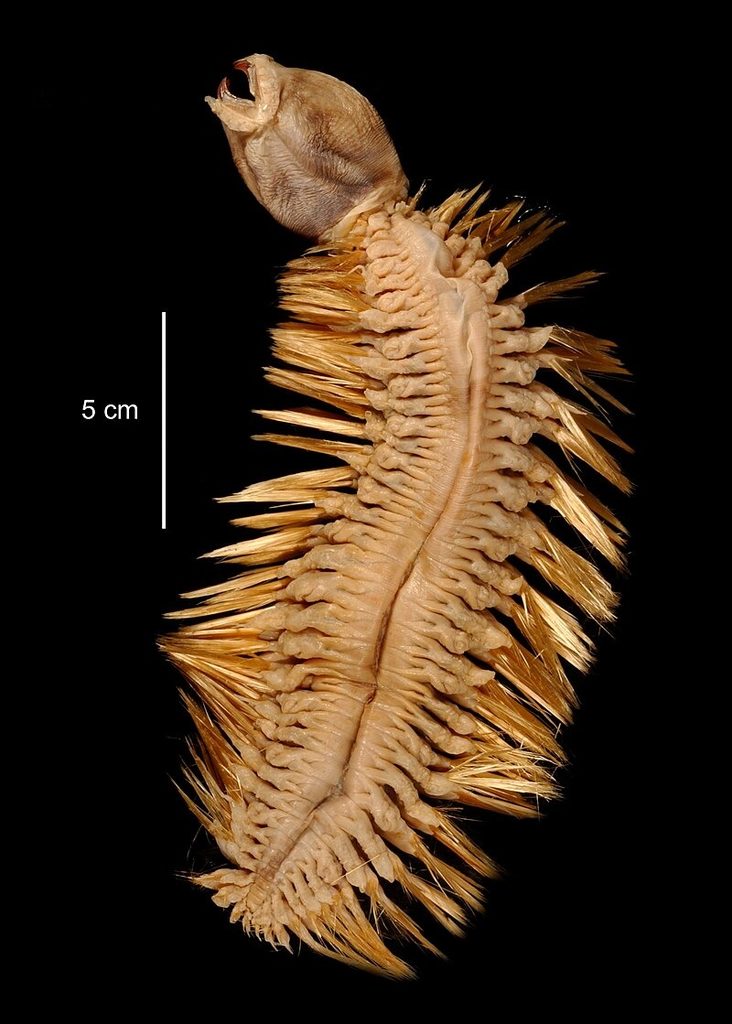
The first thing worth correcting is the idea that this creature has just been found. Eulagisca gigantea has been known to scientists for decades and sits in taxonomic databases like thousands of other deep-sea animals. Viral posts tend to recycle old photographs, often of museum specimens, and add dramatic captions. The second correction is about size. The worm grows to about 20 centimeters, or roughly 8 inches, about the length of a banana, not the half-meter figure that sometimes circulates online. There is no direct evidence that it attacks large prey, and the idea of it as a nightmare predator is mostly the work of photo editors and caption writers.
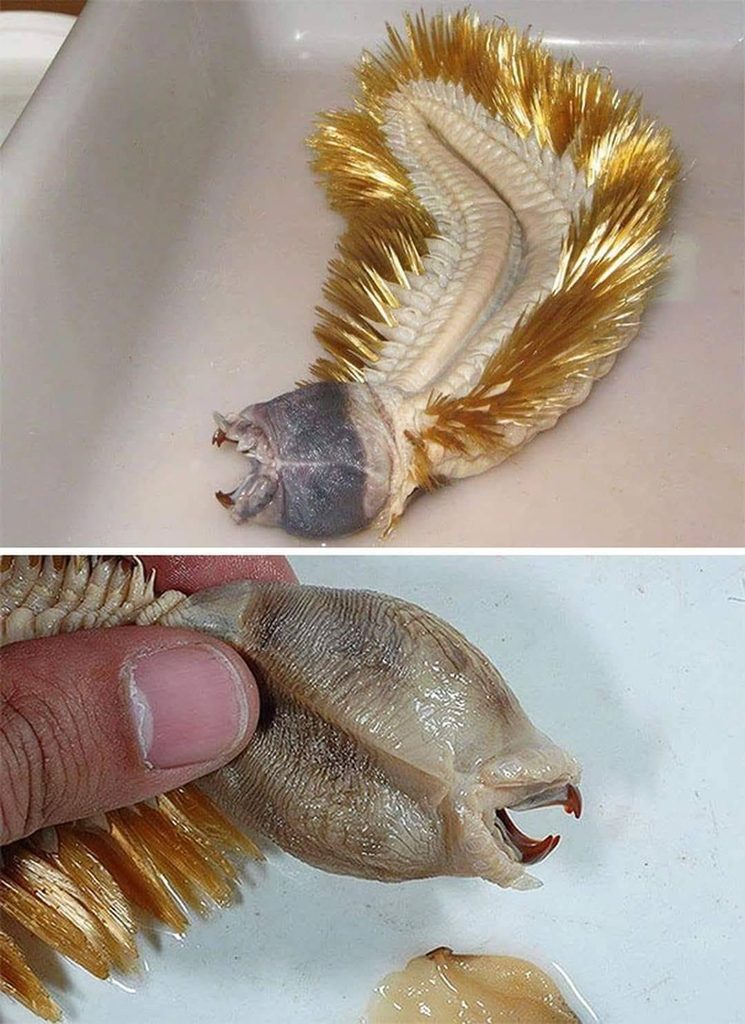
What is true is that it looks extraordinary. It belongs to a group often called scale worms, named for the overlapping plates, known as elytra, that cover the back. In this species they are said to resemble human teeth. Between them runs a fringe of shimmering golden bristles, which give the animal its glittering, ornamental look.
The Mouth That Is Not a Head
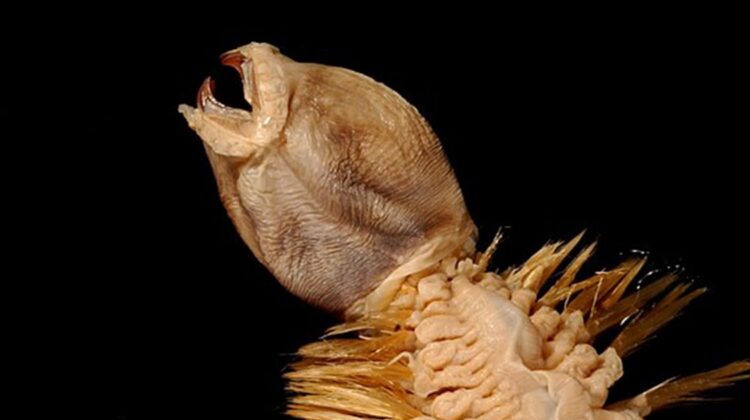
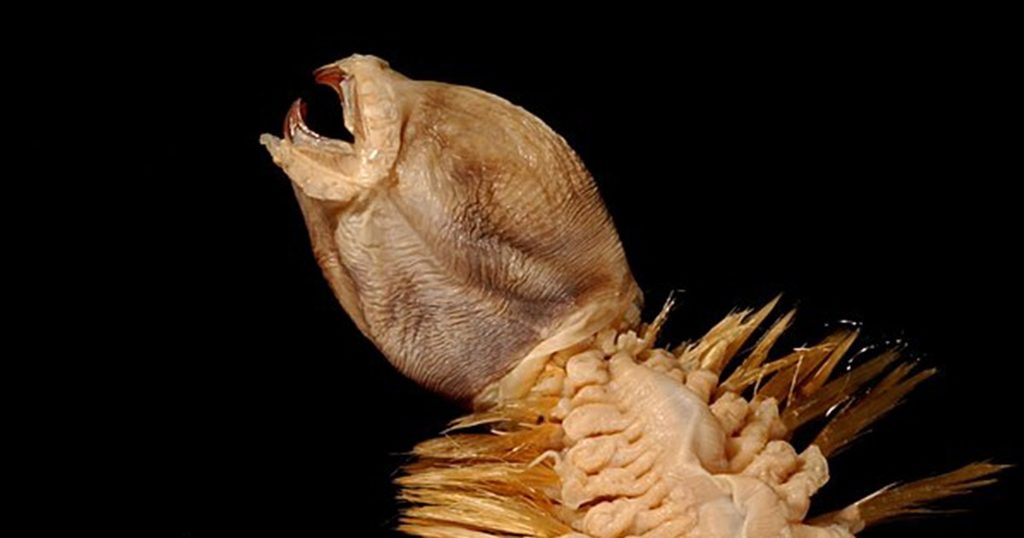
The feature that earns the worm its reputation is the front end. The purplish part that looks like a head is not a head at all. It is a retractable throat, which the worm can turn inside out and push forward to reveal a pair of jaws roughly 7 centimeters, or almost 3 inches, wide, armed with large, sharp teeth. Many marine worms feed this way, shooting out a muscular mouthpart to seize food and then pulling it back in.
What the worm eats is not actually known. Scientists believe it is a predator or scavenger that feeds on small animals or on organic debris that drifts down to the seafloor. A book on unusual animals has described it as a quick and aggressive hunter on the strength of its teeth, but that is an inference from anatomy rather than something anyone has watched. The golden bristles are equally uncertain. They may help the worm crawl or swim, or they may serve as a defense, but researchers have not confirmed their purpose.
A Life Spent in the Dark
Eulagisca gigantea lives in the deep waters of the Southern Ocean, usually below about 500 meters, or 1,640 feet. Down there sunlight does not reach, the water is close to freezing and the pressure is enormous. Very few specimens have ever been collected, and most of what is known comes from preserved animals in museum collections rather than from observing living ones in the wild. That is why a single photograph can spark such wild speculation: there is simply not much else to go on.
The worm belongs to a very large and varied group called the polychaetes, or bristle worms, which number in the thousands of species and live everywhere from sunlit coral reefs to deep-sea hydrothermal vents. Scientists believe many more remain undiscovered. Marine researchers describe bristle worms in general as fabulous recyclers and builders, creating massive reef structures and tangles of tubes, and they play important roles in the food webs of the ocean floor.
Why Strange Animals Matter
It is tempting to treat a creature like this as a curiosity, but animals that thrive in extreme cold and crushing pressure are valuable to science. Studying how they cope can reveal how life adapts to some of the harshest conditions on Earth, and it can inspire engineers. The structure of a scale worm’s armor and the flexibility of its bristles have caught the interest of researchers working on new materials and soft robotics, although this is early-stage thinking rather than finished technology.
Reaching animals like this is itself a feat of engineering. Exploring the deep Southern Ocean takes research vessels, remotely operated vehicles and sophisticated sampling equipment, much of which has only become widely available in recent years. As that technology improves and more of the seafloor is mapped, scientists expect to meet many more animals that nobody has seen alive. Antarctica is also changing, with warming waters and growing human activity, which makes it more urgent to understand what lives there before conditions shift.
So Should You Be Afraid of It?
Not in the slightest. Even in its own habitat the worm is a modest-sized bottom dweller that no swimmer or diver is ever likely to meet, since it lives far deeper than people go. Its fearsome look is a product of evolution in a dark, cold world, not an invitation to nightmares. And the next time a picture of it goes viral, it is worth remembering that the real story is not about a monster, but about how little we know about the life at the bottom of the sea.
Frequently Asked Questions
What is Eulagisca gigantea? A scale worm that lives in the deep waters of the Southern Ocean around Antarctica, known for its golden bristles and its tooth-lined, extendable mouth.
How big is it? About 20 centimeters, or 8 inches, long, roughly the size of a banana.
Is the worm dangerous to people? No. It lives in deep, cold water far below where people swim or dive, and there is no evidence it attacks large animals.
What does it eat? Nobody knows for sure. Scientists think it hunts or scavenges small animals and organic debris on the seafloor.
Is it a newly discovered species? No. It has been known to science for decades, and viral photos usually show old specimens.
Sources: Live Science; Ubergizmo; Australian Geographic; Fox News; Wikipedia.
Leave a Reply