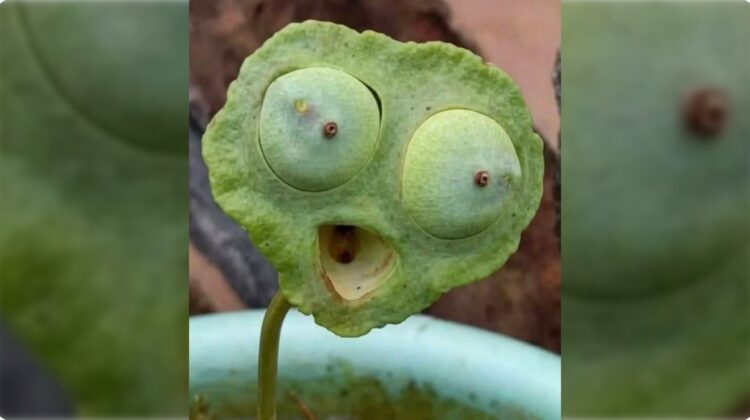
Empty a lotus seed pod of its seeds and, more often than seems reasonable, what’s left behind looks like it’s mid-scream — two wide “eyes,” a gaping “mouth,” and an expression that ranges from shocked to mournful depending on the angle.
What’s Actually in the Picture
The pods come from the sacred lotus (Nelumbo nucifera), an aquatic plant whose flower gives way to a flat, cone-shaped seed head studded with individual chambers, each holding a single seed. While the flower is blooming, those chambers sit flush with small openings above each seed. As the pod dries and the seeds are removed or fall out, the chambers become deep, round hollows — which is exactly the arrangement that, angled right, reads as a face: two large cavities as eyes, a smaller gap or split as a mouth, sometimes with the leftover seed sitting inside a socket like a pupil.
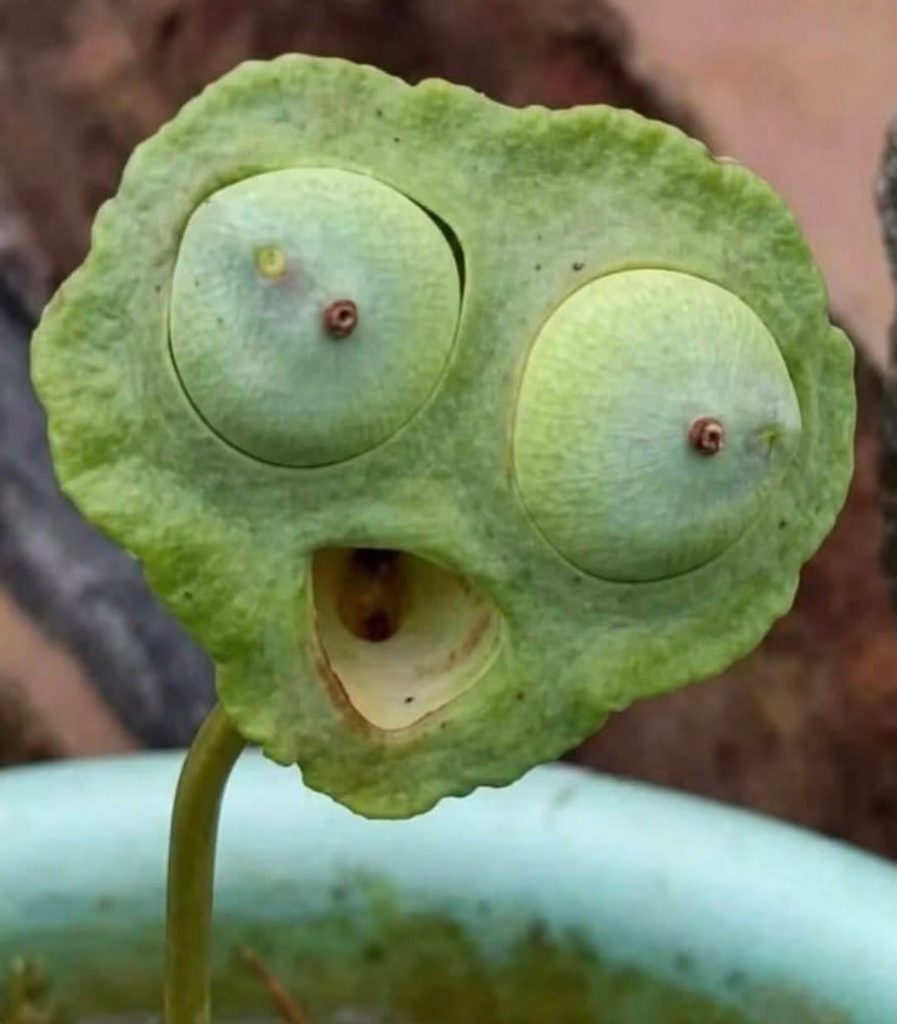
The three examples here — pale green with two round “eyes” and an open “mouth,” a paler version with visible seed-pupils, and a version photographed still resting in its pot — are typical of how widely this look gets photographed and shared online: no two pods look quite alike, but the loose “face” arrangement shows up again and again.
Two Different Things Going On at Once
There are actually two separate phenomena layered on top of each other in these photos, and they’re often conflated.
The first is pareidolia — the well-documented tendency of the human brain to detect faces in random arrangements of shapes, from clouds to electrical outlets to, in this case, a dried seed pod. It’s a byproduct of how strongly wired humans are to recognize faces quickly, and it’s why two roughly symmetrical holes and a gap below them reliably read as “eyes and a mouth” to almost anyone who looks at one of these photos.

The second is trypophobia: a widely reported discomfort or aversion to clusters of small, irregular holes, which researchers estimate affects somewhere around 15% of people to some degree. It isn’t formally recognized as a diagnosable phobia, and researchers are still debating its origins — some have proposed it’s linked to an evolved aversion to skin diseases or venomous animals with clustered markings, though that theory remains contested. What isn’t in dispute is which image researchers most often use to study it: the lotus seed pod, intact and full of holes, is one of the most consistently cited trigger images in trypophobia research going back over a decade.
The two reactions can pull in opposite directions on the same photo — one part of the brain resolving the shape into a face, another reacting to the cluster of holes underneath it.
Not a New Phenomenon, Just a Recurring One
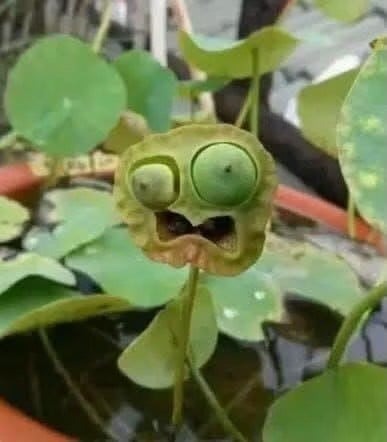
Photos of lotus seed pods “making faces” circulate regularly online, generally without a single traceable origin — they’re the kind of image that gets rediscovered and reshared repeatedly rather than tied to one specific event or photographer. Part of the appeal is that the effect is inconsistent: dry out enough pods and photograph them from enough angles, and some will look like faces, some won’t, and the ones that do rarely look like each other.
Frequently Asked Questions
Is the lotus seed pod dangerous or toxic? No. Lotus seeds are edible and widely used in Asian cuisine and traditional medicine; the pod itself poses no danger to people. The “face” effect is purely visual, a result of how the seed chambers are arranged.
Why do some people find these photos upsetting rather than funny? Clustered small holes are a well-documented trigger for trypophobia, a common but not formally diagnosed aversion. That reaction is separate from — and can coexist with — the brain’s tendency to see a face in the same image.
Do all lotus seed pods end up looking like faces? No. It depends on the specific arrangement and number of remaining seed chambers, how the pod has dried, and the angle it’s photographed from. Most pods don’t produce a strong face-like effect; the ones that do are the ones that tend to get photographed and shared.
Sources: Wikipedia (Nelumbo nucifera, Lotus seed); IFLScience; published trypophobia research (Cole & Wilkins, 2013).
Leave a Reply