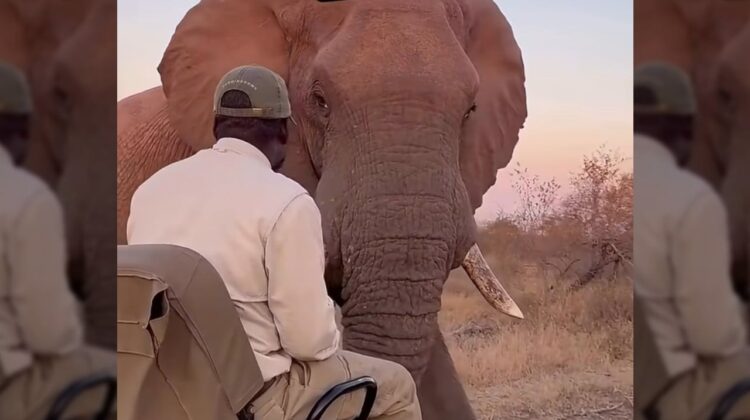
A short video of a safari encounter has people holding their breath. In the clip, a large African elephant walks straight toward an open vehicle while a guide sits in the exposed front seat. Its tusks pass on either side of him, and for a few seconds the two are only a few feet apart, according to A-Z Animals, which first described the video.
The guide doesn’t shout, jump or make any sudden move. After several long seconds, the elephant turns, walks alongside the vehicle and continues into the bush.
Why Did The Elephant Get So Close?
Honestly, only the elephant knows. The original post doesn’t say where the clip was filmed or what happened before it started, so assigning the animal a motive would be guesswork. It could have been following a familiar route, investigating the vehicle, or simply checking out the people in front of it.
What we do know is that elephants experience the world differently than we do. Park authorities in South Africa’s Kruger National Park note that elephants have excellent hearing, that their eyesight is poor in bright sunlight, and that most of the air they breathe is drawn in through the trunk, which also works as their nose, according to SANParks. A vehicle that looks still and quiet to us may be full of interesting smells and sounds to an elephant.
Was It About To Charge?
Nothing described in the 23-second clip confirms a charge. The elephant doesn’t sprint, kick up dust, toss its head or trumpet. Its ears are described as partly extended, but that alone doesn’t mean aggression.
The researchers at ElephantVoices, who document elephant behavior in the field, explain that elephants communicate with the whole body, so signals have to be read together and in context. Their behavior guide notes that elephants spread their ears, holding them about 90 degrees from the body, when facing a predator or perceived threat, apparently to look larger. But they also do it when listening, surprised, alarmed or otherwise aroused, according to the ElephantVoices ethogram entry on ear-spreading.
A clearer threat usually combines several signals, such as standing tall with the head held high and the chin up, a direct stare, and dramatic head movements, as described in the guide’s entries on standing tall and head-dips. A single detail on its own, like partly spread ears, isn’t enough to call it.
A Calm Ending Isn’t A Guarantee
The footage shows a peaceful outcome, not proof that close approaches are harmless. Wild elephants are enormously powerful and can change their behavior quickly. The elephant chose to end this encounter calmly, and that choice was the elephant’s, not the guide’s.
Visitors shouldn’t try to recreate the moment, and they should always follow the instructions of trained guides and park rules.
How Big Is An African Elephant?
The elephant appears to be an African savanna elephant, judging by its large fan-shaped ears, tusks and the open bush. That identification is visual only, since the post doesn’t confirm the species or location.
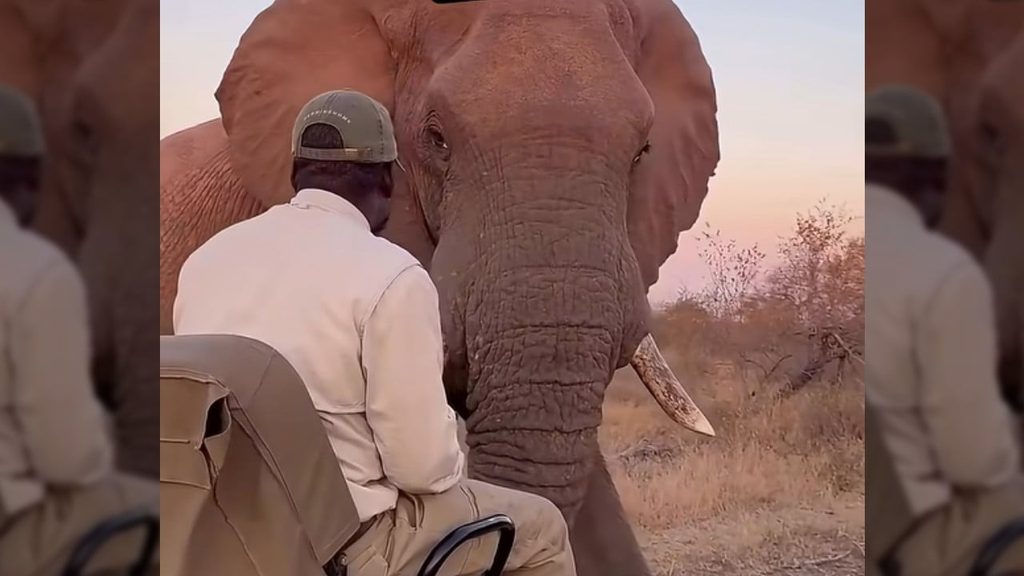
African savanna elephants are the largest land animals alive. According to the San Diego Zoo Wildlife Alliance’s fact sheet, adult males average around 6,000 kilograms (about 13,000 pounds) and stand roughly 2.9 to 3.7 meters (9.5 to 12 feet) at the shoulder, and some large bulls exceed 3.5 meters (11 feet). Females are noticeably smaller. Conservation groups often cite an average of about 12,000 pounds for African elephants overall, as the Tsavo Trust notes.
Even a guide sitting high above the vehicle would find himself nearly eye to eye with an animal that size.
Frequently Asked Questions
Why didn’t the elephant charge? The clip doesn’t show clear signs of a charge, and its motives are unknown. It may have been curious, following a path, or deciding whether the vehicle mattered.
Do spread ears mean an elephant is angry? Not necessarily. Elephants spread their ears when facing a threat, but also when listening, startled or excited. Behavior experts say signals must be read together.
What are warning signs of a threatening elephant? Standing tall with head and chin raised, a direct stare, head-dips or head-tosses, and kicking dust are among the displays documented by researchers.
How tall are African elephants? Adult males typically stand about 9.5 to 12 feet at the shoulder, with some exceeding 11 feet, according to the San Diego Zoo Wildlife Alliance.
What should you do if an elephant approaches on safari? Follow your guide’s instructions. Stay calm, avoid sudden movements and never try to approach or provoke the animal.
Sources: A-Z Animals, SANParks, ElephantVoices Elephant Ethogram, San Diego Zoo Wildlife Alliance, and Tsavo Trust.
Leave a Reply