
The past decade has seen an explosion of new research into some of the most fascinating sounds in the sea: the vocalizations of whales and dolphins.
Scientists have uncovered how humpback whales learn songs from neighboring populations, allowing these songs to travel from western Australia to South America. They discovered bowhead whales singing 184 different songs over three years and learned how bottlenose dolphins use signature whistles to shore up alliances.
Researchers have also shown that sperm whale vocal dialects become more distinct the more they interact across the Pacific, suggesting these dialects function as ethnic markers. Advancing technology, such as drones, acoustic tags, and recorders, means such insights are accumulating rapidly.
Much of what whales and dolphins signal seems to relate to identity within social contexts. This can include identifying alliance members, or members of long-term social units and clans, or a particular population or species. Vocal communication also builds and reinforces social bonds and coordinates cooperative foraging.
There has also been a resurgence of an old idea: that hiding behind all these findings is a human-like language. If we can just find the right tools, the thinking goes, we can decode it and start talking to whales like we talk to our neighbors.
The hottest new tool is AI. Reading some of the press around the topic, you could be forgiven for thinking such conversations are imminent.
Two recent studies stand out for the dramatic claims they make about whale language. One details a humpback responding to the playback of a call with a similar one (but then ultimately losing interest).
This study’s importance was to demonstrate that such playback studies are possible because playing back an animal’s calls and observing their reaction is a tested method for uncovering the meanings and functions of signals.
It’s not, however, the first playback to whales or dolphins, and neither, as the scientists claimed, were they “conversing” with the whale. If this was a “conversation”, then we’ve been having more insightful “conversations” with other species for decades – there have been over 600 such playback studies on birds.
The second study is a detailed analysis of patterns of clicks, called codas, produced by sperm whales. It shows that the whales appear to synchronously change the tempo of their codas when using them in exchanges with each other.
Such synchronous chorusing is not unique to whales. It happens across the animal kingdom, from fireflies to primates. Few animal displays are as breathtakingly synchronized as the four-part chorusing of plain-tailed wrens, while happy wrens use pair-specific duets to signal commitment to mates.
Nonetheless, the sperm whale findings are exciting and fit with our general understanding of codas having a social bonding function. But the scientists also tried to force these tempo changes into a “phonetic alphabet”, “like the International Phonetic Alphabet for human languages”, and it is this latter claim that has grabbed headlines.
There is, however, no evidence that sperm whales use these different tempos in anything like the complex sequences that characterize human language. We find better evidence for complex sequencing rules in Bengal finches. I wonder why we don’t see headlines about phonetic alphabets or imminent conversations with these birds?
Don’t Believe the Hype
We’ve been closely studying cetacean vocal behavior in the wild and in captivity for several decades now. Compare that to how quickly you or I can start exchanging ideas with another person we don’t share a language with – because we use our theory of mind to understand each other as communicative agents.
If language was there, I think we would have found it by now. The most powerful language detector we know of sits between our ears, and we used it to effortlessly learn the language of our childhood as toddlers. As the story of Helen Keller shows, language finds a way.
Persuading the BBC not to describe sperm whale clicks as “language” in their Blue Planet II series was the highlight of my science communication career. Why?
A lot of complex communication is going on in cetaceans, much of which we still don’t understand. However, I am convinced that we should drop the stifling and anthropocentric focus on language. It crowds out other perspectives on what is going on – for example, the relationship between rhythm-based communication and music might be a better way to understand the bonding function of coda synchrony in sperm whales.
We should be wary of ranking species on a single dimension relative to humans, as if all evolution is a path to something like us (much like early anthropologists ranked societies by their progress toward western “perfection”). Instead, let’s take ourselves off the top of the ladder and see other animals as distinct branches of an evolutionary tree.
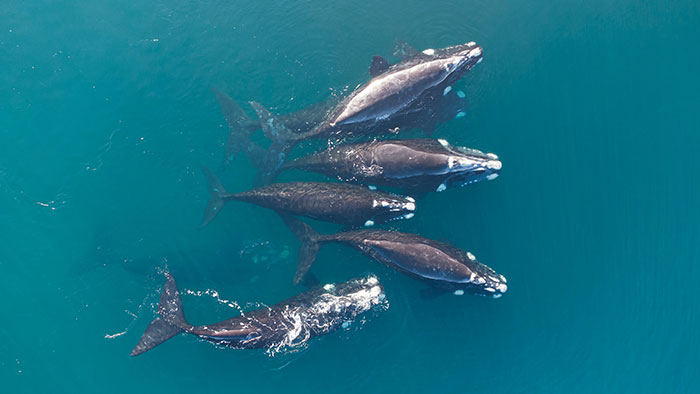
Both of the research groups promoting talking to whales are linked to, or name themselves after, the Search for Extra-Terrestrial Intelligence (SETI). The leaders of one group, Project CETI, argue that understanding whale “language” will help us when we meet ET.
We’ve been here before. John Lilly also leaned into SETI, promoting the idea that dolphins were an alien intelligence with a complex language. His weak evidence ultimately evaporated in a cloud of hype and hallucinogens.
Unfortunately, his claims kept the important discovery of bottlenose dolphin signature whistles in the shadows for far too long and cast a cloud of disrepute over the entire field of cetacean communication that took decades to disperse. It would be tragic if today’s important insights suffered the same fate because of irresponsible claims and a narrow focus on language.
We should strive to understand and value these awesome creatures for what they are, not for how they might soothe our cosmic loneliness.
Leave a Reply