
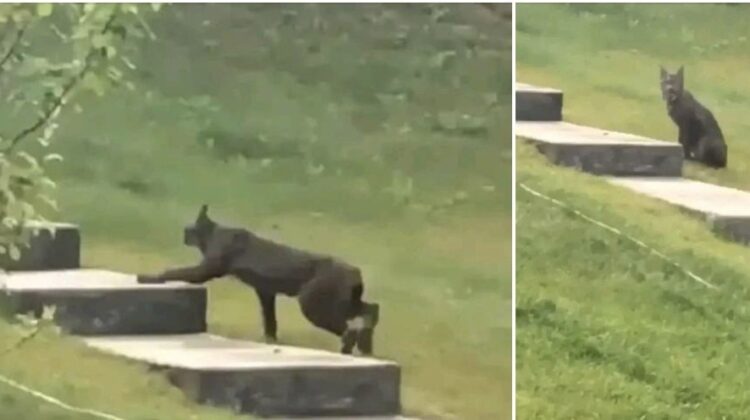
The Canada Lynx, also known as Lynx canadensis, is a species of lynx native to North America, including Canada and parts of the United States.
While the Canada Lynx typically has a light brownish-grey fur coat, individuals with black fur have been reported occasionally.
No one had captured black-colored type on camera, but in 2022, a fortunate individual managed to take some pictures that subsequently spread worldwide.
The animal was caught by a researcher at the University of Alberta, Canada. Thomas Jung, an employee of the Government of Yukon, recorded a video of the animal on his cell phone.
The discovery was documented in an article, “Paint it black: first record of melanism in Canada lynx (Lynx canadensis),” in the journal Mammalia.
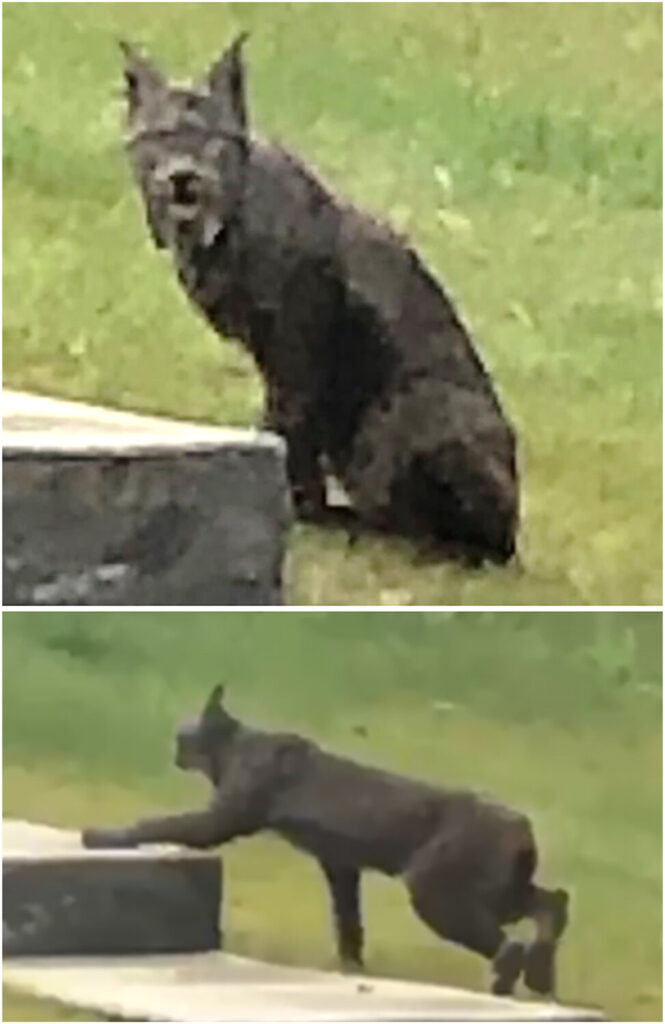
The video was caught in a rural residential area near the town of Whitehorse, Yukon. In the video, the lynx is seen at a distance of about 50 meters and is not bothering anything. Some people and a dog were nearby, and the lynx eventually crept away at the dog’s barking.In terms of behavior, the Canada Lynx is a solitary and secretive animal.
Experts on the animal confirmed that it was a Canada lynx, but could not make out too many distinctive features in the grainy video.
”It had a black coat containing whitish gray guard hairs throughout, as well as whitish gray hairs in the facial ruff and the rostrum and dorsal regions,” Jung reports.
Most of the lynx species has similar coloring, with Canada lynx often appearing with silvery gray coats in the winter. Their coats often turn reddish brown in the summer.
The lynx captured in the video is therefore an especially rare animal for its coat color variations.
Jung explains that variations like this are often adaptations that can be of evolutionary benefit (adaptive) or come as a disadvantage (maladaptive).
Scientists have yet to determine if melanism in any species if an advantage or disadvantage. Jung, however, believes that the trait in the lynx leads to a lack of necessary camouflage and is therefore maladaptive. Hunting in the winter, the animal would likely stand out in the snow with its darker hair.
Wow! We can’t believe such a unique creature was caught on camera. Let us know your thoughts in the comments!
Leave a Reply