
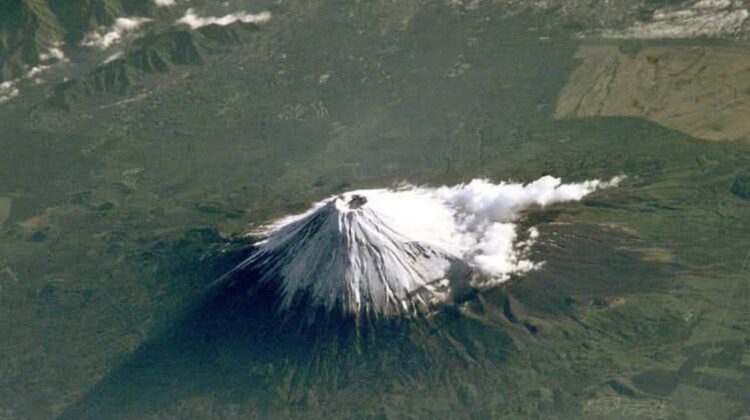
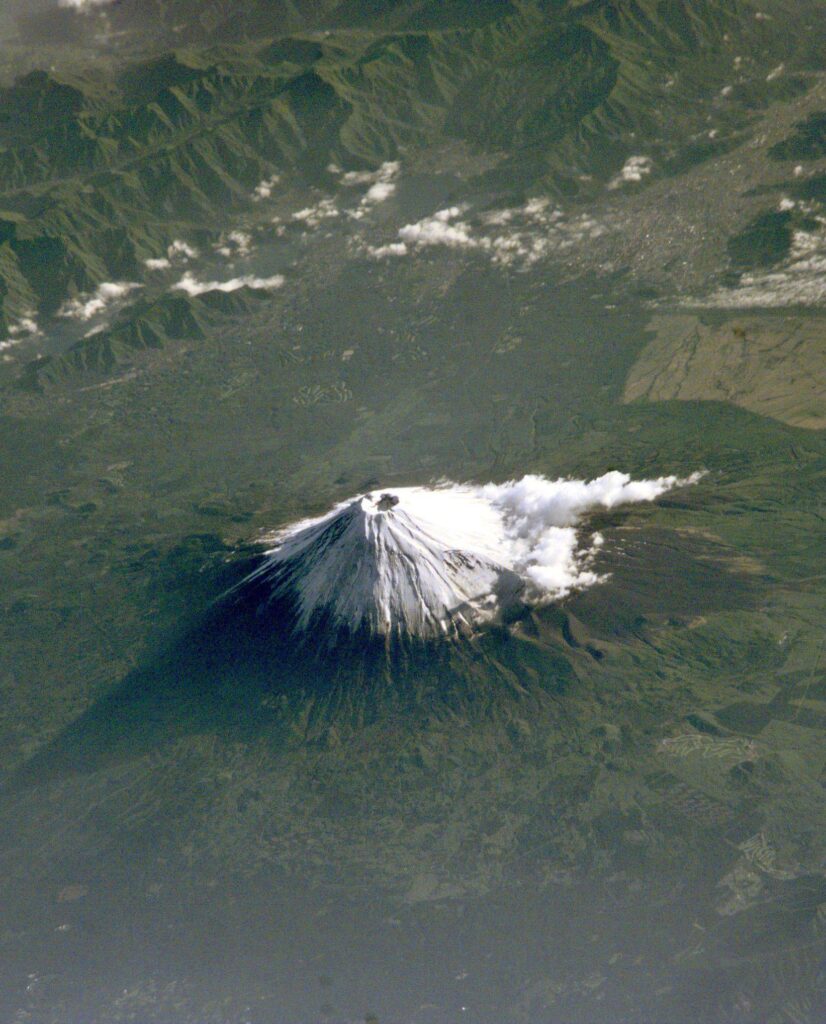
This striking image captures Mount Fuji as seen from the International Space Station, more than 400 kilometers above Earth. From this rare orbital perspective, Japan’s most iconic mountain reveals itself not just as a scenic landmark, but as a living geological record shaped by fire, ice, and time.
Rising 3,776 meters above sea level, Mount Fuji is Japan’s highest peak and a classic stratovolcano, formed by successive layers of hardened lava, volcanic ash, and debris. Its near-perfect conical shape — clearly visible even from space — is the result of repeated eruptions over hundreds of thousands of years, each one carefully layering the mountain higher and steeper.
The image highlights Fuji’s snow-covered summit, contrasting sharply with the darker, vegetation-covered lower slopes. This visual divide reflects dramatic temperature gradients with altitude and illustrates how the mountain influences regional weather patterns. Acting as a natural atmospheric barrier, Mount Fuji shapes cloud formation, wind flow, and precipitation across central Japan.
Although its last recorded eruption occurred in 1707, Mount Fuji is not considered extinct. It remains classified as an active volcano, closely monitored by Japanese scientists using seismic sensors, satellite data, and ground-based observations. Any renewed activity could have significant consequences for nearby population centers, including the greater Tokyo metropolitan area.
From orbit, ancient lava flows appear as dark streaks radiating from the summit, silent evidence of past eruptions that once reshaped the surrounding landscape. These geological scars tell a powerful story of Earth’s volatile past — a reminder that the planet’s most beautiful forms often arise from its most violent processes.
Beyond geology, Mount Fuji holds profound cultural and spiritual significance. For centuries, it has been revered as a sacred mountain, inspiring poets, monks, and artists. Its image has become synonymous with balance, endurance, and harmony between humans and nature. In recognition of this legacy, Mount Fuji was designated a UNESCO World Heritage Site in 2013.
Seen from space, Mount Fuji becomes more than a mountain. It is a symbol of Earth’s dynamic nature — where deep time, natural forces, and human meaning converge. From this distance, borders disappear, and what remains is a quiet truth: our planet is alive, ever-changing, and astonishingly beautiful.
Leave a Reply