• Skip to main content
  • Skip to primary sidebar
  • Skip to footer
  • Home
  • About Us
  • Copyright Report
  • Submit Content
  • Terms
  • Privacy Policy
  • Legal Disclaimer

Hasan Jasim

Hasan Jasim is a place where you may get entertainment, viral videos, trending material, and breaking news. For a social generation, we are the largest community on the planet.

Mount Fuji From Space: A Timeless Giant Seen From Orbit

by Hasan Jasim Editorial Team Leave a Comment

ShareTweet

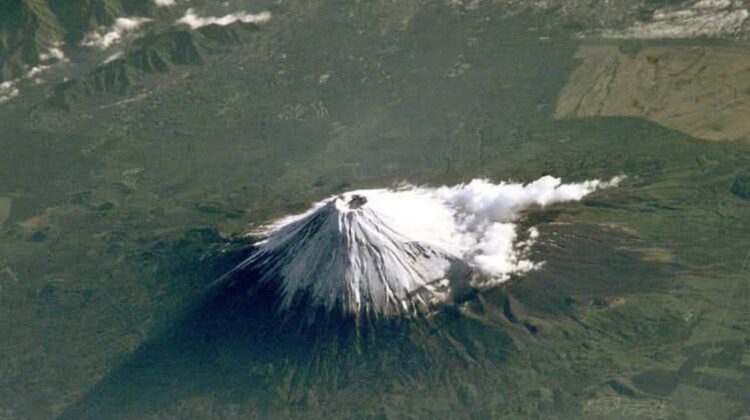
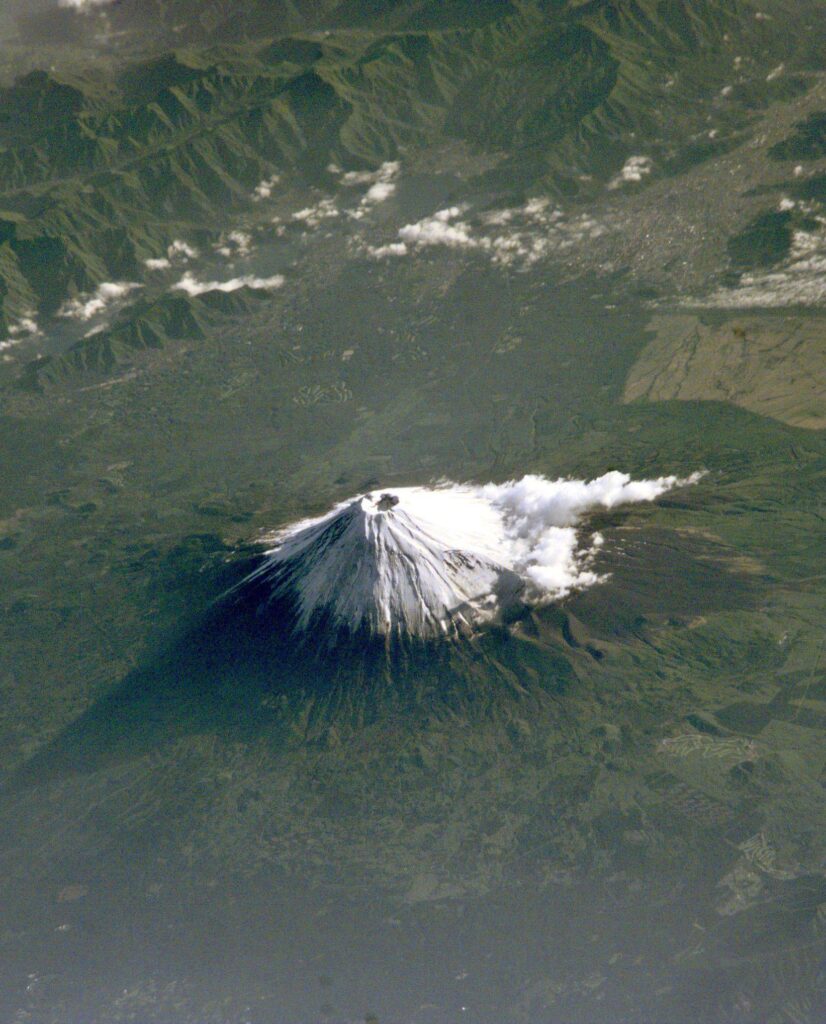
This striking image captures Mount Fuji as seen from the International Space Station, more than 400 kilometers above Earth. From this rare orbital perspective, Japan’s most iconic mountain reveals itself not just as a scenic landmark, but as a living geological record shaped by fire, ice, and time.

Rising 3,776 meters above sea level, Mount Fuji is Japan’s highest peak and a classic stratovolcano, formed by successive layers of hardened lava, volcanic ash, and debris. Its near-perfect conical shape — clearly visible even from space — is the result of repeated eruptions over hundreds of thousands of years, each one carefully layering the mountain higher and steeper.

The image highlights Fuji’s snow-covered summit, contrasting sharply with the darker, vegetation-covered lower slopes. This visual divide reflects dramatic temperature gradients with altitude and illustrates how the mountain influences regional weather patterns. Acting as a natural atmospheric barrier, Mount Fuji shapes cloud formation, wind flow, and precipitation across central Japan.
Although its last recorded eruption occurred in 1707, Mount Fuji is not considered extinct. It remains classified as an active volcano, closely monitored by Japanese scientists using seismic sensors, satellite data, and ground-based observations. Any renewed activity could have significant consequences for nearby population centers, including the greater Tokyo metropolitan area.

From orbit, ancient lava flows appear as dark streaks radiating from the summit, silent evidence of past eruptions that once reshaped the surrounding landscape. These geological scars tell a powerful story of Earth’s volatile past — a reminder that the planet’s most beautiful forms often arise from its most violent processes.

Beyond geology, Mount Fuji holds profound cultural and spiritual significance. For centuries, it has been revered as a sacred mountain, inspiring poets, monks, and artists. Its image has become synonymous with balance, endurance, and harmony between humans and nature. In recognition of this legacy, Mount Fuji was designated a UNESCO World Heritage Site in 2013.

Seen from space, Mount Fuji becomes more than a mountain. It is a symbol of Earth’s dynamic nature — where deep time, natural forces, and human meaning converge. From this distance, borders disappear, and what remains is a quiet truth: our planet is alive, ever-changing, and astonishingly beautiful.

Filed Under: Trends Worldwide Tagged With: active volcano, climate and weather, Earth from space, Earth observation, geology, iconic landmarks, International Space Station, japan, Mount Fuji, natural history, natural wonders, planetary science, satellite image, snow-capped mountains, space exploration, space photography, stratovolcano, UNESCO World Heritage site, volcanic landscapes, volcano

Reader Interactions

Leave a Reply Cancel reply

Your email address will not be published. Required fields are marked *

Primary Sidebar

More to See

The bird at the center of the worst single-species mortality event in modern history isn’t recovering, scientists say

By Hasan Jasim Editorial Team

Baby Cows Wear Earmuffs in the Winter To Keep Their Ears From Freezing Off

By Hasan Jasim Editorial Team

The Beauty of Gomesa Jiaho Queen Orchid: A Rare and Exquisite Flower

By Hasan Jasim Editorial Team

800-Pound Pig Discovered on the Streets only Wishes to be Loved

By Hasan Jasim Editorial Team

Tsunami from heaven: Spectacular timelapse footage captures storm dumping tonnes of water in an Alpine lake

By Hasan Jasim Editorial Team

Winter’s Touch: Frost Transforms Vancouver Statue into a Surreal Vision

By Hasan Jasim Editorial Team

Angel Falls: Exploring the World’s Tallest Waterfall in Venezuela

By Hasan Jasim Editorial Team

Footer

ABOUT HASANJASIM.ONLINE

Hasanjasim.online is a digital platform dedicated to publishing well-researched articles about the animal kingdom, nature, and the environment. Our editorial team works to source stories from credible outlets, scientific research, and verified reports, aiming to inform as much as we entertain. From wildlife conservation and animal behavior to natural wonders and environmental science, we cover the topics that help readers better understand and appreciate the natural world. Whether you're a lifelong nature lover or simply curious about the planet we share, Hasanjasim.online aims to be a trustworthy destination for stories worth reading — and worth citing.

Recent

  • Euphorbia Hirta (“Asthma-Plant”): What Traditional Use and Real Research Actually Show
  • A Mystery Animal Has Been Randomly Attacking People in New Hampshire — Here’s What We Know
  • A Woman Was Filmed Sharing Her Ice Cream With Her Dog — Here’s What Vets Actually Say About It
  • Dolphin Calf Incident in Ceuta Sparks Outrage After Disturbing Beach Footage Emerges
  • Lactuca Serriola Root: Traditional Uses of Prickly Lettuce (Wild Lettuce) Root
  • The Puppy a Firefighter Couldn’t Leave Behind — and the Story Didn’t End There
  • A Mother Dog Dove Into Floodwater Again and Again — Until All 7 of Her Puppies Were Safe

Search