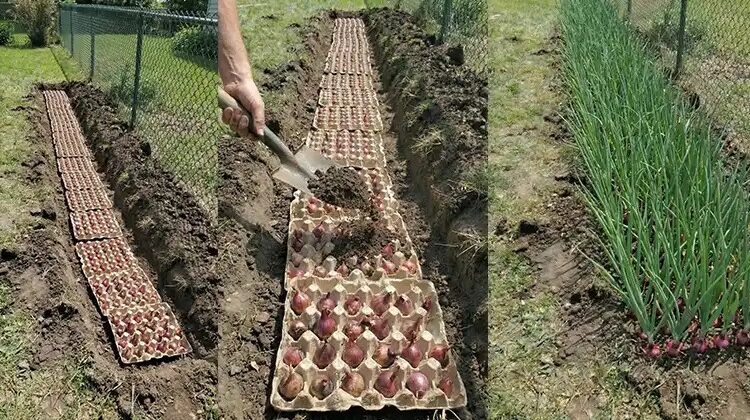
Egg carton cups are already spaced evenly, and paper cartons break down in the soil. That makes them a handy way to line up onion sets in a tidy bed. Here’s how to use the trick, along with the planting rules that matter most.
Why Try the Egg Carton Method?
Home gardeners use plain paper or pulp egg flats as a simple planting grid. A standard 30-egg flat has cups about 2 inches apart, which makes spacing easy to judge, and the paper can help block light to weed seeds while it breaks down. Use only uncoated paper or pulp cartons, never plastic or foam.
The cartons are a gardener’s shortcut, not a replacement for good growing practices, so the rest of this guide follows university extension advice.
Step 1: Pick the Right Onion for Your Region
Onions form bulbs in response to day length. Long-day onions need about 14 hours of daylight and suit northern gardens, while short-day types bulb with about 10 hours and suit the South. Day-neutral and intermediate types are more flexible. Planting the wrong type can mean no bulbs at all.
Choose smaller sets for bulbs. The University of Vermont Extension suggests sets under three-quarters of an inch, since larger ones are more likely to bolt, or flower, early. Oregon State University Extension adds that larger sets are better used for green onions.
Step 2: Time It Right
Onions are among the first crops you can plant. Vermont’s extension recommends planting about 2 to 4 weeks before the last hard frost. Oregon State’s vegetable breeder Jim Myers says “early planting is critical” for big bulbs, because bulb size depends on how large the plant is when bulbing begins. In mild-winter areas, short-day onions are often planted in fall.
Step 3: Prepare the Bed
Onions need full sun and loose, nutrient-rich soil with good drainage. Clear weeds, loosen the soil, work in compost and level the surface so the cartons lie flat. If water puddles after rain, raise the bed.
Step 4: Lay the Cartons and Plant
- Lightly wet stiff paper flats so they mold to the soil, and lay them end to end.
- Tear or poke a few holes in the bottom of each cup so roots can push through.
- Place one set in a cup with the pointed end up.
- Plant every other cup for bulbs. Extension guidance for bulbing onions from sets ranges from 2 to 4 inches (Vermont) to 4 inches (Oregon State) and 4 to 8 inches in blocks (University of Maryland).
- Cover with about a half to 1 inch of soil, as recommended by Oregon State and Maryland, and pat gently.

For green onions, Oregon State suggests planting sets deeper, about 1½ to 2 inches, and as close as 1 inch apart, so you can use every cup.
Step 5: Water, Weed and Feed
Onions are shallow-rooted, so drought can trigger early, small bulbs. Keep the soil evenly moist, water deeply but not too often, and weed by hand to avoid damaging roots. Feeding the plants early in the season while they build leaves helps them grow large before bulbing starts.
Step 6: Harvest and Cure
Harvest green onions once they are pencil-thick. Bulb onions are ready when the tops begin to fall over. Lift them, let them cure in a warm, dry, shaded, ventilated spot, and store them in a cool, dry place with good air circulation. Thorough curing increases storage life.
Common Problems
- Bolting. Large sets, wrong variety or cold stress can cause flowering. Pick smaller sets and the right day-length type.
- Small bulbs. Crowding, too little water or late planting can limit size.
- Rot. Poorly drained soil or planting too deep can cause rot.
Gear Up for Your Onion Bed
A few supplies make the job easier:
- Soil and compost. Compare organic compost, raised bed soil mix and soil test kits.
- Raised beds. Compare raised garden bed kits for better drainage.
- Watering tools. Soaker hoses and drip irrigation kits provide steady moisture.
- Mulch and tools. Browse straw mulch, garden hoes and hand trowels.
- Onion sets and seeds. Compare onion sets for your region, and mesh storage bags for curing.

Frequently Asked Questions
Can I use any egg carton? Only plain paper or pulp cartons. Avoid plastic and foam.
How deep should onion sets be planted? Extension guidance is about a half inch to 1 inch for bulbing onions, and 1½ to 2 inches for green onions.
How far apart should onions be? For bulbs, roughly 4 inches or more apart. Every other cup in a standard egg flat gives about that spacing.
Why did my onions flower? Bolting is more likely with large sets, cold stress or the wrong day-length variety.
Sources: Oregon State University Extension Service, University of Vermont Extension, University of Maryland Extension, and Douglas County Master Gardeners, all covering onion set planting depth, spacing, timing, day-length varieties, bolting and curing.
Leave a Reply