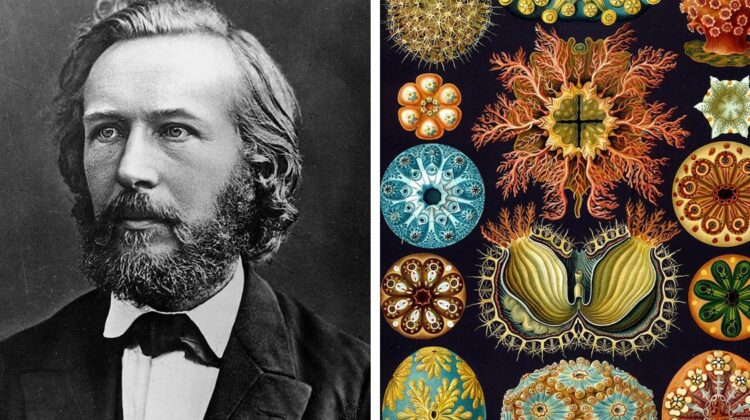
Many scientific publications now are full of detailed images that highlight the delicate elements of plant life, but before photography (particularly macro photography), botanical illustrators and researchers were responsible for recording the interesting forms of flora and wildlife. Ernst Heinrich Haeckel, a German biologist, naturalist, philosopher, and physician, was one of the scientists who used drawings to document his results.
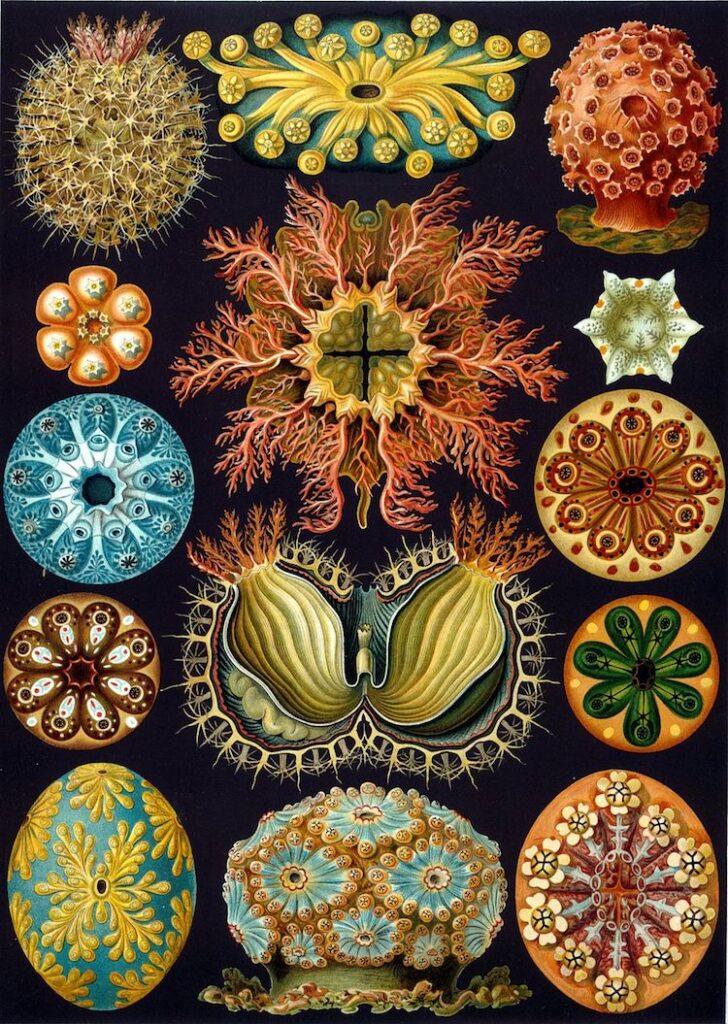
His beautifully colored and highly stylized paintings, watercolors, and sketches from the late 19th and early 20th century show how diverse types of plant life appear under the microscope. Despite the fact that each hand-drawn organism seems like something out of a science fiction novel, Haeckel’s collection of work illuminates the astounding hidden complexity of genuine, natural forms found on Earth.
Who was Ernst Haeckel, and what did he do?
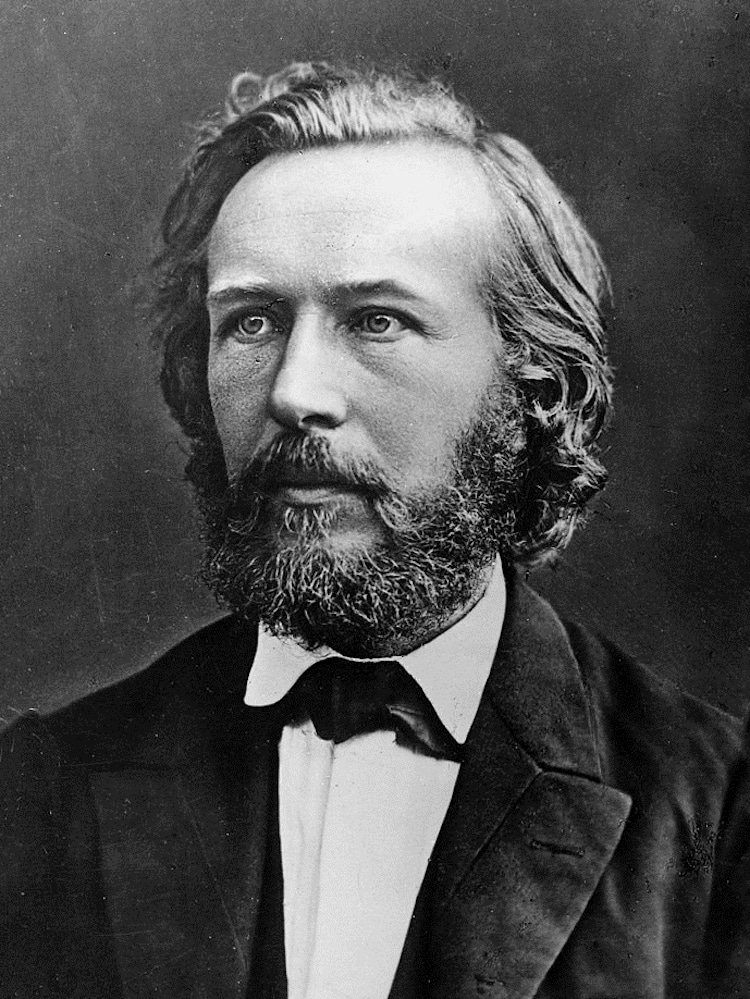
Ernst Haeckel was born in Germany in 1834 and studied medicine at the University of Berlin, graduating in 1857. His lecturer Johannes Müller took him on a summer field trip to investigate microscopic marine animals off the coast of Heligoland in the North Sea while he was a student, igniting a lifelong passion with natural forms and biology.
When Haeckel was 25, he flew to Italy and spent time in Napoli, where he discovered his creative abilities. He proceeded to Messina in the same year to study the structures of radiolarians (microscopic protozoa that produce intricate mineral skeletons). Between 1860 and 1862, he published 59 scientific pictures, together with the original microscope slides.
Art and Science in a Relationship
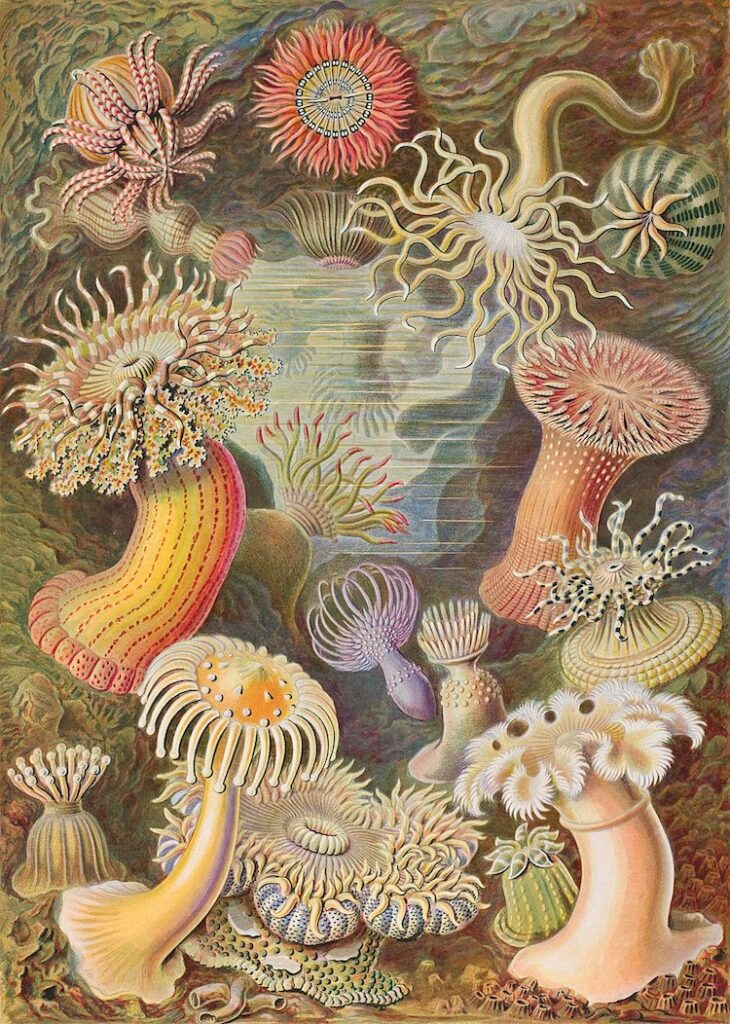
“From the highest mountaintops to the deepest seas,” Haeckel devoted his life studying flora and animals. He not only found, documented, and named thousands of new species, but he also created magnificent pictures that portrayed their shapes. Haeckel’s art, rendered with graphic clarity and subtle colouring, accepted Darwin’s idea of evolution and contributed to educate the public about previously undiscovered tiny species.
Haeckel submitted two folio volumes on radiolarians to Charles Darwin in 1864. Darwin was so taken by Haeckel’s gothic, white on black illustrations that he wrote back to thank him. “[They] were the most amazing paintings I have ever seen,” he stated, adding, “and I am happy to own a copy from the author.”
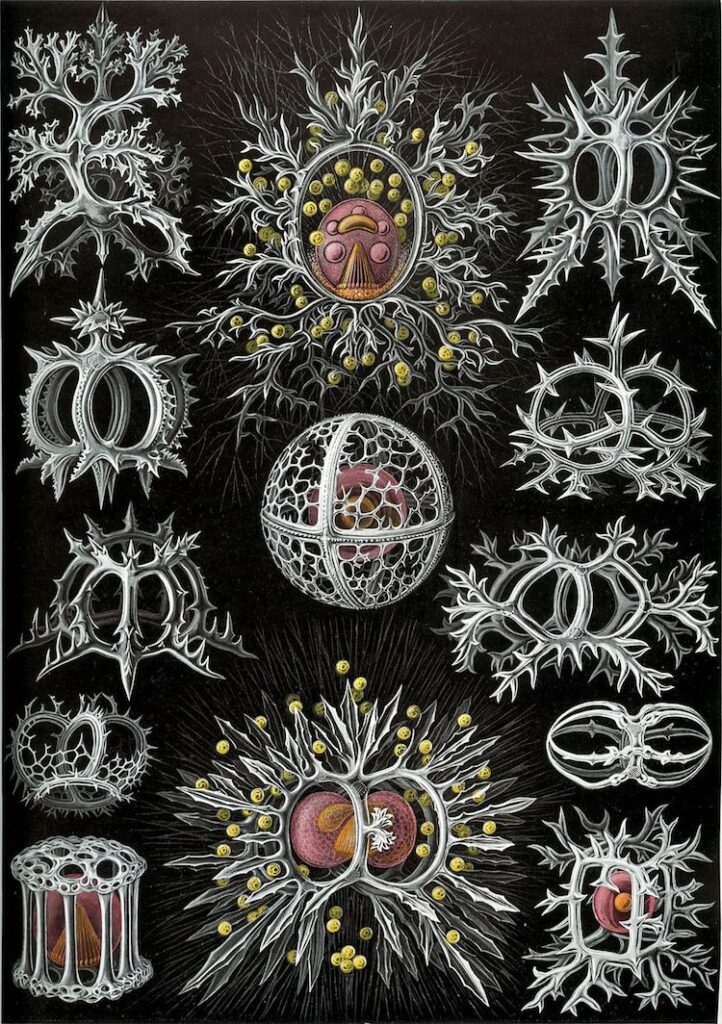
In Germany, Haeckel became a Darwinist advocate. In fact, his book, Natürliche Schöpfungsgeschichte (The History of Creation: Or the Development of the Earth and its Inhabitants by Natural Causes), published in 1868, became the primary source of knowledge about evolution before to the First World War.
His multi-volume work Kunstformen Der Natur (Artforms in Nature) from 1904, which comprises hundreds of extremely detailed drawings that became recognized as a “visual encyclopedia” of living things, is perhaps his most renowned book. Taschen just released a 704-page book titled The Art and Science of Ernst Haeckel to commemorate the series. It includes 450 drawings, watercolors, and sketches from his studies, as well as a collection of 100 prints of various creatures from 1899 to 1904.
Haeckel died in 1908 at the age of 85, but his illustrious legacy lives on in the scientific and artistic realms today. His work not only influenced scientific study, but it also influenced early twentieth-century art, design, and architecture. Haeckel’s botanical images continue to excite and remind us that the natural world is full of surprises and beauty.