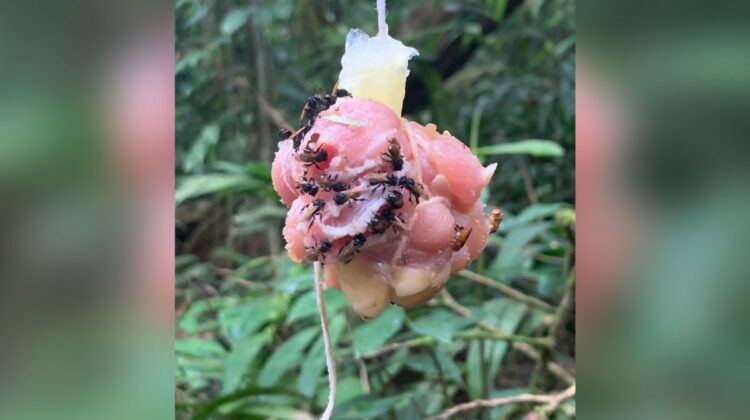
While most bees feed on pollen and nectar, some have developed a taste for rotting flesh, according to scientists.
According to a study published last week in the journal mBio of the American Society of Microbiologists, a stingless tropical bee evolved to have an extra tooth for biting and a gut that resembles that of vultures in order to munch on meat.
What’s the reason? According to study co-author Laura Figueroa, this is most likely due to intense competition for nectar.
“When asked where they can find bees, most people envision fields of wildflowers. While true for almost all species, there is a group of specialized bees, also known as the vulture bees, that instead can be found slicing chunks of meat from carcasses in tropical rainforests,” the authors wrote in the study titled, “Why Did the Bee Eat the Chicken?”
According to the study, only three bee species have evolved to eat meat exclusively, though other species that forage for pollen and nectar may consume animal carcasses when they are available.
Researchers traveled to Costa Rica to study these species, where they hung raw chicken from branches to attract vulture bees.
According to Figueroa, a postdoctoral research fellow at Cornell University, they avoided bullet ants and solved the problem when the chicken was stolen by other animals. Columbia University and the University of California, Riverside researchers also took part.
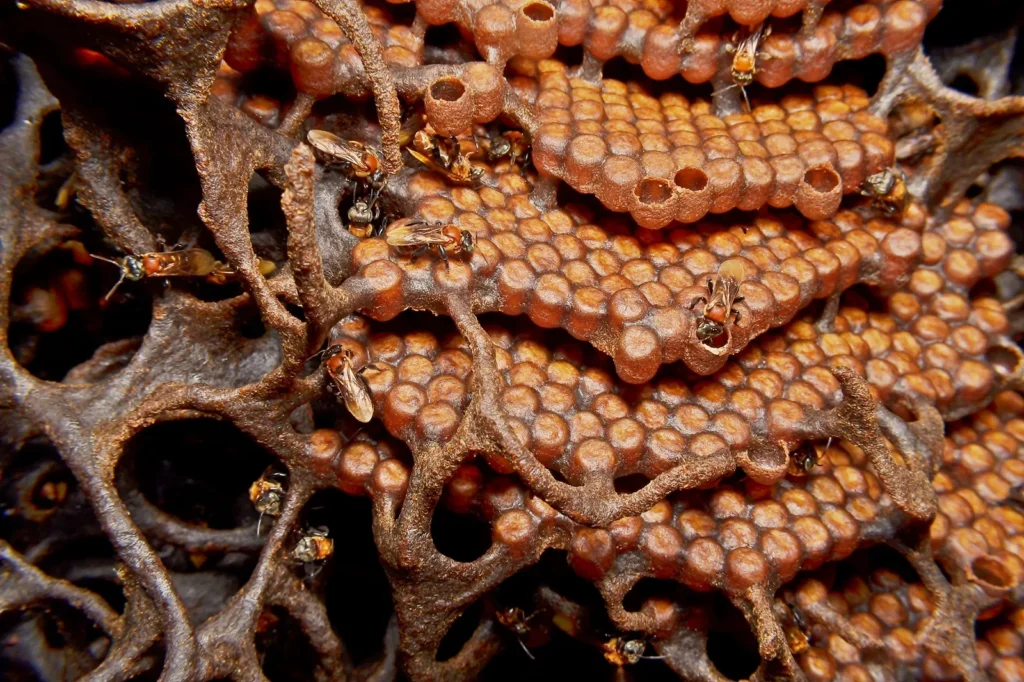
According to the study, while stingless bees collect pollen in small baskets on their hind legs, vulture bees use the baskets to transport their meat.
“They had little chicken baskets,” said Quinn McFrederick, an entomologist at UC Riverside, in a statement.
The bees also preferred fresh meat that was just beginning to decompose and avoided fully rotted meat, according to the researchers.
Further investigation revealed that the vulture bee gut microbiome contains acid-loving bacteria similar to those found in vultures and hyenas, according to Figueroa. Lactobacillus, one of the bacteria types found in vulture bee guts, is also found in fermented foods like sourdough, and Carnobacterium, another bacteria found in vulture bee guts, is associated with flesh digestion.
According to Figueroa, the bacteria protects the bees from pathogens found in rotting meat.
“When we open our fridge, we can tell if something has gone bad. And it will make you sick if you eat it “She stated. “Scavengers have evolved this microbiome and this physiology to deal with that bacteria while still taking advantage of that food source.”
Figueroa claims that vulture bees continue to produce sweet, edible honey, though she has never tasted it.
However, many carnivorous bees are not as sweet. Though they cannot sting, some species can bite and a few “produce blister-causing secretions in their jaws, causing the skin to erupt in painful sores,” according to UC Riverside entomologist Doug Yanega, one of the study’s authors.
Figueroa, on the other hand, thinks the insects are lovely. When she first met the bees in 2015, she immediately “fell in love with them” and wanted to do more research on the species, which was understudied.
“They’re not scary, even if they sound a little scary,” she explained.
She hopes the study will encourage environmental conservation in bee habitats and “get people excited about the diversity of animals in the world.”
The researchers intend to continue studying vulture bee microbiomes in order to document more of the bacteria, fungi, and viruses found in their bodies.
“We still have a lot to learn about these bees,” Figueroa said. “There are a lot of unanswered questions.”
I remember reading something about an observer seeing 🐝 bees nibbling on a discarded hotdog 🌭.. I thought “ naw !! “… a mutation !?