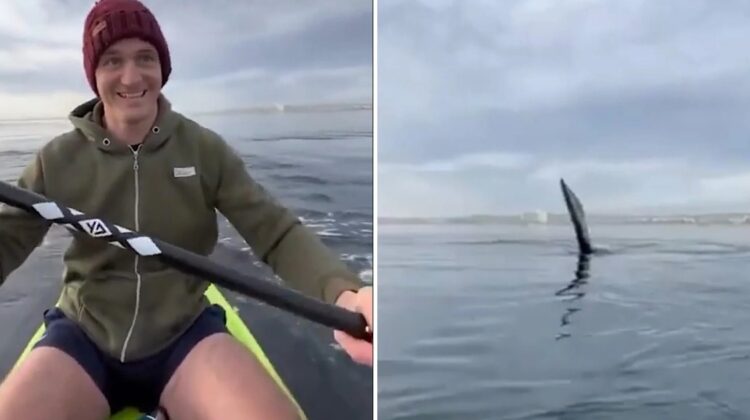
What began as a quiet paddle across open water turned into a moment suspended between awe and instinctive fear.
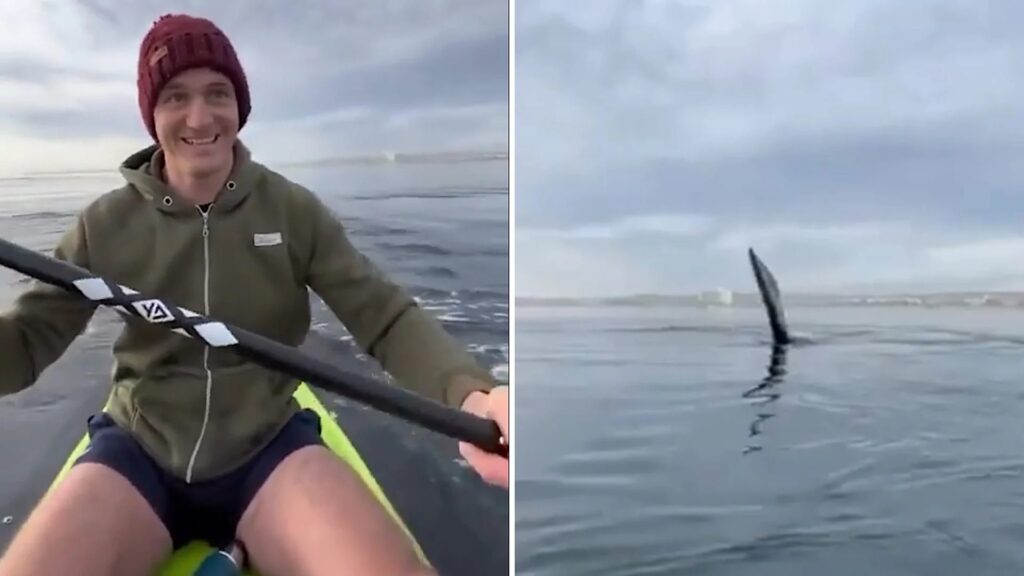
In a viral clip shared to Reddit’s r/StrangeEarth community, a kayaker glides calmly across the surface — until the ocean shifts. Without warning, the massive head of a whale rises just feet from the narrow boat. Water rolls off its dark skin. The scale is staggering. The kayak suddenly looks impossibly small.
Within seconds, more movement stirs below. Additional whales appear to circle nearby, their fins slicing through the surface. The person filming laughs — the kind of laughter that mixes disbelief with adrenaline. The kayaker’s face shows something else: wonder edged with caution.
One commenter captured the collective feeling perfectly: “I would be exhilarated and a little terrified at the same time.”
Encounters like this are rare, but they are becoming more common as human recreation increasingly overlaps with marine habitats. Coastal tourism, kayaking excursions, and wildlife tours place people closer than ever to some of the largest animals on Earth.
Whales are often called “gentle giants,” and many species display curious, non-aggressive behavior toward boats. But they are still wild animals weighing tens of tons. A single accidental movement — a tail flick, a roll, or a sudden dive — can create waves powerful enough to capsize small vessels.
The National Oceanic and Atmospheric Administration (NOAA) generally advises people to remain at least 100 feet away from whales — roughly the length of a football field. In some regions and for certain protected species, the recommended distance is even greater. These guidelines exist not only to protect humans but to reduce stress and disturbance to the animals themselves.
In this case, however, the kayakers did not appear to approach the whales. The whales approached them.
Such behavior is often interpreted as curiosity. Many whale species are highly intelligent, socially complex mammals capable of awareness and spatial precision. They are remarkably adept at navigating around boats without contact. Still, wildlife experts emphasize that remaining calm, avoiding sudden splashing, and not attempting to pursue or touch the animals is critical during close encounters.
Online reactions reflected both fear and reverence.
“Whales are such amazing and beautiful creatures,” one commenter wrote. “Would it be scary? Sure. But what a privilege.”
Imagine kayaking… and suddenly some of the biggest animals on the planet swim up alongside you
by u/MartianXAshATwelve in StrangeEarth
Another noted how aware whales seem of humans — a reminder that in these moments, we are not just observers. We are participants inside their world.
The kayaker likely set out expecting serenity. Instead, they experienced something far rarer: eye-level proximity to one of the planet’s largest living beings.
Exhilaration and fear can coexist. Especially when a giant rises from the deep — and chooses to swim beside you.
Safe whale watching practices are essential for both conservation and public safety. Agencies like the National Oceanic and Atmospheric Administration enforce marine wildlife viewing guidelines designed to minimize disturbance, vessel strikes, and behavioral disruption. Responsible eco-tourism operators follow regulated distance requirements, speed restrictions, and seasonal protections for migratory whale populations. As marine tourism expands globally, education, conservation funding, and sustainable ocean recreation policies remain critical to protecting endangered whale species and maintaining healthy marine ecosystems.
Leave a Reply