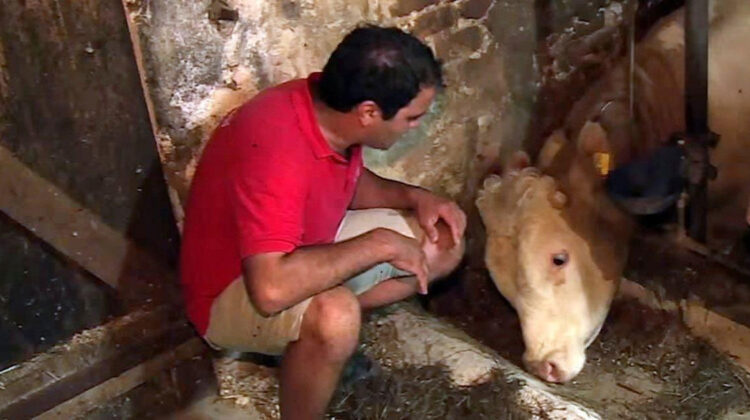
For his entire life, a bull named Bandit knew only a short chain, a concrete floor, and the inside of a narrow stable. The video of the moment that changed has now been watched more than 28 million times.
A Life on a Chain
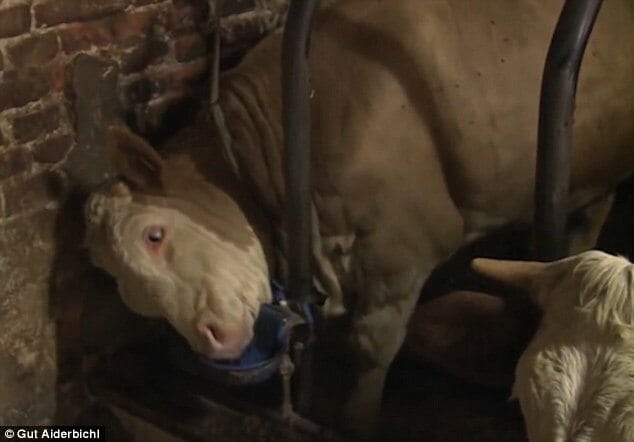
Bandit spent his days tethered to a post in cramped, tethered housing, a system still used on many farms worldwide, unable to go outside, graze on grass, or move more than a step in either direction. Research on farm animal welfare suggests this kind of early-life restriction and stress leaves a real mark: a 2014 study by researchers including Ruã Daros and senior author Daniel Weary, a professor in the Animal Welfare Program at the University of British Columbia, found that dairy calves separated from their mothers, and those who underwent hot-iron dehorning, both showed a measurable pessimistic bias in behavioral testing afterward, consistent with a negative emotional state brought on by early pain and distress.
Christian Steps In
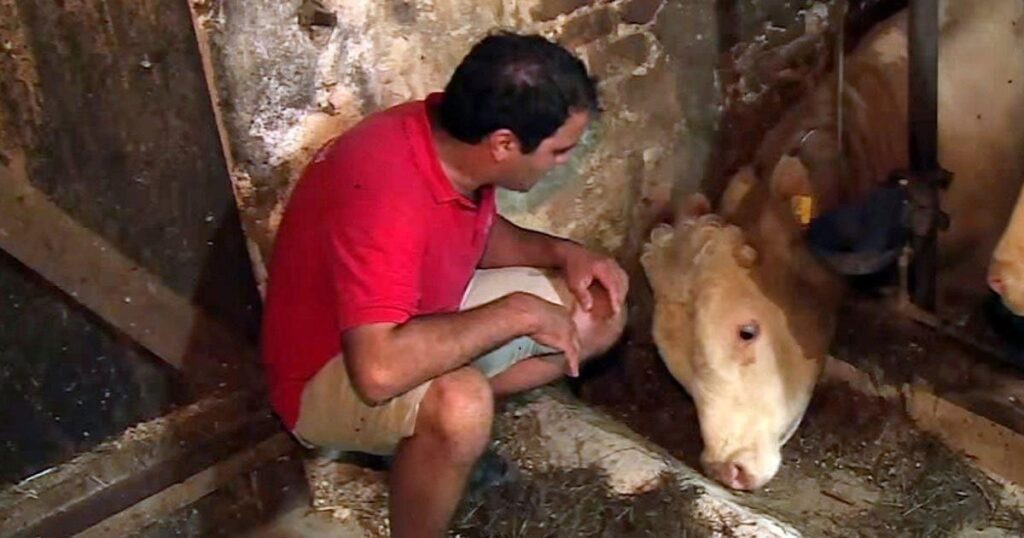
An animal advocate named Christian learned about Bandit’s situation and began working to get him, along with the other animals crowded into the same barn, out and into permanent care. On his first visit, Christian approached slowly, speaking softly and moving carefully so Bandit would understand he wasn’t a threat.
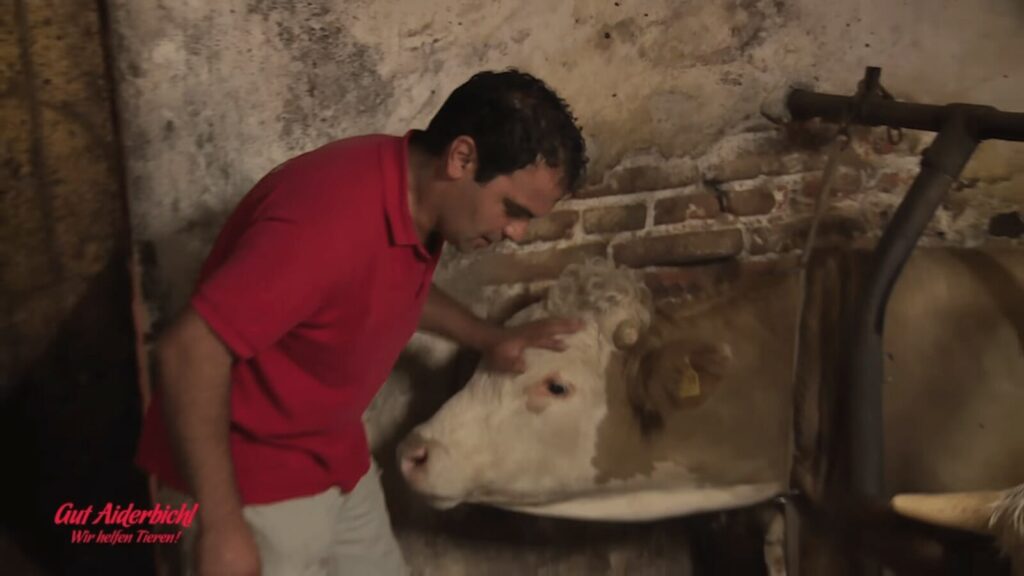
Video of the encounter shows a bull who seems unfamiliar with gentleness from a person. Bandit meets Christian’s eyes and begins softly licking his hand. Christian couldn’t leave him there. He decided, on the spot, to bring Bandit with him.
The Freedom Dance
What happens when Christian finally unchains Bandit and lets him into an open pen has become the video’s signature moment: Bandit kicks up his heels, runs, and bucks in what’s widely been nicknamed his “freedom dance,” a burst of movement from an animal who had likely never had the physical room to do it before. The clip has drawn more than 28 million views on YouTube.
Where Bandit Ended Up
Bandit and the other animals rescued alongside him were brought to Gut Aiderbichl, an Austrian animal sanctuary where Christian volunteers. Founded by German animal rights activist Michael Aufhauser, Gut Aiderbichl is the largest animal sanctuary in Austria and now cares for more than 1,000 rescued animals across multiple locations, including over 500 rescued cows, bulls, and calves. The sanctuary gained international attention in 2011 after Aufhauser purchased Yvonne, a cow who had spent months on the run from authorities in the Bavarian woods after escaping a planned slaughter.
Frequently Asked Questions
Is Bandit still alive at the sanctuary? The original footage and reporting don’t specify a current status; Gut Aiderbichl provides lifelong sanctuary care to its rescued animals.
What is tethered housing? A farming system where cattle are kept chained or tied in place, often with very limited space to move, still legal and used in parts of the world, including some regions of Europe.
How many animals does Gut Aiderbichl care for? More than 1,000 across its network of sanctuaries, including over 500 cows, bulls, and calves.
Sources: Gut Aiderbichl (YouTube); Sunny Skyz; AnimalChannel; Antarctica Journal; Daros, Costa, von Keyserlingk, Hötzel & Weary, “Separation from the Dam Causes Negative Judgement Bias in Dairy Calves,” PLOS ONE (2014); Wikipedia (Michael Aufhauser).
Leave a Reply