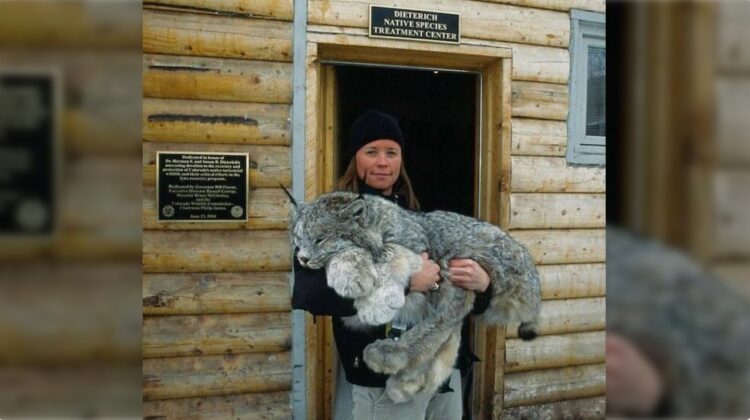
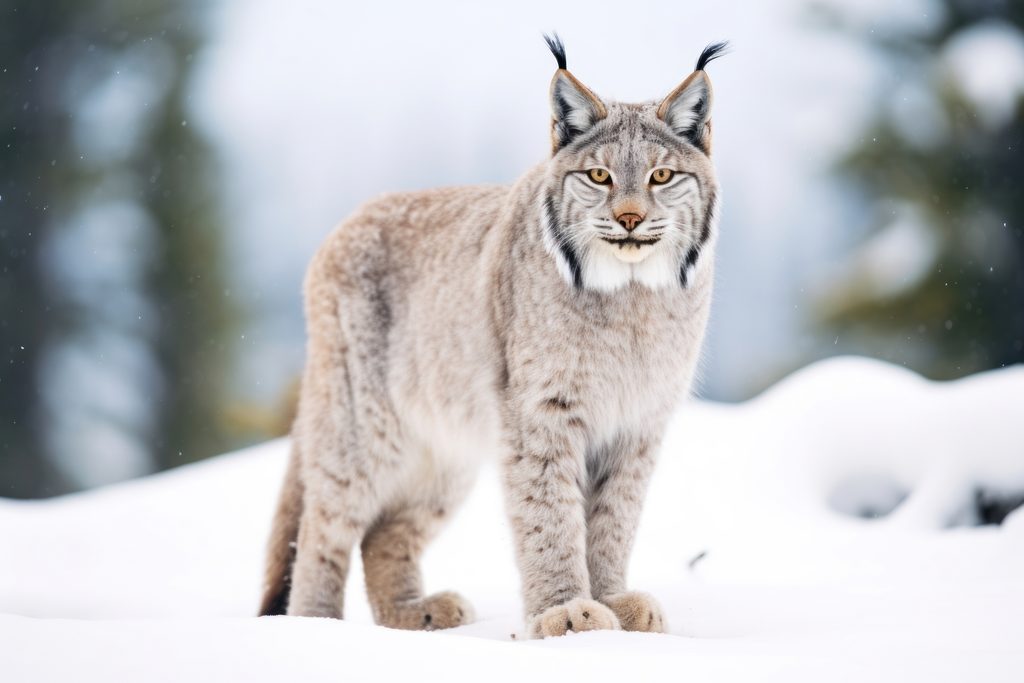
Few North American predators are as rarely seen, or as perfectly built for their environment, as the Canada lynx. Wrapped in thick, pale fur with black-tufted ears and an unmistakable bobbed tail, this elusive wild cat moves through deep snow almost silently — a trick made possible by paws so oversized they function like natural snowshoes, spreading its weight across the surface of the snowpack while other predators sink and struggle.
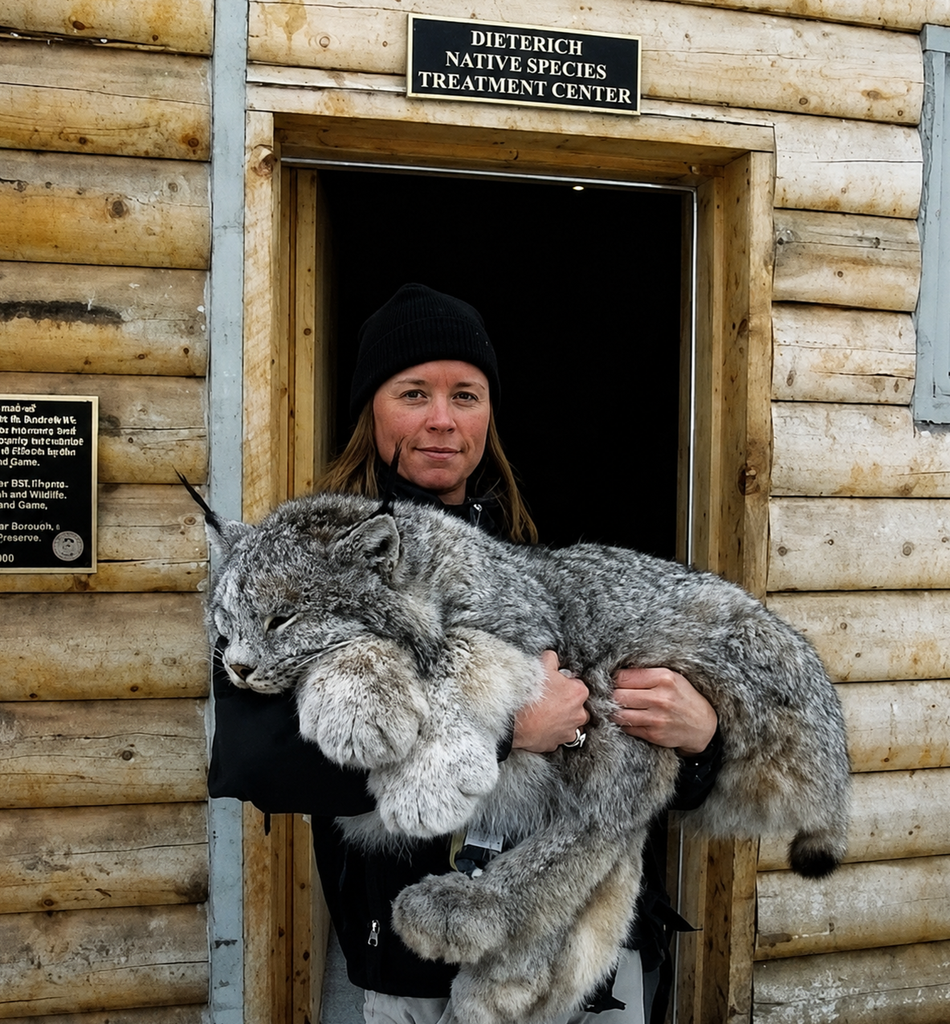
The photo above captures that scale up close: a Canada lynx, sedated for a routine veterinary health check at Colorado’s Frisco Creek Wildlife Hospital and Rehabilitation Center, cradled in a handler’s arms outside the facility’s log building — once known as the Dieterich Native Species Treatment Center. The center’s founder, longtime wildlife rehabilitator Susan Dieterich, later confirmed the cat was perfectly healthy, simply asleep from sedation during a standard checkup — a small but telling glimpse into the ongoing work behind one of the country’s most closely watched wildlife recovery stories.
A Life Built Entirely Around One Prey Animal
Few predators anywhere are as tightly bound to a single prey species as the Canada lynx is to the snowshoe hare. Hares make up the overwhelming majority of a lynx’s diet, and lynx populations rise and fall in a striking, roughly decade-long cycle that tracks hare abundance almost exactly — one of the most well-documented predator-prey relationships in all of wildlife ecology. When hare numbers boom, lynx numbers follow a few years behind; when hares crash, so do the lynx that depend on them.
As mostly nocturnal and crepuscular hunters, lynx rely on patience and stealth rather than speed, stalking through dense boreal forest cover at dawn, dusk, and through the night, when hares are most active and easiest to ambush.
The Facility Behind the Photo
Frisco Creek Wildlife Hospital and Rehabilitation Center has deep roots in Colorado wildlife care. It was founded in 1989 by Susan and Herman Dieterich on a 234-acre ranch, and over the following decades the couple treated thousands of animals — everything from songbirds to moose to black bears — earning a reputation as some of the state’s most respected wildlife rehabilitators. After Herman’s death in 2003, Colorado’s state wildlife agency formally acquired the center in 2004, and it now specializes in large carnivores, with the Canada lynx as one of its central focuses.
Why Colorado Had to Bring the Lynx Back at All
By the late 20th century, Canada lynx had effectively vanished from Colorado, wiped out by unregulated trapping, poisoning campaigns, and large-scale loss of high-elevation forest habitat. In 1999, Colorado Parks and Wildlife launched a reintroduction program, releasing lynx captured in Canada and Alaska into the state’s southern mountains. It remains one of the most closely watched carnivore reintroduction efforts in North America — and facilities like Frisco Creek play a direct role in it, conducting health checks like the one in this photo and supporting the population monitoring that tracks how the reintroduced cats are faring today.
Frequently Asked Questions
Was the lynx in the photo injured? No. It was sedated for a routine health check, not treated for an injury — the center’s founder confirmed the animal was healthy.
Are Canada lynx dangerous to humans? Lynx generally avoid human contact and aren’t considered a threat to people. Handlers only get this close when the animal is sedated for veterinary purposes, as in this photo.
Is the Canada lynx reintroduction program still active in Colorado? Yes. Colorado Parks and Wildlife continues to monitor the state’s lynx population, which has shown established breeding activity in the decades since the program began in 1999.
What do Canada lynx eat besides snowshoe hares? While hares make up the bulk of their diet, lynx will also take grouse, small rodents, and occasionally larger prey like deer when hare populations are low.
Sources consulted: Mud ‘n Feathers, “Dieterich Native Species Treatment Center”, Neatorama, “That’s a Big Kitty!”, Colorado Parks and Wildlife.
Was the lynx in the photo actually injured? No. It was sedated for a routine health check, not treated for an injury — the center’s founder confirmed the animal was healthy.
Are Canada lynx dangerous to humans? Lynx generally avoid human contact and are not considered a threat to people. Handlers only approach them directly when the animal is sedated for veterinary purposes, as in this photo.
Is the Canada lynx reintroduction program still active in Colorado? Yes. Colorado Parks and Wildlife continues to monitor the state’s lynx population, which has established breeding activity in the decades since the program began in 1999.
What do Canada lynx eat besides snowshoe hares? While hares make up the bulk of their diet, lynx will also take grouse, small rodents, and occasionally larger prey like deer when hare populations are low.
Sources consulted: Mud ‘n Feathers, “Dieterich Native Species Treatment Center”, Neatorama, “That’s a Big Kitty!”, Colorado Parks and Wildlife.
Leave a Reply