A new scientific analysis has concluded that decades of climate change, not simple geological bad luck, helped set the stage for the glacier collapse that unleashed catastrophic flooding across Nepal and Tibet in late August — a disaster that has killed more than 1,300 people, with thousands still missing.
What Happened On August 26
The disaster began with a rare rock avalanche on the north face of Langtang Lirung mountain, which triggered the simultaneous collapse of a large section of glacier — together totaling roughly 110 million cubic meters of rock and ice, an amount researchers compared to the volume of about 44,000 Olympic swimming pools. The mass plunged roughly 1,400 meters (around 4,600 feet) down to the valley floor, an impact that released as much energy as a magnitude 5.2 earthquake.
As it crashed into the valley, the debris tore loose buried glacier ice and picked up additional water and sediment, adding tens of millions more cubic meters to the resulting flood. Within about seven minutes, the surge had traveled roughly 20 kilometers (12 miles) downstream to the Nepal-China border, moving at an average speed of around 170 kilometers per hour (106 mph), before continuing onward for some 200 kilometers over the following hours. Researchers describe an event of this scale as extraordinarily rare, estimating that a rock avalanche this large occurs only once every 1,000 to 10,000 years.
Tracing The Cause Back To A Warming Climate
Rather than pointing to a single trigger, researchers from World Weather Attribution (WWA) — an international scientific collaboration that studies the role of climate change in extreme weather events — described the collapse as the result of several compounding, climate-linked factors building over decades.
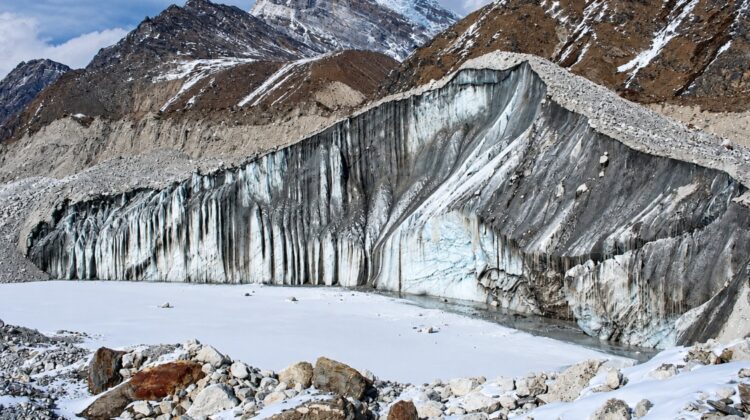
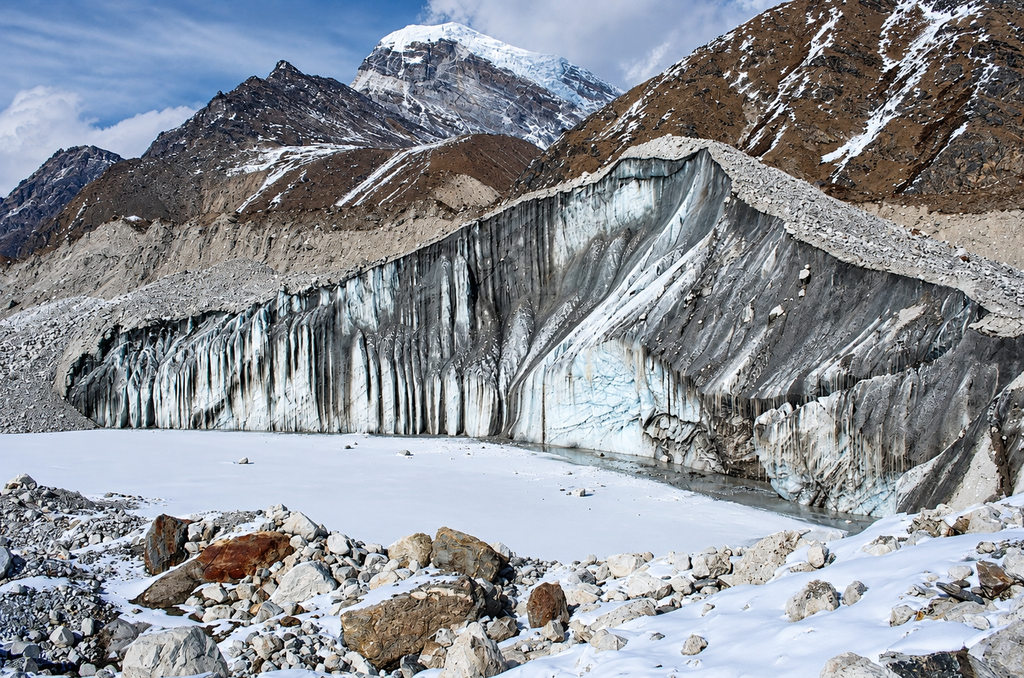
Chief among them: rapid glacier thinning. Near the failure site, the edge of the glacier retreated just 75 meters between 1964 and 2000, but that pace accelerated dramatically between 2010 and 2026, retreating an additional 373 meters — stripping away ice that had been physically supporting the rock wall above it.
At the same time, permafrost — permanently frozen ground that helps bind rock, sand, and soil together — has been thawing at the elevations most sensitive to warming, roughly between 4,500 and 5,500 meters. “Thawing permafrost reduces the rock strength and allows more water to penetrate into the slope,” said Walter Immerzeel, a mountain hydrologist at Utrecht University and a co-author of the analysis, who described the overall event as “an unprecedented disaster” in the Himalayas.
Unusually heavy snowfall the previous October and November — typically a dry stretch for the region — added another layer of risk once temperatures climbed. July and August 2026 were the hottest ever recorded locally, generating large volumes of meltwater that likely further weakened the slope in the days before it gave way. Researchers found that temperatures in the region were running roughly 5°C (9°F) above the 30-year average in the days leading up to the collapse.
Dr. Friederike Otto, a climatologist at Imperial College London and one of the study’s authors, was direct about the connection: “There’s absolutely no doubt that human induced climate change played a role here in the preconditioning of the disaster through permafrost thawing, through thinning of the glaciers, through having more rainfall instead of snow.”
A Warming Region
The WWA analysis found the area around Langtang Lirung is now roughly 2°C warmer than it was in preindustrial times, with the Himalayas’ freezing line — the elevation above which temperatures reliably stay below freezing — having risen by about 100 meters per decade since the 1980s. That shift means ground that once stayed frozen year-round now thaws for longer stretches, steadily raising the odds of instability across steep mountain terrain throughout the region.
The Human Toll
The flood destroyed homes, roads, bridges, and entire settlements, cutting off survivors from essential services in its immediate aftermath. Total losses from the disaster are now estimated at around $5 billion. Researchers and officials have also pointed to a broader injustice underlying the tragedy: the communities hit hardest had contributed almost nothing to the emissions driving the warming behind it.
“Communities in Nepal are paying with their lives for a crisis driven by fossil fuel emissions thousands of miles away,” Otto said.
Nepal Seeks International Support
Nepal has formally requested assistance from the United Nations’ loss and damage fund, a mechanism designed to help countries cope with irreversible climate-related destruction. Applications to the fund typically depend in part on demonstrating a scientific link between a specific disaster and a shifting climate — making attribution studies like this one directly relevant to Nepal’s case.
The country’s foreign minister, Shisir Khanal, has called on major greenhouse gas emitters, including China and India, to take greater responsibility for disasters like this one.
Madhab Uprety, senior technical advisor for the Red Cross Red Crescent Climate Centre, which contributed to the WWA analysis, framed the disaster as part of a broader pattern of climate injustice: “In addition to the human tragedy on an unimaginable scale, the cost of recovery for this disaster is substantial. For a nation that’s done virtually nothing to contribute to this problem, it underlines the need to find fairness in helping climate vulnerable nations cope with the problems they have not unleashed.”
Frequently Asked Questions
Did climate change directly cause the Nepal glacier collapse? Researchers stopped short of saying warming alone caused the collapse. Instead, their analysis found that rising temperatures, glacier thinning, and permafrost thaw combined over decades to destabilize the slope, making a collapse significantly more likely.
How many people were affected by the disaster? More than 1,300 people were confirmed killed, with thousands still reported missing as of mid-September, and total damages estimated at roughly $5 billion.
How rare is an event like this? Extremely rare. Researchers estimate that a rock avalanche of this scale occurs only once every 1,000 to 10,000 years in this type of terrain.
What is World Weather Attribution? It’s an international collaboration of climate scientists that uses peer-reviewed methods to assess how much of a role climate change played in specific extreme weather and disaster events.
What is Nepal seeking from the international community? Nepal has formally requested support from the United Nations’ loss and damage fund, which is designed to help countries recover from climate-linked disasters, and its foreign minister has called on major emitting countries to take greater responsibility.
Sources: Inside Climate News, Reuters, Dhaka Tribune, and The Guardian, cited above.
Leave a Reply