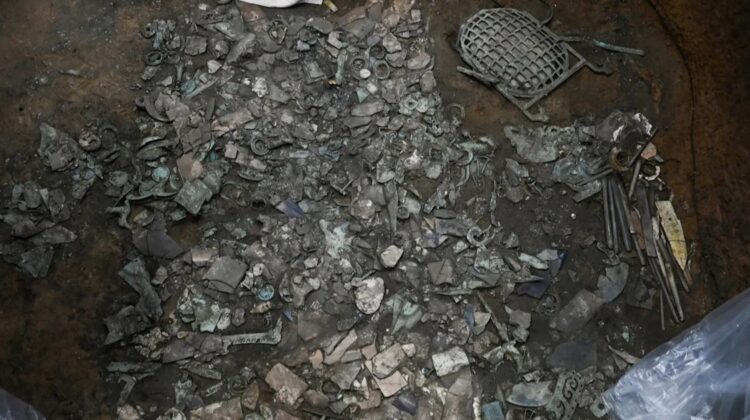
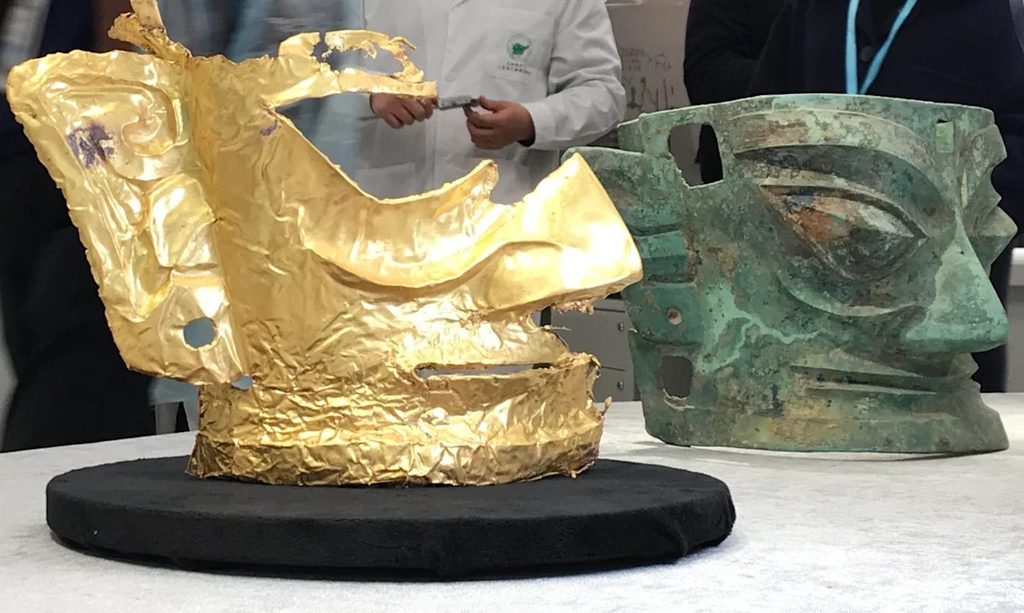
The strange, striking relics unearthed at China’s famed Sanxingdui site have long invited wild speculation, with some fringe forums and tabloids even floating the idea of alien artifacts. A newly confirmed discovery from the site won’t settle those rumors — because in a very literal sense, part of it really did come from outer space.
A Mysterious Object From Pit No. 7
Sanxingdui, located in Guanghan in China’s Sichuan Province, is believed to be the remains of the ancient Shu Kingdom, with the broader site dating back roughly 4,500 to 3,000 years. The location includes a palatial zone, production areas, and a series of sacrificial pits that have yielded an extraordinary range of bronze masks, figurines, and other ritual objects since excavations began.
In 2021, archaeologists working in the site’s Pit No. 7 spotted a long, corroded object standing upright at the bottom of the pit — roughly 20 centimeters long and 5 to 8 centimeters wide, badly deteriorated and shaped like an axe or halberd. Given its fragile condition, the team opted to extract the object along with the surrounding block of soil, transporting the entire section to a laboratory for careful study.
Confirmed: It Came From Space
A team led by archaeologist Haichao Li of Sichuan University, along with researchers from the Sichuan Provincial Cultural Relics and Archaeology Research Institute, published their findings on the object — now catalogued as K7QW-TIE-1 — in the journal Archaeological Research in Asia.
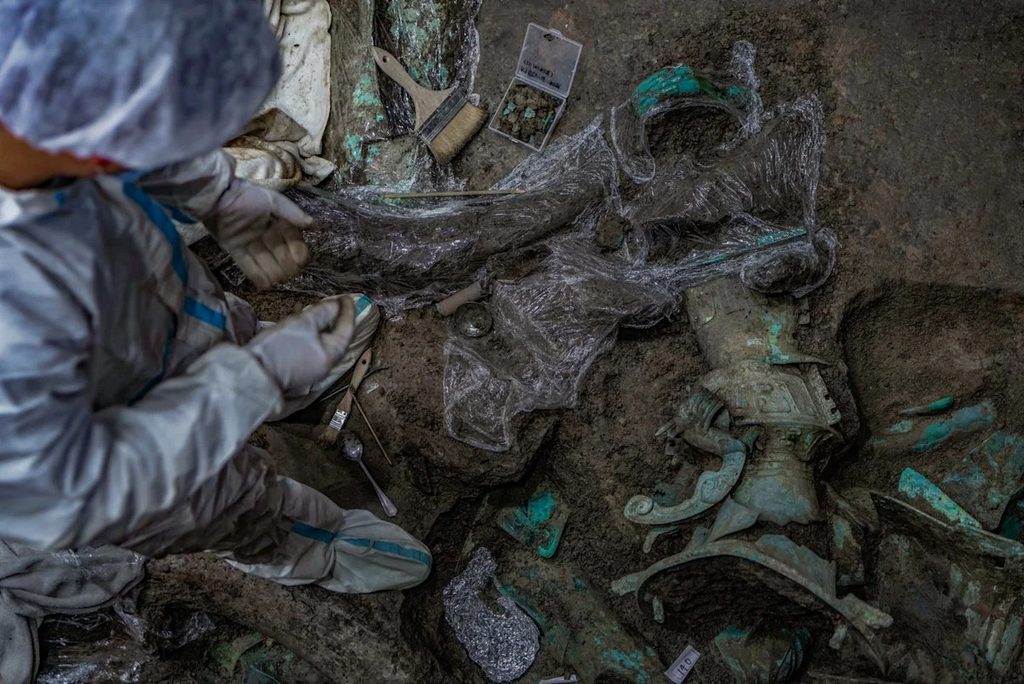
Metallographic examination showed no evidence of significant cold-working, and X-ray fluorescence testing revealed the object was composed of more than 90% iron and roughly 7.4% nickel, with that nickel distributed evenly throughout the object in a pattern highly unusual for artifacts of this era — since China had not yet developed iron-smelting technology by the time the object was made. That specific composition and structure led researchers to conclude the object had been crafted from meteoric iron: metal that arrived on Earth embedded in a meteorite.
“As the earliest Bronze Age meteoritic iron artefact found in Southwest China,” Li’s team wrote, “it fills a critical gap in the region’s metallurgical records and provides new insights into early iron use both regionally and globally.”
Rare Company
The discovery places K7QW-TIE-1 in a very small group. Meteoric iron artifacts have turned up in various sites around the world, but only 13 have ever been found in China, mostly concentrated in the country’s northern regions. The oldest previously known example, a knife found in a cemetery in Xinjiang, dates to around 3000 B.C.E. — but the Sanxingdui axe now holds the distinction of being the oldest meteoric iron object ever found in Southwest China.
The two objects share another rare trait. While the other 11 known Chinese meteoric iron artifacts combine iron with bronze, only the Xinjiang knife and the Sanxingdui axe are monometallic, made entirely from meteoric iron with no bronze mixed in — a detail researchers say points to genuinely distinct metallurgical traditions developing in Southwest China, separate from practices in the Central Plains region.
A Practical Tool, Or A Sacred Object?
What researchers still can’t say for certain is exactly what the object was used for. It’s possible it simply served as a practical tool. But its placement inside a sacrificial pit at Sanxingdui — deliberately positioned vertically at the bottom of the pit’s eastern wall — strongly suggests it carried ritual significance beyond ordinary use.
The object itself bears no decorative markings or symbols that might confirm religious purpose. Still, researchers note that metal of celestial origin was used to craft ritual objects elsewhere in the ancient world, including in Egypt and Anatolia, making it plausible that the object’s origin in the sky held similar symbolic weight for the people of Sanxingdui. Whether the axe played a direct role in the site’s elaborate rituals, or was even used to help craft the bronze masks that clearly carried ceremonial meaning, remains unknown.
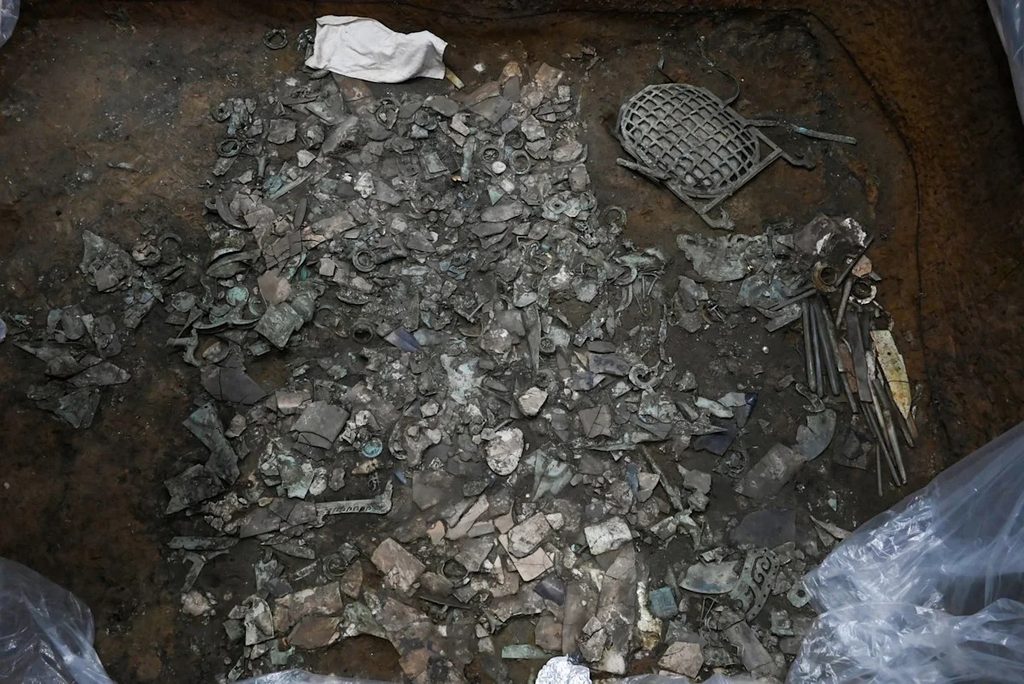
Researchers say future excavation and analysis at the site should help place the object more precisely within Sanxingdui’s broader archaeological context — even as the discovery itself deepens rather than resolves the enduring mysteries surrounding the site’s sacrificial pits.
Frequently Asked Questions
What is meteoric iron, and why is it significant here? Meteoric iron is metal that arrives on Earth already embedded in a meteorite, distinct from iron smelted from terrestrial ore. Its presence in this Bronze Age artifact is significant because China had not yet developed iron-smelting technology at the time the object was made, making this a rare early use of iron sourced directly from space.
How did researchers confirm the object was made from meteoric iron? Metallographic and X-ray fluorescence analysis showed the object was composed of more than 90% iron and roughly 7.4% nickel, with the nickel distributed evenly throughout in a pattern characteristic of meteoric metal rather than terrestrial iron ore.
How rare is this kind of discovery? Extremely rare. K7QW-TIE-1 is only the 13th confirmed meteoric iron artifact ever found in China, and it holds the distinction of being the oldest such object discovered in Southwest China specifically.
What was the object likely used for? Researchers aren’t certain. Its axe-like shape suggests it could have functioned as a practical tool or weapon, but its deliberate placement within a sacrificial pit suggests it may have held ceremonial or ritual significance instead.
Does this discovery support claims that Sanxingdui artifacts are extraterrestrial in origin? No. While the metal itself originated in outer space as part of a meteorite, the object was crafted by human hands using Bronze Age metalworking techniques — the study offers no evidence supporting broader “alien artifact” theories associated with the site.
Sources: ScienceAlert, Archaeology magazine, The Debrief, and World Archaeology, cited above.
Leave a Reply