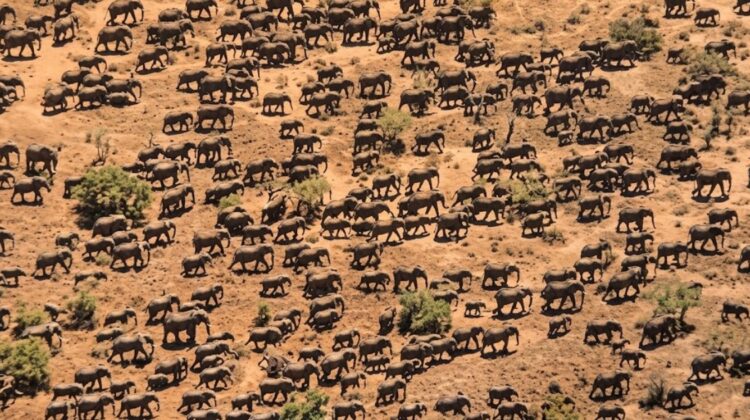
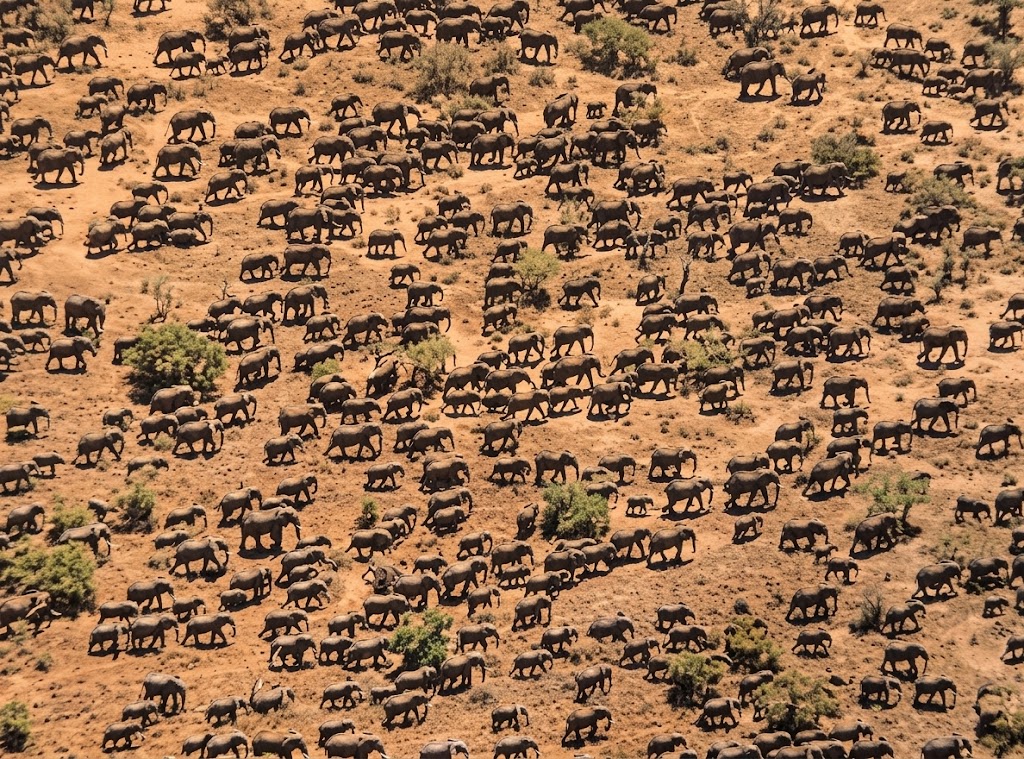
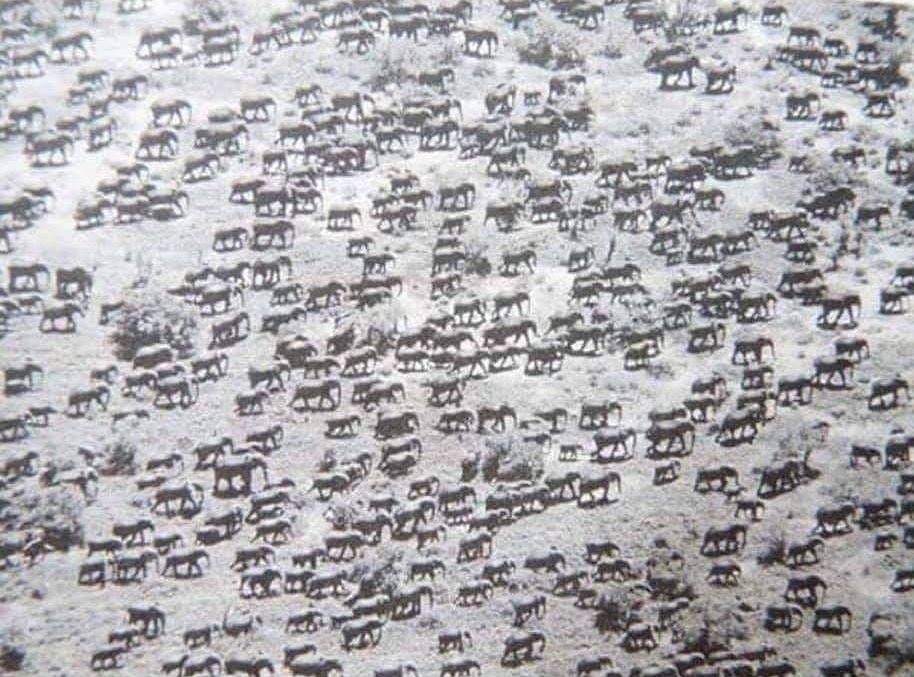
If you close your eyes for a moment and travel back in time to the plains of Tsavo, Kenya, in the 1950s, you wouldn’t just see the scene—you would feel it. The earth trembling beneath the feet of hundreds of “red elephants,” and a massive cloud of orange dust rising to embrace the savanna horizon. These “super-herds” marched in perfect harmony, a majestic army guided by the wisdom of the oldest matriarchs.
But open your eyes and return to the present; those heavy footsteps have quieted, and the dust has settled. This historical photograph is no longer just a beautiful snapshot. It has become an elegy for a world we have lost, and a stark testament to the rapid, irreversible changes humanity has inflicted on the natural world.
The Fall of the Ivory Empire
In the past, barriers were alien to the African plains. Elephants gathered by the hundreds in a complex, deeply ingrained social phenomenon. Different families would merge to exchange greetings, share generational knowledge, and navigate migration routes carved into their genetic memory for millennia.
However, the winds of change blew harshly during the 1970s and 1980s. Drought was not the only enemy; human greed took center stage. The fever for “white gold” (ivory) led to horrific poaching massacres. The tragedy was not merely in the plunging population numbers, but in the assassination of memory. Poachers specifically targeted the oldest and largest females—the herd leaders carrying the maps of survival, safe routes, and hidden water sources in their minds. With their loss, families scattered in terror, and the intricate social structure that allowed for these massive gatherings completely collapsed.
The Siege of Geography and Climate
Today, even if elephants attempted to gather in such staggering numbers, the modern landscape simply no longer permits it.
- Concrete and Iron Fences: Open corridors have been replaced by physical barriers. Cities have encroached, agriculture has expanded, and highways and railways have sliced through the heart of the savanna. Massive nature reserves have been turned into isolated “islands,” heavily besieged by human activity.
- Scarcity of Resources: With the escalating severity of climate change, droughts have become significantly longer and more brutal. For hundreds of massive elephants to gather in one area today would mean the immediate depletion of incredibly scarce water and limited vegetation. Dispersing into smaller, fragmented groups is no longer a choice, but an absolute necessity for survival.
“The loss of biodiversity is not measured solely by the extinction of species, but by the extinction of the grand natural behaviors that once defined the spirit of the wild.”
A Mirror to the Future
When we look at that rare photograph from the 1950s, we are not just looking at the past; we are looking at a glaring warning for the future. It raises a fundamental question about our ability to coexist with nature, and whether we are willing to make the necessary compromises to ensure that Earth’s greatest creatures do not become mere faded images in historical archives.
Elephants still walk in Tsavo today. But they walk with extreme caution, scattered, and in silence—navigating the shadows of a world that no longer has the space to accommodate their ancient grandeur.
Leave a Reply