
It’s an unfortunate truth, but a truth nonetheless: if you own a house, you will be sharing it with some unwanted guests.
Before you panic, I’m talking about insects, not strange people who might have taken up residence in your crawlspace. More specifically those insects too small for you to notice, pick up, and carry outside. I’ll be frank, I’m not a ‘bug person’, and so the idea of living communally with ants, spiders, and earwigs – as well as anything else that happens to want to wander in – is drastically unappealing.
That said, it’s unavoidable. I’m sure they don’t see it as a planned home invasion. Or at least I hope they don’t. That would be weird.
In any case, I’ve grown to tolerate the majority of insects that are effectively squatting within my walls. That said, I draw the line, totally and unequivocally, at ticks.

Would all those present raise their hand if they love ticks? See, I’m willing to bet that almost 100% of hands stayed down. Ticks are truly among the nastiest, most easy-to-dislike insects, known for carrying diseases and spreading like… well, like the plague.
Which is why it’s of paramount importance that you know how to identify clutches of tick eggs, and what you should do if and when you find them in your backyard. Luckily for you, we’ve compiled a handy sheet of information that will in all likelihood answer the most pressing questions you have.
Identifying
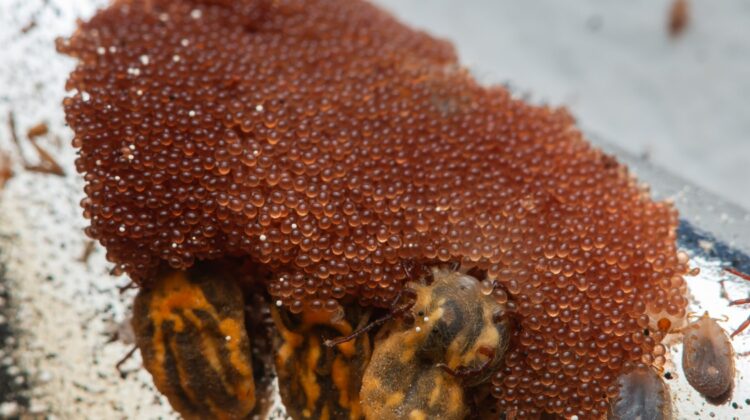
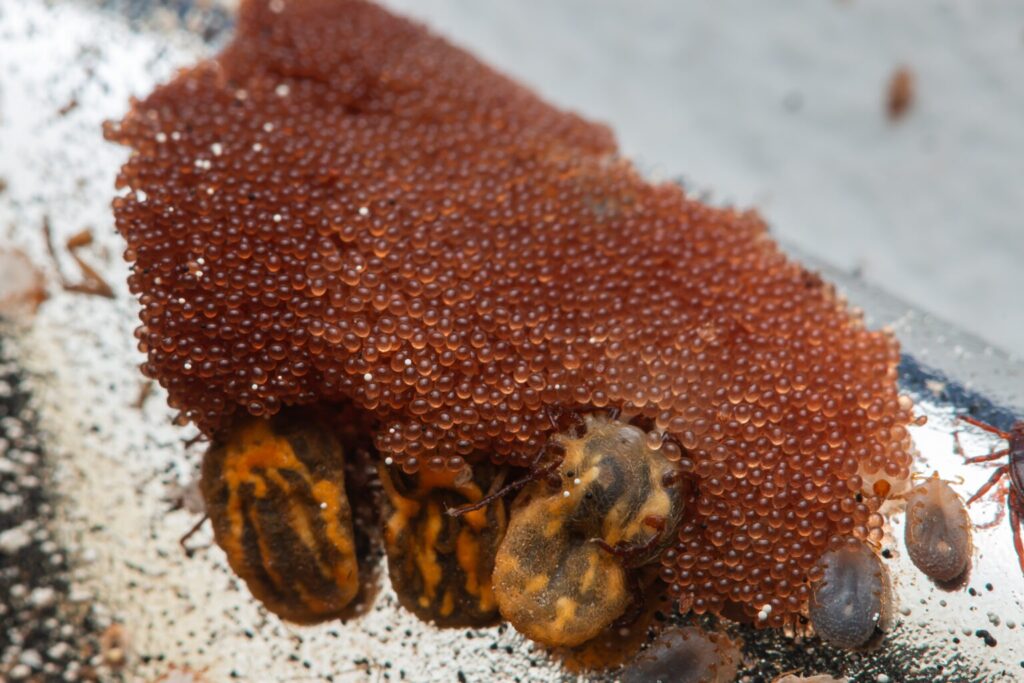
Tick eggs are roughly the size of a poppy seed, making them extremely small to the human eye (roughly 0.5mm in diameter). They’re usually oval or pear-shaped, with a translucent appearance, and are often laid in clusters clinging to vegetation, leaf litter, or other surfaces close to the ground.
The eggs will become more opaque as they mature, and are typically smooth and glossy in texture, ranging in color from pale yellow to light brown.
What to do
So, you’ve stumbled upon a clutch of suspected tick eggs and you’re running around the house screaming in panic. Oh, wait a second, that’s just me.
In all seriousness, tick eggs can pose a serious problem, and given the fact that ticks are known to carry such diseases as Rocky Mountain Spotted Fever and Lyme Disease, it’s best you dispose of the eggs in a safe manner.
To that end, we recommend you always consult with a professional pest control expert or local veterinarian for proper identification and guidance on the next steps.
Let’s be honest, none of us want to find tick eggs in our backyard, front-yard, or any other yard we might have. Which is why it can be good to know the appropriate steps to minimize the risk of them being there in the first place.
You can take proactive steps such as removing plants that attract deer – ticks are known to thrive on deer – such as tulips, hostas, and azaleas. You can also plant tick-repelling plants and herbs, including mint, rosemary, and chrysanthemums.

It’s also advised that you keep your law mowed and do your best to eliminate bush cover. Keep any wood piles off the ground, too, as ticks like dark, moist spaces in which to lay their eggs.
Using natural tick repellents and actively keeping small mammals such as mice and rabbits out of your garden will also help! The application of insecticides is another precaution you might take, though you should always proceed with caution so as not to destroy the ecosystem.
Did you know anything about tick eggs? Share this article if you think it might help your family and friends.
Leave a Reply