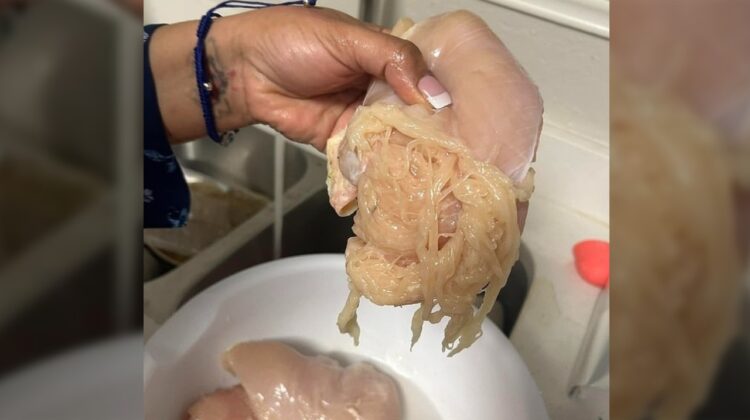
A mother’s viral social media post has sparked widespread discussion after she discovered an unusual chicken breast that appeared to fall apart into string-like fibers while preparing dinner for her family.
The woman, Alesia Cooper from Texas, shared photos showing raw chicken that separated into thin strands while she was washing it before cooking. Surprised by its appearance, she questioned whether the product might be “fake meat.”
However, food experts say the unusual texture is most likely a condition known as “spaghetti meat,” a naturally occurring muscle abnormality that affects a small percentage of commercially raised chickens.
What Is “Spaghetti Meat”?
“Spaghetti meat” is the name researchers use to describe chicken breast tissue that separates into long, soft strands resembling cooked spaghetti. Unlike normal chicken muscle, the fibers become loose and stringy, making the meat appear unusually soft and fragile.
Scientists believe the condition is linked to the rapid growth of modern broiler chickens, which have been selectively bred over decades to develop larger breast muscles in a much shorter period of time.
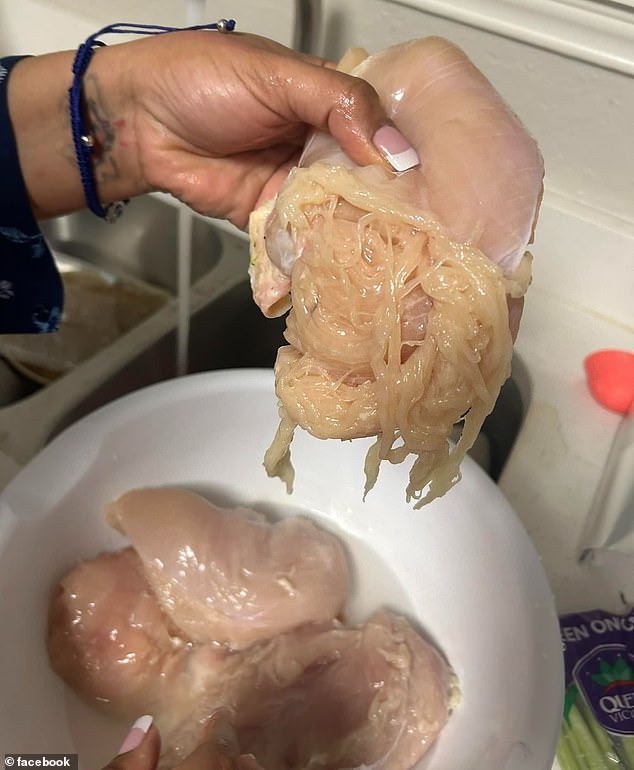
According to researchers, when muscle tissue grows faster than the bird’s circulatory system can adequately supply oxygen and nutrients, the muscle fibers may weaken and begin separating, producing the distinctive string-like texture.
Is It Safe to Eat?
Food scientists emphasize that spaghetti meat is generally considered safe to eat. The condition primarily affects the texture and appearance of the meat rather than its food safety.
Chicken with spaghetti meat may feel softer than normal and can have a slightly chewier or less desirable texture after cooking, but it does not indicate that the meat is artificial or contaminated.
Why Is It Becoming More Common?
Over the past several decades, commercial chickens have been bred to reach market weight much faster than in previous generations.
Industry data show that modern broiler chickens now reach significantly heavier weights at approximately the same age compared with birds raised decades ago. While this has improved production efficiency, researchers say rapid muscle growth has also contributed to muscle conditions such as spaghetti meat and another well-known abnormality called “woody breast,” in which chicken breast becomes unusually hard and tough.

Several scientific studies have associated these muscle disorders with fast-growing poultry breeds, prompting ongoing research into animal genetics, nutrition, and farming practices.
Some food companies have responded by sourcing slower-growing chicken breeds, arguing that improved animal welfare and slower development may also result in better meat quality and texture.
Growing Consumer Awareness
As unusual images continue circulating on social media, food experts encourage consumers to understand that naturally occurring muscle abnormalities can sometimes alter the appearance of poultry without affecting its safety.
Nevertheless, shoppers who notice an unusual odor, discoloration, or signs of spoilage should avoid consuming the product and contact the retailer if they have concerns.
Understanding Modern Food Production
Advances in agricultural science have dramatically increased food production over the past century, helping meet growing global demand. At the same time, researchers continue studying how genetics, nutrition, animal welfare, and farming practices influence both meat quality and consumer expectations. Increased transparency about food production allows consumers to make more informed choices while encouraging ongoing improvements throughout the poultry industry.
Leave a Reply