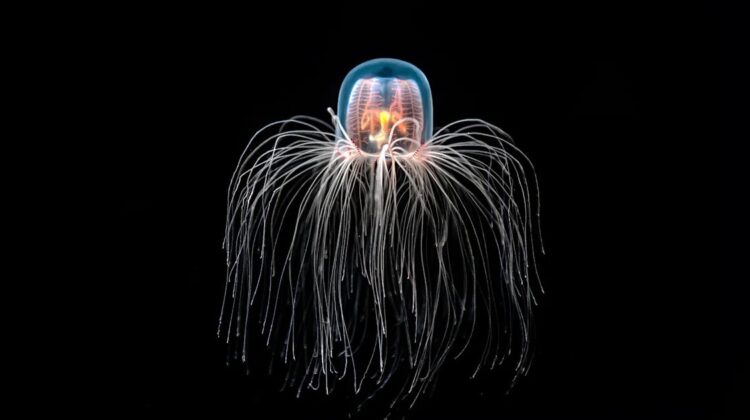
Most animals get one shot at life: grow up, grow old, and eventually die. One jellyfish, barely the size of a pinky nail, appears to have found a loophole.
Meet the “Immortal Jellyfish”
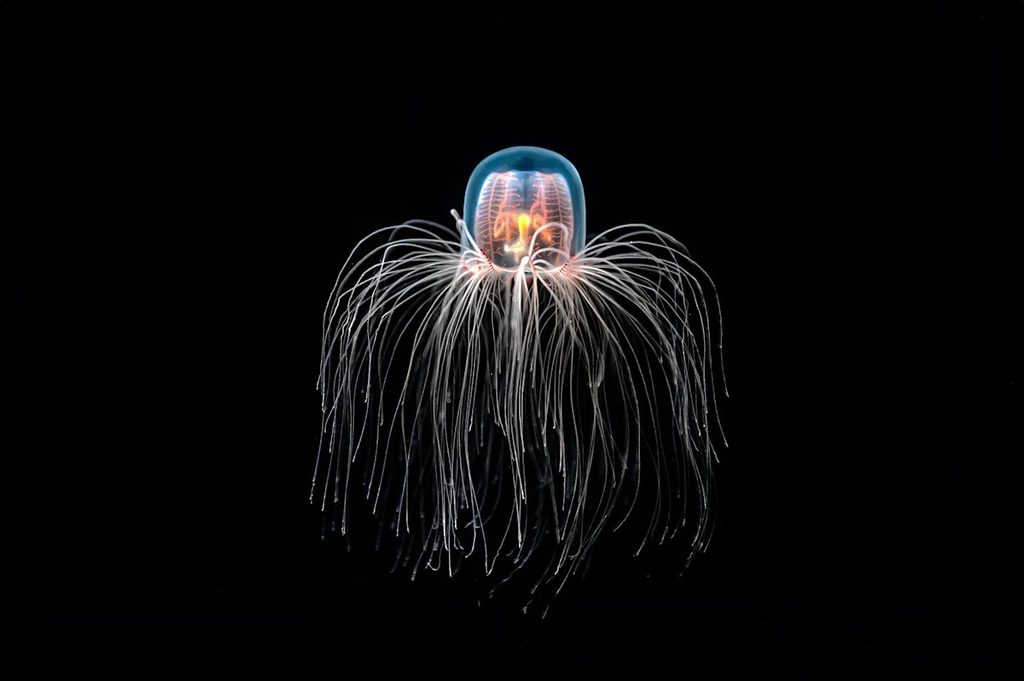
Turritopsis dohrnii was first described from the Mediterranean Sea in 1883, but its most remarkable trait wasn’t documented until over a century later, in 1992. When the jellyfish is injured, starving, or otherwise under severe stress, it can trigger a process called transdifferentiation: its fully mature adult cells essentially reset, converting back into an earlier, more basic cell type. Its entire body then reorganizes itself back into a polyp — the juvenile stage of its life cycle — and effectively starts over.
It’s the same individual animal, biologically speaking, beginning a new life cycle rather than dying of old age.
Watched Happening, Repeatedly, in a Lab
This isn’t a one-time trick. Japanese marine biologist Dr. Shin Kubota, at Kyoto University’s Seto Marine Biological Laboratory, has documented triggering this reversal in a single jellyfish specimen 14 separate times under laboratory conditions — restarting its life cycle again and again, according to accounts of his research. His experiments only ended when a typhoon disrupted the lab’s saltwater systems, killing the specimens — underscoring a key point about this species: it can dodge aging, but it’s still fragile in plenty of other ways.
As far as researchers can tell, there’s no known built-in limit to how many times an individual jellyfish can repeat this cycle.
Not Actually Invincible
“Immortal” here comes with real caveats. T. dohrnii can still be eaten by predators, succumb to disease, or die from injuries severe enough to prevent the reversal process from completing. What it doesn’t appear to do, under normal circumstances, is die specifically of old age — a distinction researchers describe more precisely as biological immortality rather than true invincibility.
Quietly Spreading Worldwide
Originally native to the Mediterranean, T. dohrnii has since turned up in oceans across the globe, most likely by hitching rides in the ballast water cargo ships take on and discharge to stay stable while at sea. Smithsonian Tropical Research Institute scientist Maria Miglietta, who has studied the species’ global genetics, has described the pattern bluntly: “We are looking at a worldwide silent invasion.” Unlike more disruptive invasive species, T. dohrnii‘s spread has gone largely unnoticed for decades, thanks to its tiny size and lack of any obvious ecological disruption.
Why Scientists Are Genuinely Invested in This
Beyond its novelty factor, T. dohrnii has become a real focus in aging and regenerative medicine research. Dr. Christine Schnitzler, a biologist at the University of Florida’s Whitney Laboratory, has discussed the species’ relevance to this field in interviews with Newsweek, and researchers at Texas A&M University at Galveston, led by marine biology professor Maria Pia Miglietta, are actively studying whether insights from the jellyfish’s cellular reprogramming could someday inform human regenerative medicine.
It’s worth tempering expectations here: humans are dramatically more biologically complex than a jellyfish with a handful of cell types, and no researcher is suggesting a direct path to reversing human aging. But understanding exactly how T. dohrnii pulls off cellular transdifferentiation could still offer genuinely useful clues for the broader science of aging and tissue regeneration.
Frequently Asked Questions
Can the immortal jellyfish actually live forever if left alone? In principle, yes, with respect to aging specifically — but in practice, predation, disease, and environmental hazards mean individual jellyfish rarely, if ever, get the chance to repeat the cycle indefinitely in the wild.
Is the immortal jellyfish dangerous to humans? No — it’s roughly the size of a fingernail and poses no meaningful threat to people; its significance is entirely scientific rather than being any kind of physical hazard.
Could studying this jellyfish actually help humans live longer someday? Researchers are cautiously optimistic that its cellular reprogramming process could inform regenerative medicine research, but scientists are clear that humans’ far greater biological complexity means any practical application, if one emerges at all, is likely a long way off.
Sources: Wikipedia, Newsweek (via University of Florida’s Whitney Laboratory), Texas A&M University, and bioRxiv (Bavestrello et al. research lineage on T. dohrnii genetics), cited above.
Leave a Reply