

At first glance, the tree looks unusually dense, as if it’s overflowing with thick green leaves. But in several London neighborhoods, this striking sight has nothing to do with foliage. As night falls, these trees are not filled with leaves at all — they are completely covered in ring-necked parakeets.
As the sun sets, the birds gather together in massive numbers, settling into the branches for the night. Their bright green feathers blend so closely that the individual birds become almost impossible to distinguish. From a distance, the tree appears to glow, ripple, and shift, creating the illusion that it is alive.

Ring-necked parakeets are not native to the United Kingdom. Decades ago, small numbers escaped from captivity — a mix of accidental releases and abandoned exotic pets. What began as a minor curiosity slowly turned into one of the most successful urban wildlife stories in Europe.
Today, their population in London has grown into the tens of thousands. The city’s relatively mild climate, combined with abundant food sources and limited natural predators, has allowed the species to thrive. Parks, gardens, and residential streets now form an interconnected habitat perfectly suited to these adaptable birds.
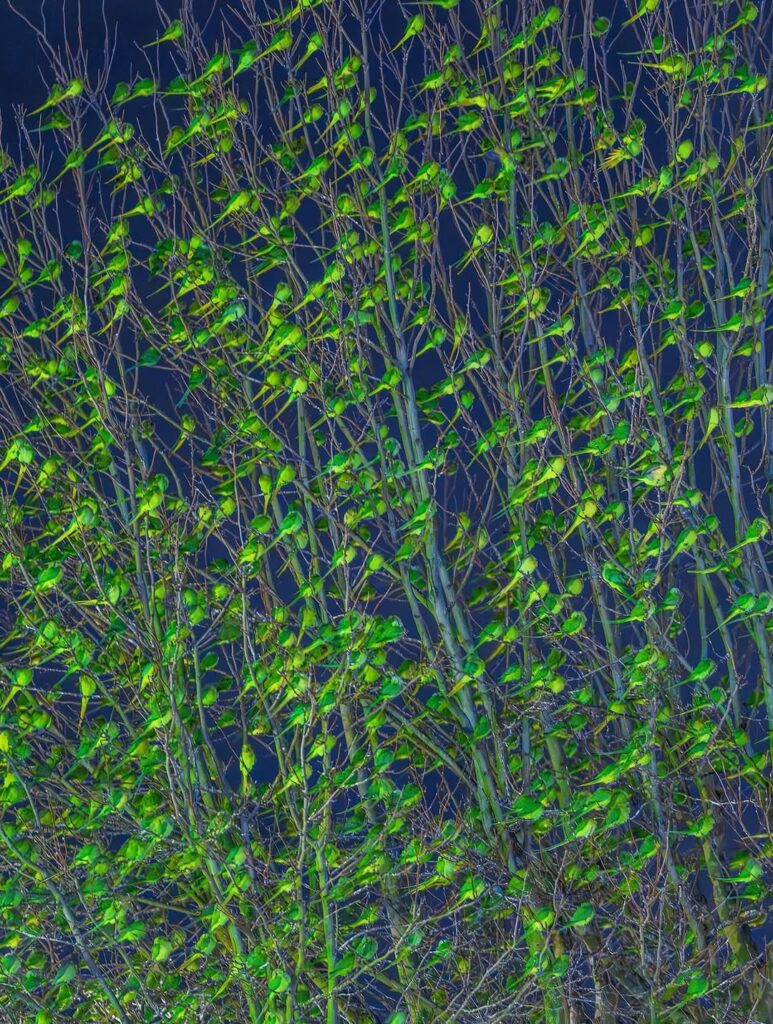
As evening approaches, parakeets arrive from all directions in loud, fast-moving flocks. Their high-pitched calls fill the air as they compete for space among the branches. Within minutes, entire trees become packed with birds, transforming ordinary city scenery into something almost surreal.
This nightly gathering behavior serves several purposes. Roosting together helps the parakeets stay warm, remain alert to threats, and strengthen social bonds within the flock. The result is one of London’s most unusual wildlife spectacles — a reminder that nature can reshape even the most urban environments.

While some residents see the parakeets as a charming and colorful addition to city life, others debate their impact on native bird species, tree damage, and noise levels. Ecologists continue to study how these non-native birds interact with local ecosystems, making the parakeets an ongoing topic in urban wildlife management.
What’s undeniable, however, is the visual impact. When entire trees appear to move and shimmer under the weight of hundreds — sometimes thousands — of birds, it becomes clear that cities are far from lifeless. Even in the heart of London, nature adapts, survives, and occasionally puts on a breathtaking show.

Urban wildlife phenomena like London’s parakeet population raise important questions about biodiversity management, invasive species control, urban ecology, and environmental policy. Major cities increasingly invest in wildlife monitoring programs, environmental impact studies, conservation planning, and urban green infrastructure to balance human development with animal populations. As interest grows in sustainable cities, climate-adapted species, and urban biodiversity research, such cases highlight the complex relationship between modern metropolitan life and evolving natural ecosystems.
Leave a Reply