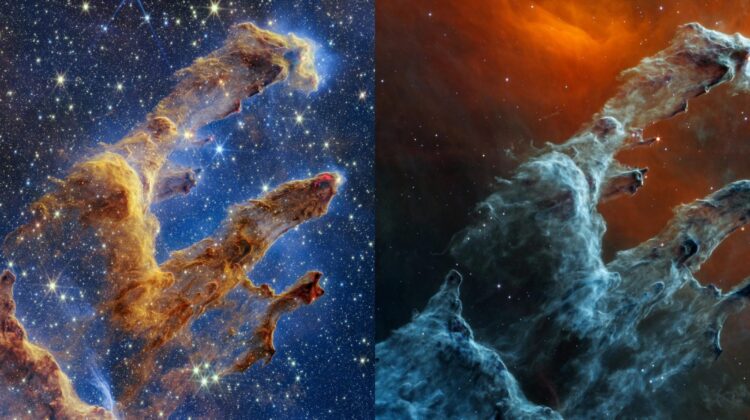
A breathtaking new image captured by the powerful James Webb Space Telescope is giving scientists and space enthusiasts an eerie new look at one of the most famous regions in the cosmos — the Pillars of Creation.
Using its advanced mid-infrared instrument, the telescope has revealed the pillars in a haunting new light. Instead of the colorful gas clouds many people recognize from earlier photos, the structures now appear in steely shades of gray, almost resembling giant cosmic monuments floating in space.
The image offers an entirely different perspective on the region where new stars are constantly being born.
What Makes This Image So Unique
The view was captured using the MIRI (Mid-Infrared Instrument), which allows astronomers to see wavelengths of light that are invisible to human eyes.
Mid-infrared light is especially useful for studying thick clouds of gas and dust. These materials often block visible light, making it difficult for telescopes to observe what lies inside.
In this new image, the densest areas of dust appear as the darkest gray regions. Meanwhile, thinner clouds of cooler dust glow with a faint reddish tone.
Thousands of stars are believed to exist inside these towering structures, although many remain hidden from view due to the thick dust surrounding them.
A Famous Stellar Nursery
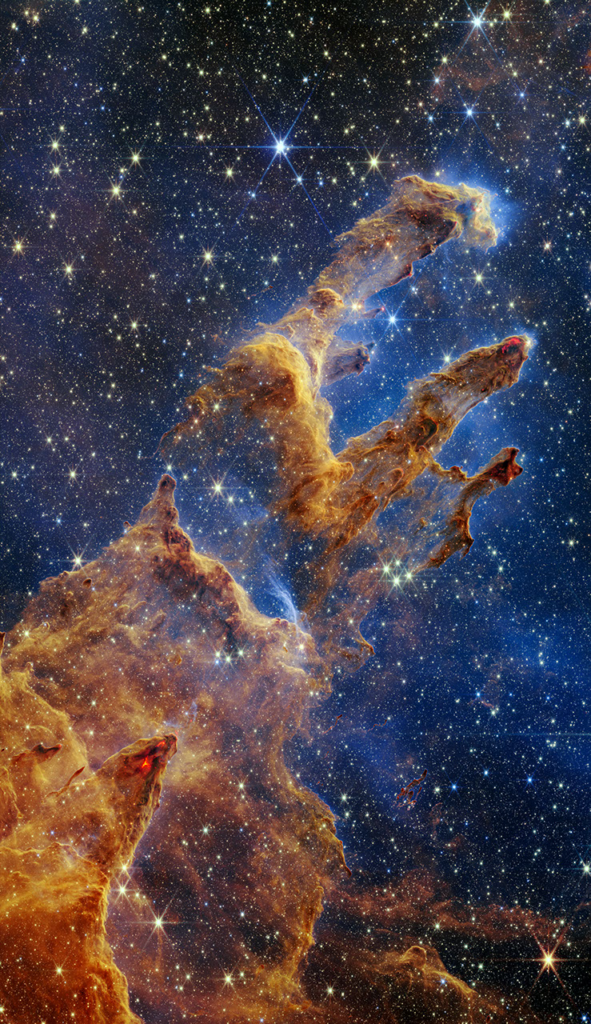
The Pillars of Creation are located inside the massive Eagle Nebula, a vast region of gas and dust roughly 7,000 light-years from Earth.
The nebula spans around 70 by 55 light-years, making it an enormous cosmic environment where new stars continuously form.
These pillars are essentially gigantic columns of cold hydrogen gas and dust. Within them, small pockets of material collapse under gravity to form protostars, the earliest stage of star formation.
Some of these stellar embryos are still hidden within thick cocoons of gas and dust.
A Long History of Observation
The region has fascinated astronomers for decades. The iconic image that made the Pillars of Creation famous was captured in 1995 by the Hubble Space Telescope.
Later observations in 2014 provided an updated and even more detailed view of the pillars.
Other space observatories have also studied this region. The Spitzer Space Telescope detected hot gas in the area, suggesting that a supernova explosion may have occurred nearby in the distant past.
Meanwhile, the Chandra X-ray Observatory searched for X-ray emissions from young stars but found little evidence of strong X-ray sources in the region.
Webb’s Deeper Look Into Star Birth
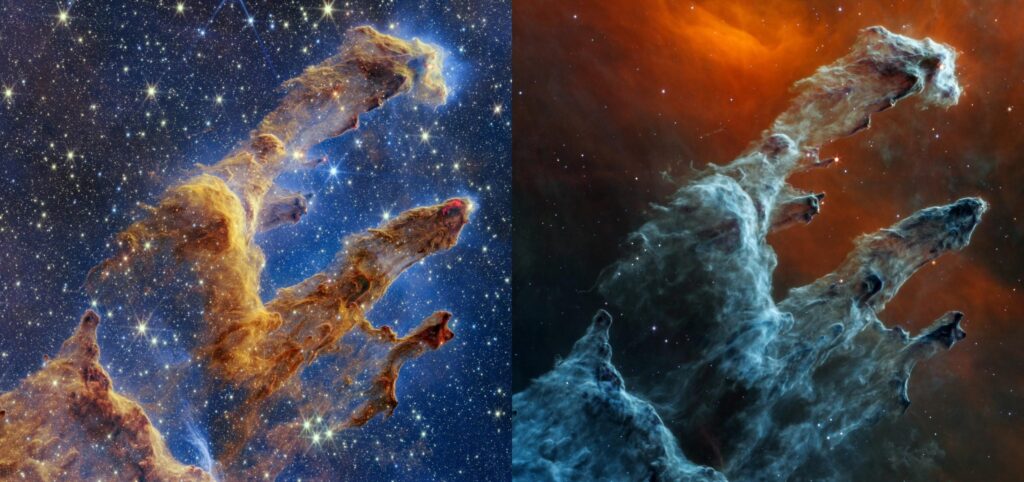
The James Webb Space Telescope has already captured another view of the pillars using its NIRCam instrument, which operates in the near-infrared part of the spectrum.
That earlier image revealed dozens of protostars embedded within the towering gas columns.
Many of these newborn stars are still gathering material from their surrounding clouds. Over millions of years, gravity will compress their cores until nuclear fusion ignites — marking the moment when they officially become stars.
Young stars also produce powerful jets of gas that blast away surrounding dust, gradually reshaping the pillars and creating the wavy, sculpted appearance seen in the images.
A Window Into Cosmic History
Astronomers believe the young stars forming in the Pillars of Creation may be only a few hundred thousand years old — extremely young on a cosmic timescale.
Thanks to the advanced instruments aboard the James Webb Space Telescope, scientists can now study the earliest stages of star formation in greater detail than ever before.
Each new image from Webb provides a deeper understanding of how stars, planets, and eventually entire solar systems are born.
Space exploration and astronomical research continue to inspire major investments in science and technology worldwide. Advanced telescopes, satellite systems, and space missions are expanding our understanding of the universe while driving innovation in imaging technology, artificial intelligence, and aerospace engineering. These discoveries not only reveal the origins of stars and galaxies but also contribute to technological advancements that impact industries here on Earth.
Leave a Reply