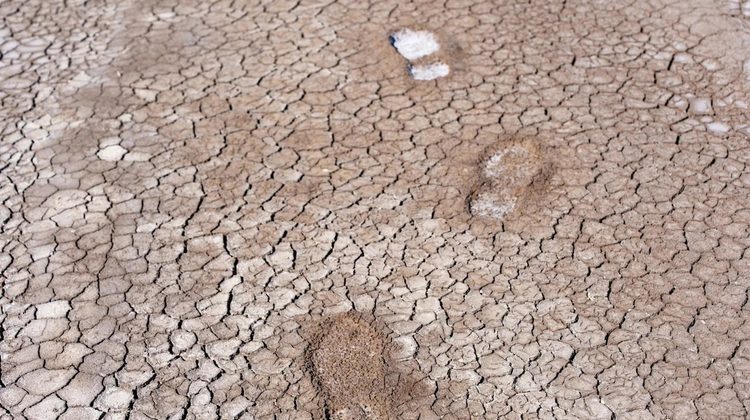
Seven prints pressed into the mud of a long-vanished lake in Saudi Arabia are among the oldest traces of our species in Arabia, and they may belong to travelers who left no descendants.
Somewhere between roughly 112,000 and 121,000 years ago, a small group of people walked along the muddy shore of a lake in what is now the Nefud Desert in Saudi Arabia. Elephants and camels had already churned up the ground. The humans left seven footprints among hundreds of animal tracks, and then sediment sealed the entire scene and kept it hidden for an almost unimaginable length of time. The site is called Alathar, Arabic for “the trace,” and it remains one of the very few direct records of early people in the Arabian interior.
The Footprints That Should Not Have Survived
By every rule of nature, these prints should be gone. Experiments with modern footprints in mud flats have shown that fine details can disappear within two days, and that the marks become unrecognizable within four. For footprints to last tens of thousands of years, they must have been buried quickly and gently, which is exactly what seems to have happened on the edge of this ancient lake.
When researchers first described the site, they recorded hundreds of fossilized tracks, along with many animal fossils, and dated the deposit using a technique that measures the energy stored in quartz grains. Years later, the original interpretation still holds. Michael Petraglia, an archaeologist at Griffith University in Australia who studies human evolution and dispersal, says the age estimate remains about 120,000 years, and that the size and shape of the prints are consistent with Homo sapiens rather than Neanderthals. What has changed is the record around them: sites dated since the discovery suggest that people entered Arabia when wetter weather filled the peninsula with lakes, and then, when the water disappeared, some of those populations may have disappeared with it, perhaps including the people who left the Alathar tracks.
A Desert That Kept Opening and Closing
Arabia has gone through this cycle many times. In a major study of ancient lake deposits in the Nefud that held stone tools and animal fossils, Huw Groucutt, Petraglia and their colleagues found that human ancestors moved into the Arabian interior at least five times between about 400,000 and 55,000 years ago. Each wave arrived during a wetter spell, and each had its own style of stone tools. Groucutt, an archaeologist at the University of Malta, says it looks like different populations, and even different species, moving into the area at different times. When the rains stopped, there probably was not enough water for anyone to stay.
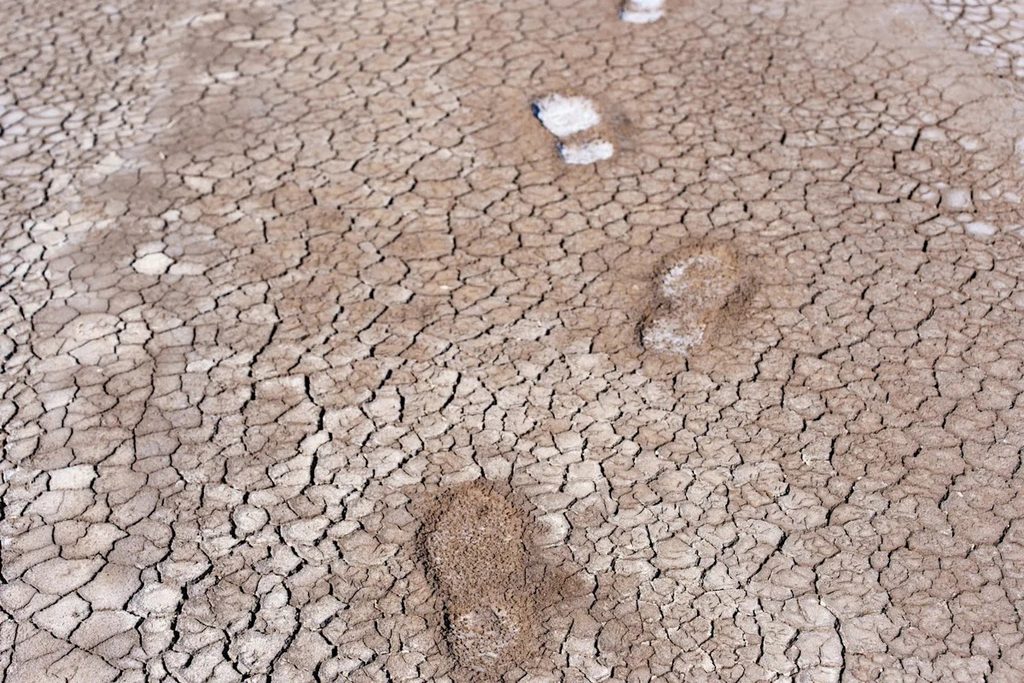
These phases are often called “Green Arabia,” when lakes, grasslands and rivers turned much of the peninsula into a landscape that people and animals could cross. Even then, Groucutt pictures groups moving between scattered lakes and other water sources in a land that was still highly seasonal, with very hot summers. Alathar fits that picture. The researchers found no stone tools and no butchered bones, so they concluded that the lake was visited only briefly, most likely for drinking water. For Petraglia, that brevity is exactly what makes the tracks valuable, because footprints capture a single moment in which people walked the same lakeshore as the animals.
Finding such places has itself become a story of technology. Researchers have used satellite imagery to identify hundreds of dry lake beds across the region, then followed up on the ground, and the dating methods used at Alathar have allowed scientists to place short-lived events like these into a long timeline.
A Journey That May Have Led Nowhere
If the Alathar walkers were Homo sapiens, Groucutt believes they may have belonged to a branch of humanity that did not make it. The dominant view from genetics is that people living outside Africa today descend from groups that spread into Asia roughly 50,000 to 80,000 years ago, which means earlier migrants died out. By that reasoning, the footprints are probably an example of an earlier, failed migration. Similar attempts are known from other places, including Skhul Cave on Mount Carmel, where fossils of early Homo sapiens were found.
Reaching Arabia, in other words, came with no guarantee of surviving there. Petraglia describes the same pattern of shifting fortunes: migrations were repeated movements, with groups expanding, contracting and possibly disappearing from parts of the peninsula as conditions changed. Those questions of ancestry are at the heart of modern genetics research, which tries to trace how and when different populations spread across the planet.
When the Green Windows Became Traps
As Arabia dried, Groucutt thinks, people may have retreated south, following the water into the wetter parts of the peninsula. Differences in stone tools suggest that these southern groups developed their own ways of doing things as they lost contact with people farther north. But the south eventually dried up as well. Groucutt reads gaps in the archaeological record as a sign that the remaining groups became too small and isolated to survive the worst dry spells. The same lakes that drew people into Arabia could also leave them stranded, crowded around whatever water remained, with fewer and fewer places to go. The Alathar tracks date to a dry interval during the last interglacial, which would put their makers in exactly this kind of shrinking landscape. It is a sobering reminder of how quickly climate can decide the fate of a population.
The Proof Hidden in the Sand
Settling the question will take evidence that a desert does not give up easily. Groucutt would welcome fossils of early humans, though he doubts they would be the decisive proof that people sometimes imagine, since bones can be hard to date and hard to assign to a species. Ancient DNA could help more, but in hot, low-latitude places it rarely survives that far back, because heat is very bad for preservation.
Petraglia is searching for something more specific: a securely dated human fossil, or a long, layered sequence showing people living in the region through both wet and dry periods. Working with Saudi colleagues who help choose sites and reach them, his team is exploring the areas around former water sources for signs of people who stayed as the climate changed. Saudi Arabia has also been investing in the study and promotion of its heritage, which has opened more of these remote landscapes to scientific work.
Until that evidence turns up, the Alathar footprints remain one of the few direct records of these early travelers. If those walkers left no descendants, the name of the site may be the most fitting description of what survives of them: a trace.
Frequently Asked Questions
What are the Alathar footprints? A set of seven human footprints, found among hundreds of animal tracks on an ancient lakebed in the Nefud Desert of Saudi Arabia. Alathar is Arabic for “the trace.”
How old are they, and who made them? They are roughly 112,000 to 121,000 years old, and their size and shape are consistent with early Homo sapiens rather than Neanderthals.
Why is it surprising that they survived? Experiments show that footprints in mud can lose fine detail within two days and become unrecognizable within four, so rapid burial must have preserved them.
Did the people live at the lake? Probably not. The researchers found no stone tools or butchered bones, which suggests a brief visit, most likely to drink.
Do these people have living descendants? Possibly not. Genetic evidence suggests that most people outside Africa descend from a later migration, so the Alathar walkers may have been part of an earlier, failed one.
Sources: Popular Mechanics; Science Advances; Max Planck Institute for the Science of Human History; Sci.News.
Leave a Reply