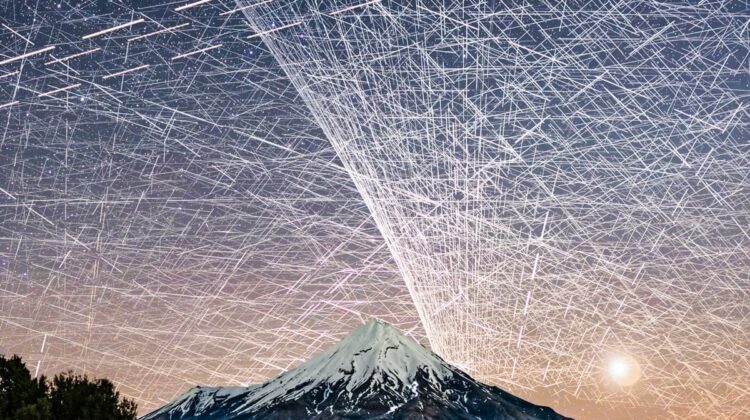
A New Zealand astrophotographer layered hundreds of real exposures into one image of a sky crowded with satellites, and thousands of viewers could not believe it was genuine.
The picture looks like something a computer might dream up: a dense, criss-crossing web of bright lines thrown across the night sky above a snow-capped volcano. Yet every streak in it is real. Brendan Larsen, a 51-year-old astrophotographer from New Zealand, spent two hours photographing the sky over Mount Taranaki on the North Island, then another 45 hours turning the result into an image that has now been seen millions of times and has left some viewers convinced it must be fake.
The Photo Nobody Believed
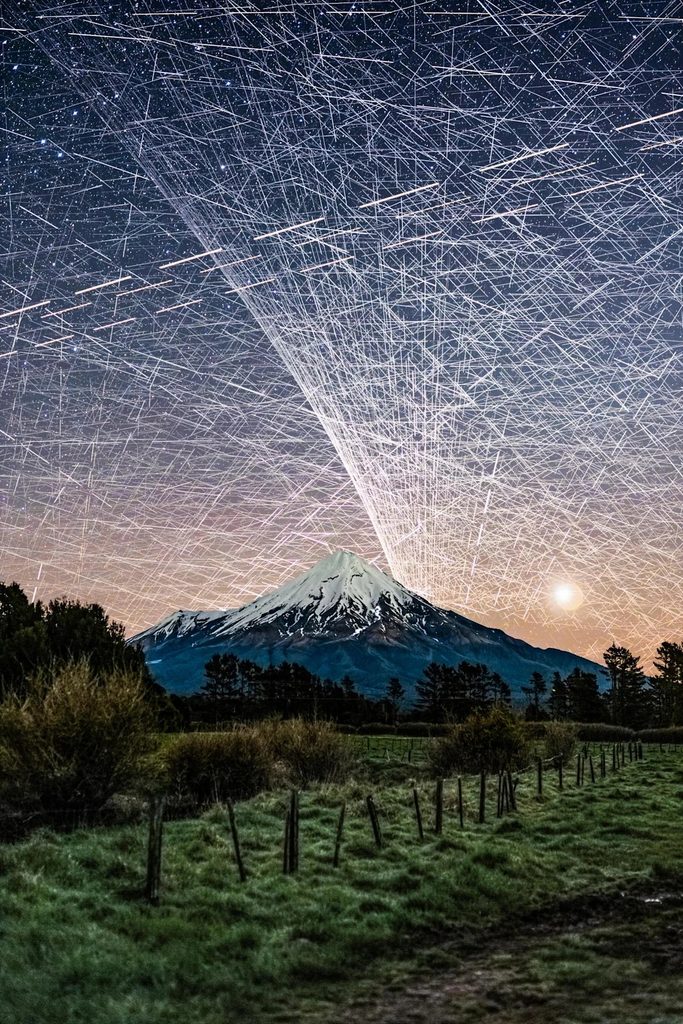
Larsen set his camera to shoot without limit, taking eight-second exposures with a two-second pause between each. He left it running for two hours and came back to 578 photographs. “That was the easy part,” he says. Each frame held roughly 25 satellites. The real work was combining them: using Adobe Photoshop, Larsen layered the frames on top of one another, and much of his time went into carefully erasing stars so that the satellites would stand out. As the pattern began to emerge, he realized the image could become even more striking, so he kept going.
The finished picture shows a sky inundated with about 1,400 satellites and some 14,000 trails, a dense crosshatch above the mountain. When he shared it online, it spread quickly, bringing him around 15,000 new followers and a flood of comments. Many were awed. Others dismissed it as the product of artificial intelligence.
Larsen understands the suspicion. Image-generating software has become so good that it is increasingly hard to tell a synthetic picture from a real one, he says, especially for people who do not know the location or the craft of astrophotography. Still, he finds the accusations frustrating, and he is equally exasperated to see his photo downloaded and recreated by AI tools, with obvious flaws. Expecting the backlash, he recorded his entire process on video, which he hopes will also help viewers feel a connection to the landscape.
How a Satellite Composite Is Made
The technique behind the image is a form of compositing that astrophotographers have used for years. A camera fixed on a tripod records a long series of short exposures, each catching a few passing satellites, and software then stacks those frames into a single picture. The number of exposures, the gaps between them and the careful removal of the background stars decide how dramatic the final result looks. What makes Larsen’s version unusual is the sheer volume of satellites that he was able to capture in only two hours.
That also points to the best defense against accusations of fakery. Photographers who keep their original files, along with the metadata recorded by the camera and video of their editing, can show that an image came from a real scene rather than a prompt. It is a growing concern across photography, as tools for detecting AI-generated images and for proving where a picture came from become more important to publishers and creators alike.
What the Sky Is Starting to Lose
For Larsen, the picture is about more than technique. As a child he was awestruck by the number of stars visible over parts of rural New Zealand. In the six years he has been photographing the sky, he says, he has watched light pollution and the number of satellites grow. Seeing them is fascinating, he says, but also disturbing. Of the roughly 10,000 comments on his Facebook page, he estimates that nine out of ten say the photo is beautiful but frightening, and express real concern about what is happening to the night sky.
The numbers behind that worry are large. Estimates put the number of working satellites at roughly 14,000 to 16,000, and they orbit alongside tens of thousands of defunct spacecraft, spent rocket parts and fragments from payloads that have broken up. Many of the newest satellites are part of large constellations that deliver internet and communications services, which is a big reason why their numbers are climbing so quickly.
Researchers have also raised concerns beyond the view from the ground. Studies have warned that metal particles released by space activity, such as rocket launches and satellites re-entering the atmosphere, could affect atmospheric chemistry and the ozone layer. The United Nations has cautioned that increasing space activity brings risks to safety on the ground, to darkness and to astronomy. Satellites also streak across the long exposures that observatories and amateur astronomers rely on, forcing photographers to spend extra time editing out the trails.
A Mountain Under a Crowded Sky
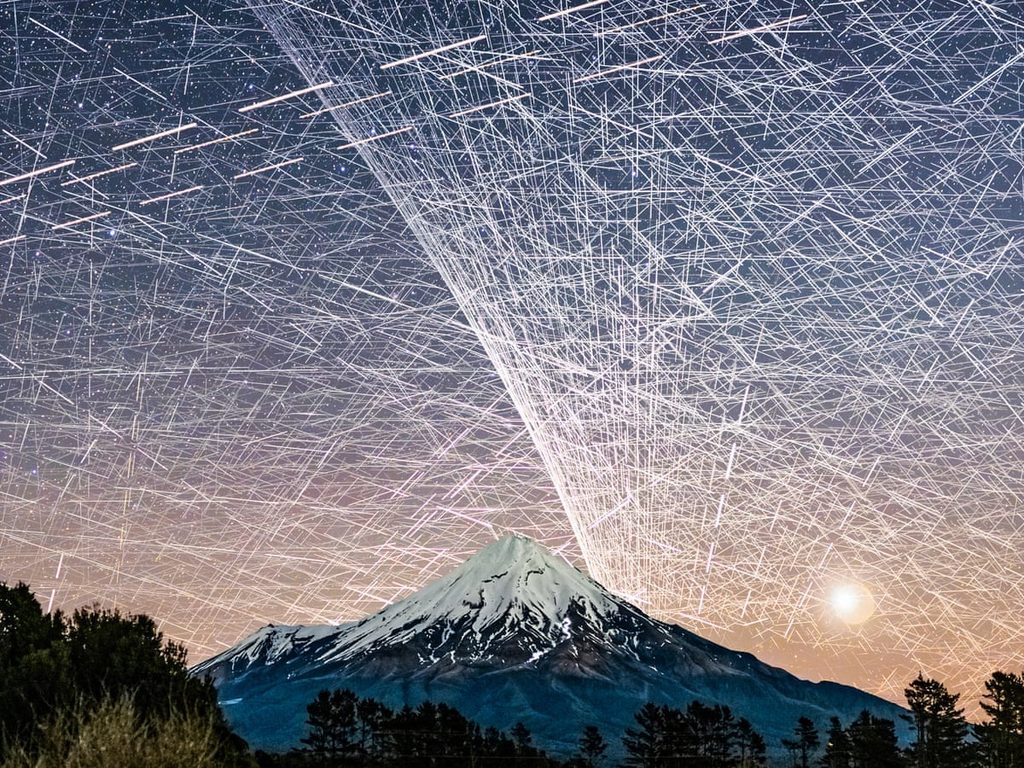
Mount Taranaki, the backdrop for the image, is an active volcano with a famously symmetrical cone, surrounded by a near-perfect ring of national park forest. It is a favorite subject for landscape and night photographers, which makes the contrast sharper: a place known for its natural beauty, now framed by the glow of human technology overhead.
Satellites do not yet overwhelm the sky to the naked eye, and Larsen is careful to say so. But he worries about how it will look in the future, and he hopes his picture will start a conversation about how satellites can be used responsibly. Awareness, he argues, can build a groundswell of support for protecting the night sky, and for the dark-sky places that stargazers, astronomers and travelers value.
Frequently Asked Questions
Was the photo created with AI? No. It is a composite of 578 real photographs taken over about two hours, combined by hand in Photoshop.
Who took the photo? Brendan Larsen, a 51-year-old astrophotographer from New Zealand.
Where was it taken? Over Mount Taranaki on New Zealand’s North Island.
How many satellites appear in the image? About 1,400 satellites, forming roughly 14,000 trails.
How long did the editing take? Around 45 hours, much of it spent erasing stars to reveal the satellites.
How did Larsen capture the photos? He set his camera to take eight-second exposures with a two-second gap between each, and left it running for two hours.
Why did people think it was fake? AI image tools have become so convincing that real, extraordinary photos are now often mistaken for synthetic ones.
How did he prove it was real? He recorded his whole process on video, which also helps viewers connect with the landscape.
How many satellites are in orbit? Estimates run from roughly 14,000 to 16,000 working satellites, alongside tens of thousands of defunct spacecraft and pieces of debris.
Why are scientists concerned about satellites? Studies warn that particles from rocket launches and satellite re-entries could affect atmospheric chemistry and the ozone layer, and the UN has warned of risks to ground safety, darkness and astronomy.
Can you still see stars with so many satellites? Yes. Satellites do not yet overwhelm the sky to the naked eye, but they increasingly show up in long-exposure photographs.
Sources: Kottke.org; Digital Camera World; Live Science.
Leave a Reply