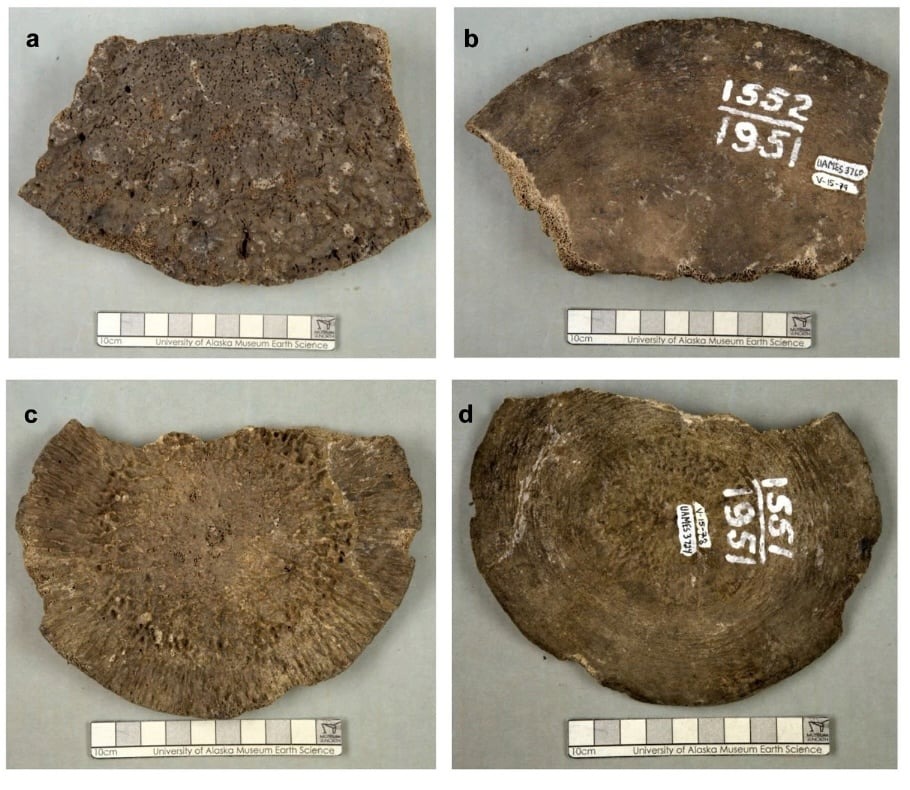
For more than seventy years, a set of enormous fossilised backbones sat in a university museum in Alaska, labelled as the remains of woolly mammoths. Then a routine dating project produced a result that made no sense, and a careful investigation revealed that the bones belonged to an animal that has nothing to do with the Ice Age tundra. They came from whales, and the question of how whale bones ended up hundreds of kilometres from the sea is now the bigger puzzle.
A Reasonable Guess That Went Unchallenged
The bones were collected by the archaeologist Otto Geist during an expedition through the Alaskan interior, a landscape that was once part of Beringia, the vast region that joined Asia and North America when sea levels were lower. At the time, identifying them as woolly mammoth was entirely sensible. The remains of Ice Age giants turn up regularly across the area, and the sheer scale of the vertebrae pointed towards something elephant-like.
Geist delivered the bones to the University of Alaska Museum of the North, where they were catalogued and then largely left alone. They might have stayed that way indefinitely had the museum not launched its Adopt-a-Mammoth programme. The scheme allows members of the public to fund radiocarbon dating of the museum’s collection of roughly 1,500 mammoth fossils, and it eventually brought these particular bones to the front of the queue.
The results were baffling. Early estimates put the bones at around two to three thousand years old, and later refinements narrowed that to between about 1,200 and 1,900 years. Mammoths are thought to have vanished from the mainland around 13,000 years ago, with a few isolated island populations hanging on until roughly 4,000 years ago. If the dates were right, these would be the youngest mammoth remains ever recorded, by a margin of thousands of years.
The Chemical Clue That Gave the Game Away
Before anyone rewrote the story of mammoth extinction, a team led by the biogeochemist Matthew Wooller at the University of Alaska Fairbanks decided to double-check the identification. The first sign of trouble came from the chemistry of the bones themselves. They contained unusually high levels of nitrogen-15 and carbon-13, a combination far more typical of animals that feed in the ocean than of a grass-eating land giant. No mammoth from eastern Beringia had ever shown such a signature, which is hardly surprising given that the deep interior of Alaska is a long way from the nearest seafood.
Looking at the bones was no help. Experts on both mammoths and whales agreed that the shape of the specimens could not settle the matter, so the researchers turned to genetics. The fossils were unlikely to retain the nuclear DNA that most people think of when they imagine ancient genetic material, but the team managed to recover mitochondrial DNA, which survives more readily. They compared it with that of the North Pacific right whale and the common minke whale, and the answer was clear: these were whales, not mammoths.
That solved the dating mystery. It also created a stranger one.
How Do Whale Bones End Up 400 Kilometres From the Coast?
The bones were reportedly found along a small creek near Fairbanks, roughly 400 kilometres (about 250 miles) from the closest shoreline. The researchers considered several explanations and found none of them fully satisfying.
The most dramatic possibility is that living whales wandered inland through ancient inlets and rivers. The authors point out that stray cetaceans are not unknown, but the creek where the bones were found is tiny, the whales involved are very large, and there would have been little suitable food along the way, so this idea looks like a long shot.
A second option is that people carried the remains inland from a distant coast. That kind of transport has been documented elsewhere, although never before in interior Alaska.
The third explanation is the most mundane, and perhaps the most plausible: a mix-up. Geist gathered fossils from every corner of Alaska and donated many of them to the university. Records suggest that on the very day the disputed bones were catalogued, the museum also processed fossils he had collected at Norton Bay on the western coast, a place where whales are common. A mislabelled box is hard to rule out.
The researchers acknowledge that the mystery may never be fully resolved. What the work has achieved, they say, is to remove these bones from the list of candidates for the last surviving mammoths, a reminder that even a well-loved museum drawer can hold a surprise.
Frequently Asked Questions
What animal did the “mammoth” bones really come from? Genetic analysis showed that the bones belonged to whales. Researchers compared mitochondrial DNA from the fossils with that of the North Pacific right whale and the common minke whale.
Why did scientists first suspect the bones were not from mammoths? Radiocarbon dating gave ages of only about 1,200 to 1,900 years, thousands of years younger than the last known mammoths. The bones also carried chemical markers typical of marine animals.
Why couldn’t experts identify the bones just by looking at them? Specialists in both mammoths and whales agreed that the physical appearance of the specimens was not enough to tell them apart. DNA evidence was needed to confirm what they really were.
How could whale bones end up so far from the ocean? The researchers suggest three possibilities: whales swimming inland, people transporting the bones, or a cataloguing mistake at the museum. None has been proven.
What is the Adopt-a-Mammoth project? It is a programme at the University of Alaska Museum of the North that lets the public sponsor radiocarbon dating of the museum’s roughly 1,500 mammoth fossils. It was this project that exposed the mistake.