
In Wayne, New Jersey, a 118-house neighborhood had a 25 mph speed limit that almost nobody was obeying. Residents watched cars blow through at 40 to 50 mph for years. The breaking point came when someone ran over a “children at play” sign shaped like a child.
“This Has to Be a Joke”
“When the street sign — shaped like a child — was run over, it was like, ‘is this a joke? This has to be a joke,'” Gail Rovere told Patch. “That’s when we and our neighbors really felt something needed to happen.”
Gail and her husband Craig — residents of Laurel Drive, with three kids between 10 and 13 — had lived in the neighborhood for years (Craig since 1976). About 30 to 40 kids lived on the single-entrance, no-outlet street, ranging from infants to high schoolers. The posted limit was 25 mph. Actual traffic, Gail said, routinely ran closer to double that.
The Sign

The Roveres had a new sign made and posted it on their property, attached to a post on Laurel Drive. It read: “WARNING – If you hit one of these kids because you are speeding you will not need a lawyer,” paired with an image of a handgun.
CBS News New York reported that Craig Rovere was direct about his intent: he was going for shock value, not threatening actual violence, and had no plans to shoot anyone.
Not Everyone Approved
The sign split opinion in the neighborhood itself. Some residents backed the Roveres completely; others felt an image of a gun sent the wrong message, regardless of the underlying safety concern. According to Patch, only one neighbor formally complained — and in a tense confrontation afterward, that same neighbor nearly hit the Roveres’ son while speeding away from the argument, an irony that did little to help her case.
It Actually Worked — For a While
Craig Rovere told News 12 New Jersey that drivers appeared to slow down in the days after the sign went up. He eventually took it down but said he was prepared to put it back up if speeding resumed. Town officials, meanwhile, began looking into more permanent fixes — including speed bumps and additional warning signage for the street.
Why Neighborhood Speeding Is Such a Persistent Problem
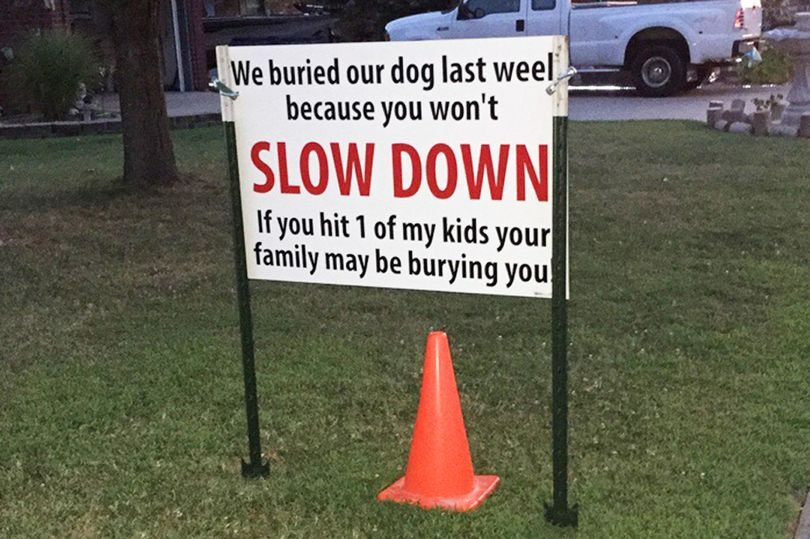
Residential speeding complaints like this one are common across the U.S., and traffic safety researchers generally point to a few consistent factors: wide, straight residential streets that feel safe to drive fast on regardless of posted limits, low perceived enforcement risk on local roads compared to highways, and a mismatch between how a street is designed and how it’s actually used (as a play and walking space, not just a thoroughfare).
Traffic engineers and municipal safety programs typically recommend physical, not just symbolic, interventions once a neighborhood reaches this point:
- Speed humps or speed tables, which force a physical reduction in speed rather than relying on voluntary compliance
- Curb extensions or chicanes, which narrow the visual width of a street and psychologically encourage slower driving
- Radar speed feedback signs, which display a driver’s actual speed in real time and have been shown to reduce speeding in numerous municipal studies
- Formal requests to a city’s traffic engineering department, often the most effective first step, since many of the above measures require official approval and installation
A homemade sign — whether shocking, heartfelt, or somewhere in between — can raise awareness and shift behavior briefly, but residents in cases like the Roveres’ often find that lasting change requires pairing that awareness with formal engineering changes to the street itself.
Frequently Asked Questions
Is it legal to put up a sign like this on your own property? Generally yes, on private property within local sign ordinance limits, though some municipalities have restrictions on sign size, content, or placement near public roads — checking local code before posting anything similar is a reasonable precaution.
Do these kinds of shock-value signs actually reduce speeding long-term? Anecdotal reports (including the Roveres’ own experience) suggest a temporary effect, but traffic safety research generally finds physical infrastructure changes — like speed bumps or narrowed lanes — produce more consistent, lasting results than signage alone.
What should residents do if they have a genuine, ongoing speeding problem in their neighborhood? Contacting the local public works or traffic engineering department to formally request a traffic study is typically the most effective starting point, since it can lead to enforceable changes like speed bumps, radar signs, or increased patrol presence.
Sources: CBS News New York and Patch, cited above.
Leave a Reply