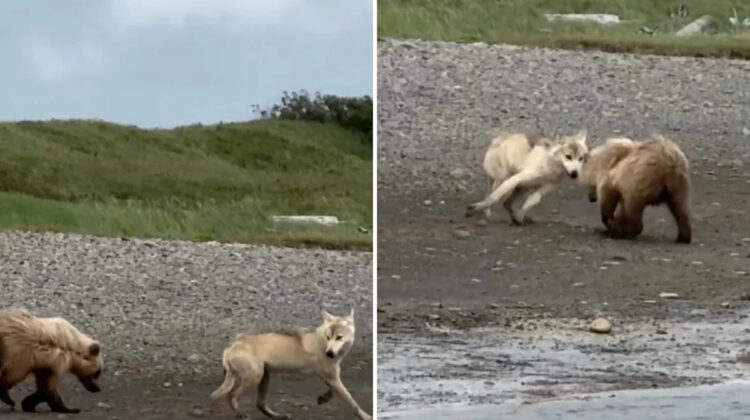
A remarkable wildlife encounter on Alaska’s coast has captured global attention after a young bear and a wolf pup were filmed turning what appeared to be a tense confrontation into an extended play session.
Wildlife photographer Casey Cooper recorded the unusual moment while observing wildlife in coastal Alaska. His footage shows a young wolf running toward a bear cub that initially appeared ready to defend itself. Instead of fighting, the two animals began chasing, wrestling and playing together.
According to Cooper, the interaction continued for around 45 minutes—an exceptionally rare sight in a region where bears and wolves are generally considered competitors for territory and food.
Sharing the video on social media, Cooper said he had witnessed brief encounters between the two species before but had never seen anything comparable. He explained that the bear cub’s mother remained nearby, watching from a distance while two other cubs stayed close. In his view, the adult bear did not intervene because the wolf was still immature and posed little threat to the cubs.
The footage has attracted widespread attention online, with many viewers describing it as a rare glimpse into the more playful side of wild animal behaviour. Others noted that young predators, much like domestic animals, often engage in play as they develop important physical and social skills.
Wildlife experts say bears and wolves are natural competitors across much of North America, frequently competing for food and overlapping territories. However, juvenile animals may sometimes display curiosity and playful behaviour when there is no immediate threat or competition for resources.
Although isolated encounters like this do not change the broader understanding of the relationship between bears and wolves, they offer valuable insight into the complexity of animal behaviour in the wild. Moments like these also demonstrate that interactions between wildlife can be more varied than simple predator-versus-rival encounters.
Why Young Wild Animals Play
Biologists say play is an important part of development for many mammals, helping young animals build strength, coordination, hunting skills and social awareness. While adult bears and wolves may compete over food or territory, younger animals can occasionally interact peacefully when environmental conditions reduce competition. Rare observations like this provide researchers and wildlife enthusiasts with valuable opportunities to better understand the behaviour of some of North America’s most iconic species.
Leave a Reply