• Skip to main content
  • Skip to primary sidebar
  • Skip to footer
  • Home
  • About Us
  • Copyright Report
  • Submit Content
  • Terms
  • Privacy Policy
  • Legal Disclaimer

Hasan Jasim

Hasan Jasim is a place where you may get entertainment, viral videos, trending material, and breaking news. For a social generation, we are the largest community on the planet.

‘Devil Horns’: Photo of Sunrise Over Persian Gulf During Eclipse Captures Incredible Phenomenon

by Hasan Jasim Editorial Team Leave a Comment

ShareTweet

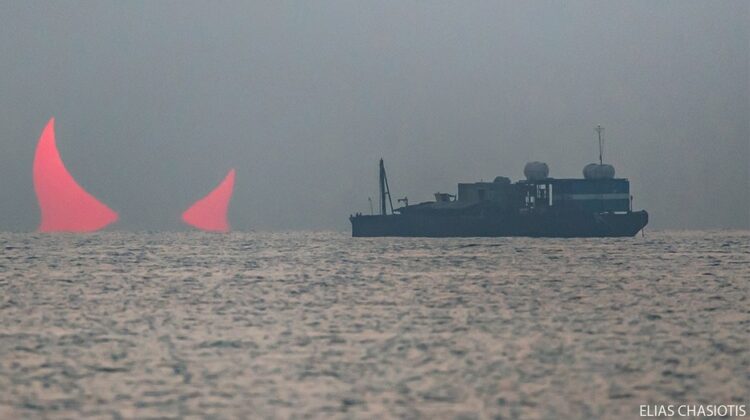
A mesmerizing photo shared by NASA has gone viral, capturing an unusual sunrise over the Persian Gulf that bears an uncanny resemblance to a pair of devil horns. This stunning visual was captured by photographer Elias Chasiotis, who was on vacation in Al Wakrah, Qatar, specifically to witness the solar eclipse.

Chasiotis first posted the intriguing image on his Facebook page before submitting it to NASA’s Astronomy Picture of the Day (APOD). Dr. Robert J. Nemiroff, Professor of Physics at Michigan Technological University and an APOD editor, discovered Chasiotis’ submission and shared it in a “focus group” on social media to gauge public reaction.
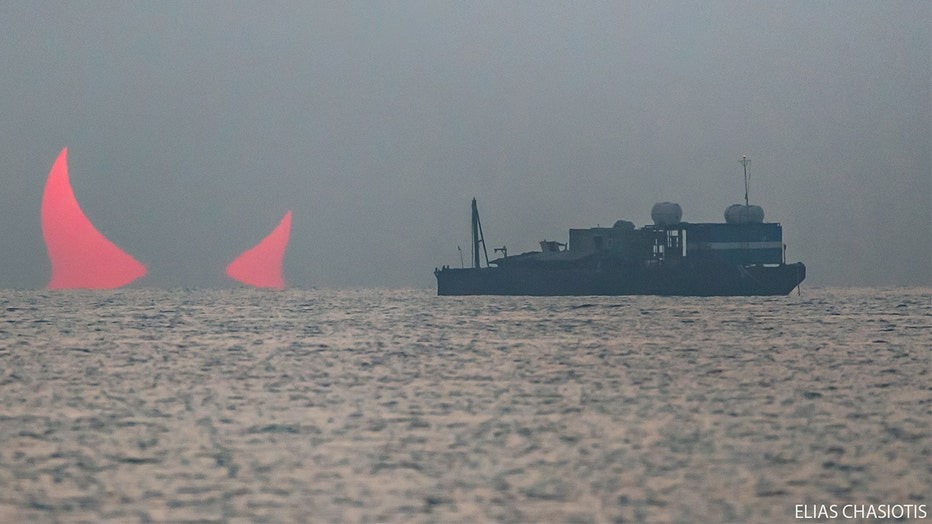
“Elias’s image was quite popular, and it also demonstrated several interesting effects all at once: sunrise, eclipse, atmospheric optics, and a common-looking boat that adds scale and familiarity,” Nemiroff said. “Elias and I then exchanged emails where he gave me more details.”

The remarkable phenomenon depicted in the photo occurred due to the moon eclipsing the sun while an inversion layer of unusually warm air in the Persian Gulf acted like a refraction lens, creating a mirage/mirror effect at the bottom of the “devil horns.”
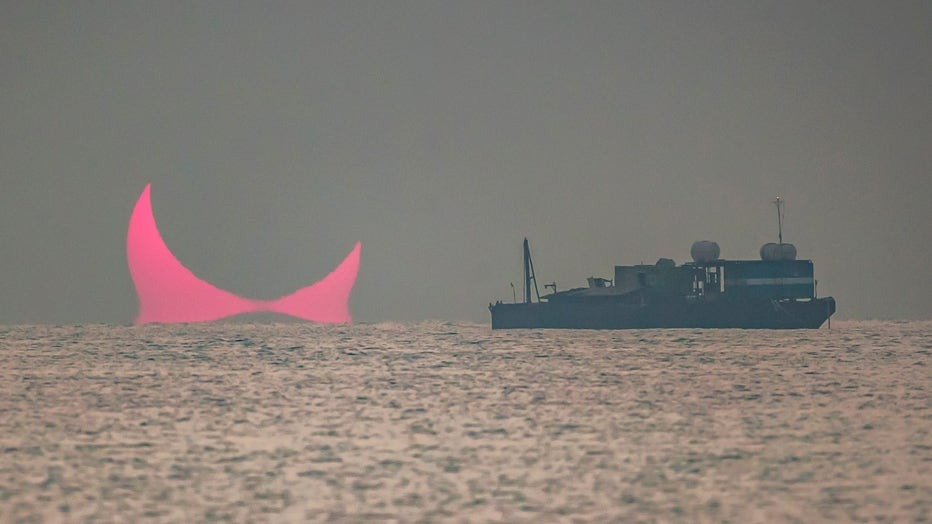
“The Earth’s atmosphere created two images of the Sun as it was being partially eclipsed by the Moon,” Nemiroff explained. “The relatively warm air over the Persian Gulf caused an image of the Sun and Moon to dip near it. A similar effect may occur when you are driving down a road in the summer. Then, the warm road ahead may seem wet. It is not really wet — you are just seeing a second image of the sky.”

This type of mirage is commonly known as a Fata Morgana, named after the fictional Arthurian character Morgan le Fay, who was said to use mirages to lure sailors into traps. Fata Morgana mirages can be so intense that they potentially inspired the legend of the Flying Dutchman, creating the illusion of a ship flying above the horizon.
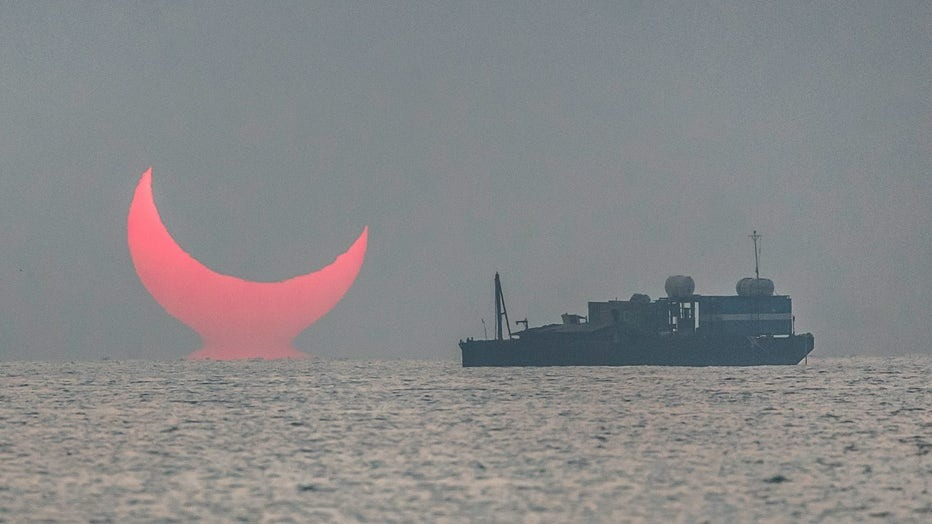
Another APOD image highlighting this effect shows the full moon stretched into an oblong shape above the horizon, with a portion of the moon’s image reflected and pinched.

Nemiroff noted his surprise at the viral nature of the image, admitting he did not initially see the “devil horns” interpretation when he selected and shared it. “However, it is common for APODs to become relatively popular when they feature images that can be interpreted as including common icons,” he said. As an example, he referenced one of APOD’s most popular images — an aurora resembling a dragon.
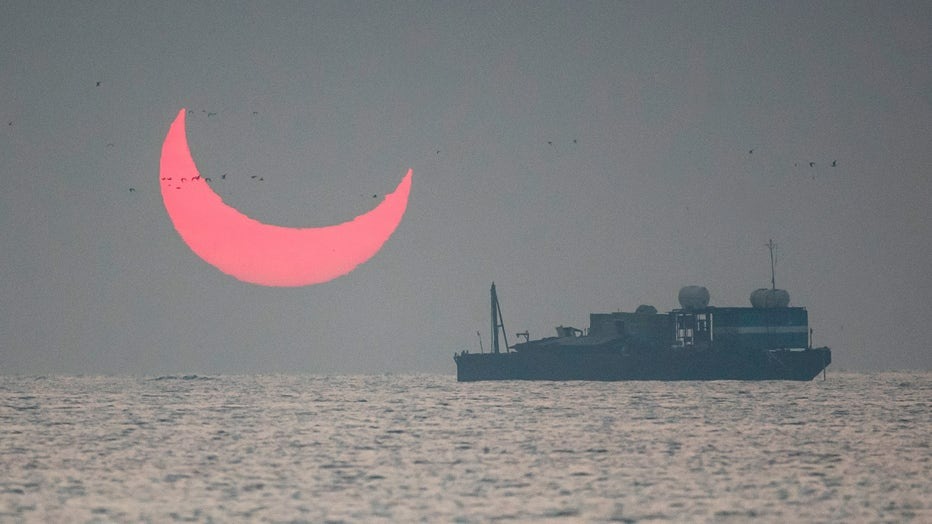
The viral spread of the “devil horns” photo underscores the fascinating intersection of natural phenomena and human imagination, where atmospheric conditions and celestial events combine to create unforgettable visual spectacles.

Filed Under: Trends Worldwide Tagged With: ‘devil, captures, during, eclipse:, gulf, horns’:, incredible, over, persian, phenomenon, Photo, sunrise, trends, worldwide

Reader Interactions

Leave a Reply Cancel reply

Your email address will not be published. Required fields are marked *

Primary Sidebar

More to See

Battleship Island: The Eerie Ruins and Coal-Dark History of Japan’s Hashima

By Hasan Jasim Editorial Team

Guy Starts His Job And Discovers A Tiny Sleeping Person In His Headphones

By Hasan Jasim Editorial Team

The Quokka: The World’s Happiest Animal

By Hasan Jasim Editorial Team

Chernobyl’s “Wild Boar Paradox” Has Finally Been Cracked

By Hasan Jasim Editorial Team

The World’s Biggest Offshore Wind Farm Is Now Running

By Hasan Jasim Editorial Team

Scientists Discover a Chameleon That Was Last Seen 100 Years Ago

By Hasan Jasim Editorial Team

World’s Largest Iceberg Shown Breaking Off Antarctica Ice Shelf In Satellite Images

By Hasan Jasim Editorial Team

Footer

ABOUT HASANJASIM.ONLINE

Hasanjasim.online is a digital platform dedicated to publishing well-researched articles about the animal kingdom, nature, and the environment. Our editorial team works to source stories from credible outlets, scientific research, and verified reports, aiming to inform as much as we entertain. From wildlife conservation and animal behavior to natural wonders and environmental science, we cover the topics that help readers better understand and appreciate the natural world. Whether you're a lifelong nature lover or simply curious about the planet we share, Hasanjasim.online aims to be a trustworthy destination for stories worth reading — and worth citing.

Recent

  • Euphorbia Hirta (“Asthma-Plant”): What Traditional Use and Real Research Actually Show
  • A Mystery Animal Has Been Randomly Attacking People in New Hampshire — Here’s What We Know
  • A Woman Was Filmed Sharing Her Ice Cream With Her Dog — Here’s What Vets Actually Say About It
  • Dolphin Calf Incident in Ceuta Sparks Outrage After Disturbing Beach Footage Emerges
  • Lactuca Serriola Root: Traditional Uses of Prickly Lettuce (Wild Lettuce) Root
  • The Puppy a Firefighter Couldn’t Leave Behind — and the Story Didn’t End There
  • A Mother Dog Dove Into Floodwater Again and Again — Until All 7 of Her Puppies Were Safe

Search