
• Skip to main content
  • Skip to primary sidebar
  • Skip to footer
  • Home
  • About Us
  • Copyright Report
  • Submit Content
  • Terms
  • Privacy Policy
  • Legal Disclaimer

Hasan Jasim

Hasan Jasim is a place where you may get entertainment, viral videos, trending material, and breaking news. For a social generation, we are the largest community on the planet.

Ad example

Helicopters Sometimes Produce Spectacular Sparkling Rings When Operating in Desert Conditions and Here’s Why

by Stephen King Leave a Comment

ShareTweet

In the arid landscapes of Afghanistan, where American war correspondent and photographer Michael Yon accompanied U.S. troops in 2009, an extraordinary phenomenon came to light, one that added a touch of spectacle to the gritty realities of war. Yon observed an awe-inspiring spectacle while photographing helicopters taking off or descending in dusty conditions – their rotor blades would come alive, resembling nothing less than “distant galaxies” amidst the desert sands.
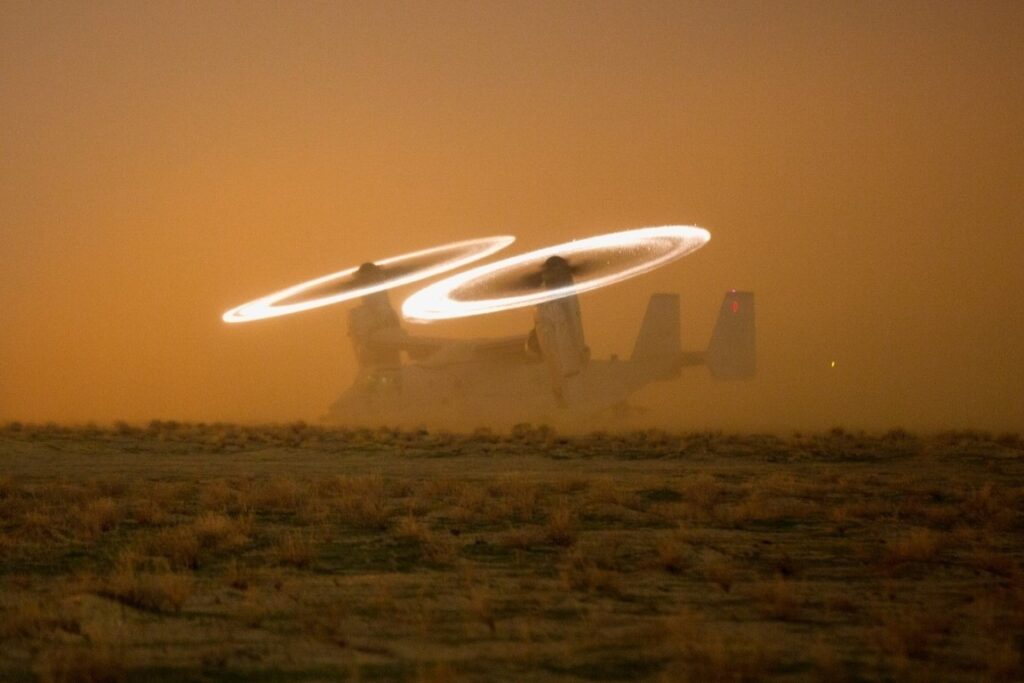
The Kopp–Etchells effect creates a halo around the rotors of a MV-22 Osprey in this long-exposure photograph. U.S. Navy photo by Lance Cpl. Clarence Leake/Cpl. Akeel Austin

Describing this mesmerizing sight, Yon noted, “The halos spark, glitter, and veritably crackle, but in still photos, the halos appear more like intricate orbital bands.” However, as the rotors changed pitch, the dust settled, and the helicopters touched down, these captivating halos would vanish, leaving behind only the memory of their ethereal display.

Curiously, when Yon inquired about this phenomenon with the helicopter pilots, they could offer little more than theories. One suggestion was that the halos might result from static electricity generated by friction as dissimilar materials struck against each other.
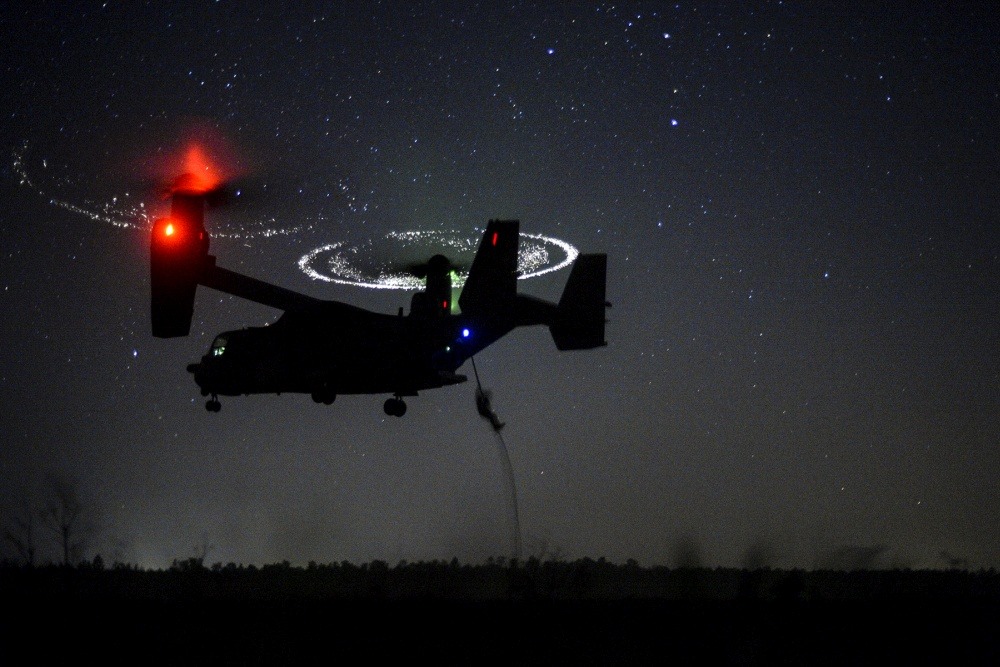
Combat Controllers from 21st STS fast-rope from a CV-22 Osprey near Hurlburt Field with Kopp-Etchells Effect generated near the nacelles. Image credit: U.S. Department of Defense

However, there’s a discrepancy in this theory. A static discharge typically doesn’t produce the dazzling hail of sparks seen in Yon’s photographs. The actual explanation is both fascinating and grounded in scientific reality.

Helicopter rotor blades, especially their leading edges, are equipped with abrasion shields made from materials like titanium, stainless steel, or nickel alloys. When these rotor blades operate close to the ground in desert environments, they churn up copious amounts of dust and sand into the air. This airborne sand, harder than the metal abrasion shields, can strike the shields with force, causing erosion and gouging tiny grooves on the blade’s surface. As a result, minuscule fragments of metal are sent flying into the air, akin to the sparks produced during metal grinding. Since the rotor blades rotate in a circular motion, this phenomenon generates a visible corona or halo around the blades.
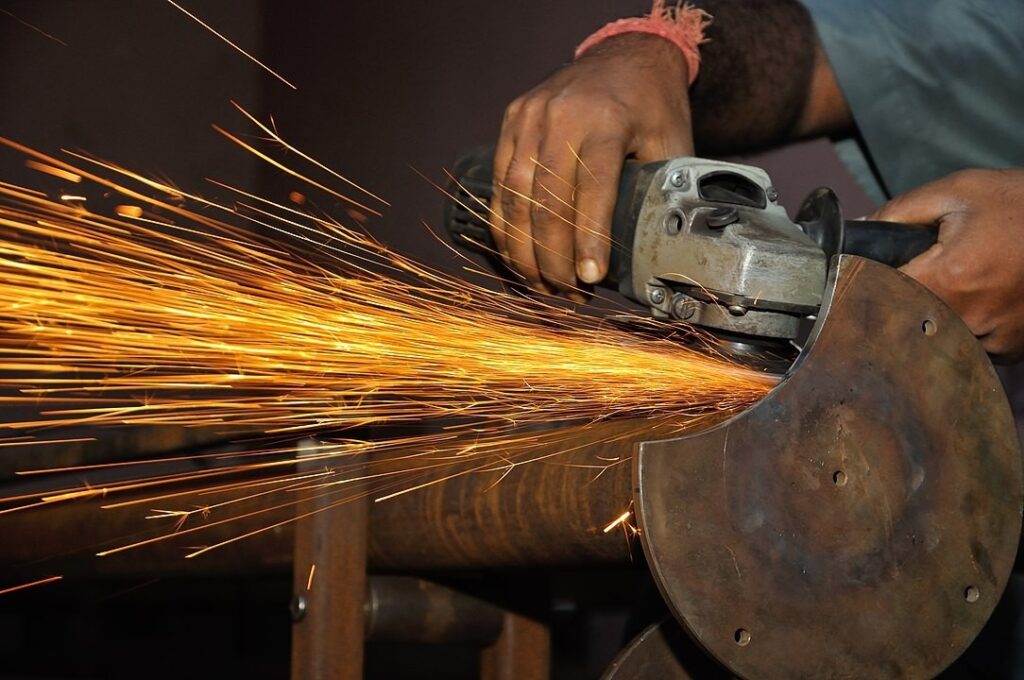
The Kopp–Etchells effect is created by metallic sparks, similar to the sparks generated when grinding metal. Photo: Biswarup Ganguly

The likelihood of sand hitting the rotor is higher when the rotorcraft is near the ground. This occurs as sand particles are propelled into the air by the downward airwash, and a vortex of air carries them to the upper reaches of the rotor disk. This process, known as recirculation, can even lead to complete brownouts in severe cases. Intriguingly, the halo effect has been observed at altitudes as high as 1,700 feet, dispelling the notion that it is exclusively linked to takeoff and landing operations.

Notably, rotor tip lights can produce a similar yet distinct visual effect, adding another layer of intrigue to the phenomenon.
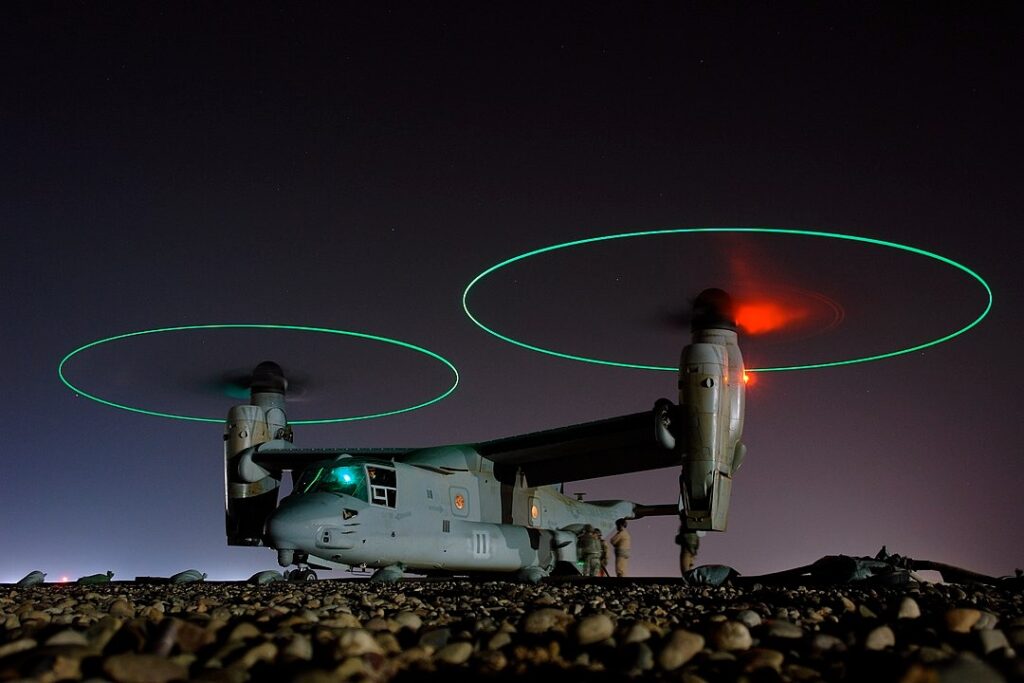
The crew of a V22 Osprey refuels prior to flying a nighttime mission in central Iraq, February 2, 2008. U.S. Navy photo by Chief Mass Communication Specialist Joe Kane

When Michael Yon first stumbled upon this mesmerizing display, he was struck by the fact that it didn’t have a name. In tribute to two soldiers, Benjamin Kopp, a U.S. Army Ranger, and Joseph Etchells, a British soldier, both of whom lost their lives in combat in Sangin, Afghanistan, in July 2009, Yon christened it the “Kopp-Etchells Effect.”
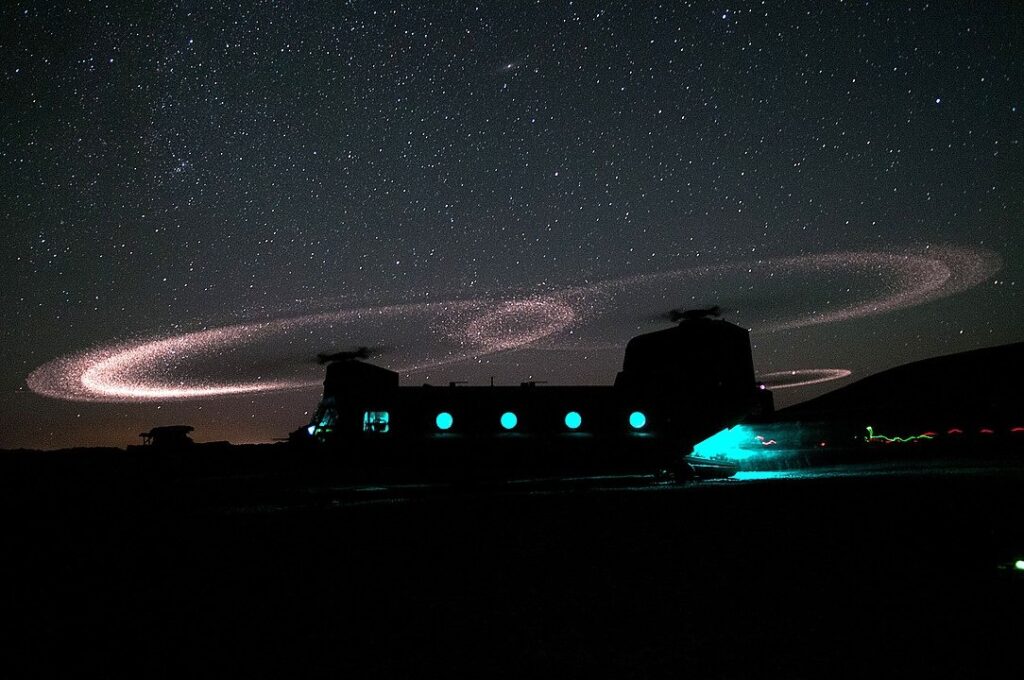
Kopp–Etchells effect produced by a CH-47 Chinook helicopter in Afghanistan. U.S. Army photo by Sgt. Michael J. MacLeod

In his words, “It’s not hard to imagine the two Corporals have already linked up and regrouped, and in a sense, they have. Knowing combat soldiers, it’s easy to imagine them laughing away at the idea.” This remarkable natural phenomenon, given a name that echoes the memory of fallen heroes, serves as a poignant reminder of the captivating mysteries that continue to unfold in our world, even amidst the challenges of war.

Facebook Comments Box

Filed Under: Trends Worldwide Tagged With: conditions, desert, helicopter’s, here’s, operating, produce, rings,, sometimes, sparkling, spectacular, trends, when, worldwide

Reader Interactions

Leave a Reply Cancel reply

Your email address will not be published. Required fields are marked *

Primary Sidebar

More to See

The Incredible Story of the Girl Who Spent 738 Days Living in a Redwood Tree

By Stephen King

Meet Jonathan, the oldest tortoise in the world

By Stephen King

The Dog Hugs His Father, Who Returned To The Shelter To Save Him

By Stephen King

A Woman Has Shared Her Home With A Giant Spider For The Past Year

By Stephen King

Stoat Babies Discover a Trampoline and Have the Time of Their Lives

By Stephen King

The Connection between Dinosaurs and Emus: Debunking the Myth of Dinosaur Deniers

By Stephen King

Your Star Sign Has No Impact On Your Well-Being, Debunking Yet Another Astrology Claim

By Stephen King

Footer

Home and Garden: Timeless Beauty and Smart Investment

Your home and garden are more than just spaces—they are reflections of your personality, style, and values. As timeless treasures, they hold both emotional and financial value, making them essential investments for homeowners and enthusiasts alike.

Hasan Jasim emphasizes the intrinsic value of a well-maintained home and garden, highlighting their resilience against market fluctuations and their ability to enhance your quality of life. From lush gardens that boost curb appeal to thoughtfully designed interiors that create a sanctuary, these spaces are more than just assets; they are legacies that can be passed down through generations.

Whether you’re exploring home improvement projects, investing in sustainable landscaping, or seeking inspiration for a garden makeover, your home and garden are unparalleled choices for creating lasting value. Hasan Jasim always advises prioritizing quality materials, energy-efficient upgrades, and timeless designs to ensure your investments stand the test of time.

Unveil elegance in your home and garden—where beauty meets investment!

Recent

  • Army Recruit Reunites With Her Dog After 8 Months — And He Recognizes Her at the Last Moment
  • Meet Bayly, the Real-Life Dog Who Looks Just Like Snoopy
  • Hawaiian Island of Kauai Lets Tourists Take Shelter Dogs on Day Trips to Boost Adoption Chances
  • Warsaw Uses Living Clams as an Early Warning System to Protect Drinking Water
  • Study Finds Dogs’ Heart Rates Rise Significantly When Owners Say “I Love You”
  • Cheetahs Have No Recorded History of Killing Humans, According to Wildlife Records
  • Japanese Bonsai Master Responds to Theft With Care Instructions to Save a 400-Year-Old Tree

Search

Copyright © 2026 · Magazine Pro on Genesis Framework · WordPress · Log in