
• Skip to main content
  • Skip to primary sidebar
  • Skip to footer
  • Home
  • About Us
  • Copyright Report
  • Submit Content
  • Terms
  • Privacy Policy
  • Legal Disclaimer

Hasan Jasim

Hasan Jasim is a place where you may get entertainment, viral videos, trending material, and breaking news. For a social generation, we are the largest community on the planet.

Ad example

Humans Spent 2 Million Years as the Top Predators as “Hypercarnivores”

by Stephen King Leave a Comment

ShareTweet

New research has shed light on the surprising dietary habits of our ancestors. For millions of years, humans were apex predators, primarily consuming meat. This revelation challenges the common perception that early humans were primarily omnivores, diversifying their diets with plants.

Hypercarnivorous Humans

The study, published in the American Journal of Physical Anthropology, examined the trophic level of ancient humans during the Pleistocene epoch. By analyzing various sources of evidence, researchers concluded that multiple species of the Homo lineage engaged in “hypercarnivory” for approximately 2 million years.

Challenging Previous Assumptions

Previous studies often relied on comparisons with modern hunter-gatherer societies to infer the dietary habits of ancient humans. However, these comparisons can be problematic due to the significant changes in the biological landscape and human preferences over time.

The Role of Megafauna

The extinction of megafauna, such as mammoths and other large animals, played a crucial role in shifting human diets. As these resources became less abundant, populations that incorporated more plants into their diets had a higher chance of survival.

Genetic and Morphological Evidence
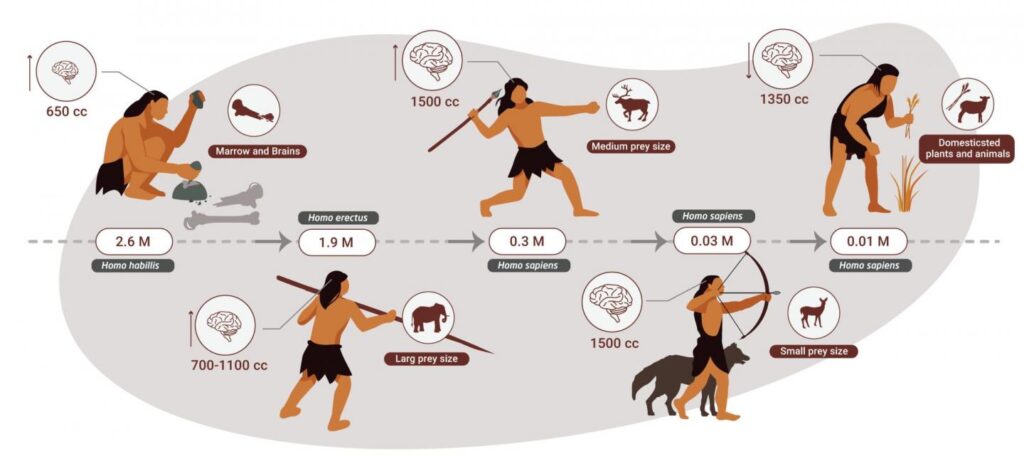
How the diet of ancient humans changed as our brains evolved. Image credit: Dr Miki Ben Dor

The study examined genetic evidence, finding that human genome expression of genes related to plant digestion did not become widespread until late in the Pleistocene. Additionally, morphological adaptations in ancient hominids, such as Homo erectus, suggest a focus on hunting and consuming meat.

The Transition to Omnivory

While humans were primarily carnivorous for millions of years, the shift to a more omnivorous diet occurred towards the end of the Pleistocene. This transition was likely driven by the scarcity of animal resources and the need to adapt to changing environmental conditions.

The Impact on Agriculture

The researchers argue that the late shift to a more omnivorous diet played a significant role in the development of agriculture. As humans began to rely more on plants, they developed new tools and techniques for processing them.

The study’s findings challenge the traditional understanding of ancient human diets. For millions of years, humans were apex predators, primarily consuming meat. It was not until the late Pleistocene that humans began to diversify their diets and eventually develop agriculture. This new research provides valuable insights into the evolution of human dietary habits and our place in the food chain.

Filed Under: Trends Worldwide Tagged With: agriculture, ancient human diet, ancient humans, archaeology, carnivorous diet, DIET, Genetics, human evolution, hunter-gatherer diet, hunter-gatherers, hypercarnivorous humans, hypercarnivory, megafauna, metabolism, morphology, paleontology, plant-based diet, pleistocene, Pleistocene era, stone tools

Reader Interactions

Leave a Reply Cancel reply

Your email address will not be published. Required fields are marked *

Primary Sidebar

More to See

The Enduring Wonder of Jaya Sri Maha Bodhi: World’s Oldest Living Human-Planted Tree

By Stephen King

Woman wakes to 5m python beside her bed

By Stephen King

Road Trip to the Roof of the World: Conquering the Karakoram Highway

By Stephen King

Unveiling the Ancient Mystery: Why Magnolias Are Pollinated by Beetles

By Stephen King

A Man Walking Down The Street Notices The Largest Snake He Has Ever Seen

By Stephen King

Secret UFO civilization, aliens could be here on Earth already: Harvard scientists

By Stephen King

Two Tanks With The Same Water in Them, But One of Them Contains Oysters.

By Stephen King

Footer

Home and Garden: Timeless Beauty and Smart Investment

Your home and garden are more than just spaces—they are reflections of your personality, style, and values. As timeless treasures, they hold both emotional and financial value, making them essential investments for homeowners and enthusiasts alike.

Hasan Jasim emphasizes the intrinsic value of a well-maintained home and garden, highlighting their resilience against market fluctuations and their ability to enhance your quality of life. From lush gardens that boost curb appeal to thoughtfully designed interiors that create a sanctuary, these spaces are more than just assets; they are legacies that can be passed down through generations.

Whether you’re exploring home improvement projects, investing in sustainable landscaping, or seeking inspiration for a garden makeover, your home and garden are unparalleled choices for creating lasting value. Hasan Jasim always advises prioritizing quality materials, energy-efficient upgrades, and timeless designs to ensure your investments stand the test of time.

Unveil elegance in your home and garden—where beauty meets investment!

Recent

  • This Woman Lets a Fox Inside During a Thunderstorm, and He Makes Himself Right at Home
  • Paddleboarder Sees Iguana Swimming Toward Her — Then He Climbs Up To Ask For Help
  • Northern Ont. polar bear chows down on a massive pumpkin
  • Driver Thinks Hawk Has A Squirrel — But The Truth Makes Her Hit The Brakes
  • ‘David Attenborough Effect’: Meet the wildlife artists inspired by the legendary broadcaster
  • Living Fossils in the Palm of Your Hand: The Wondrous Secrets of “Triops”
  • Missing businessman found dead inside huge crocodile lifted from river – horrific new details emerge

Search

Copyright © 2026 · Magazine Pro on Genesis Framework · WordPress · Log in