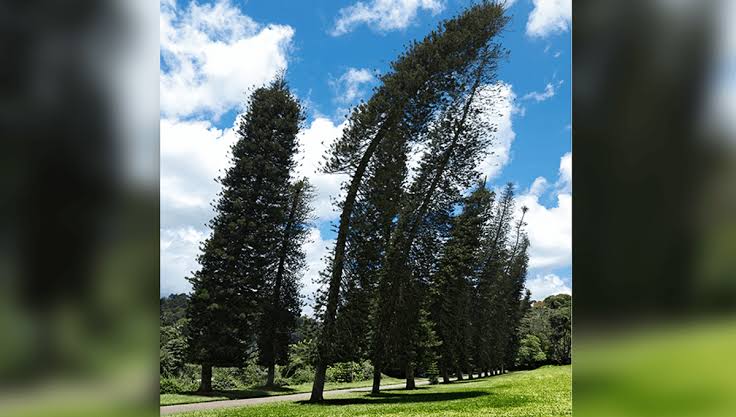
Walk through a park in California, Australia, or Hawaii and you might notice something odd about the tall, narrow conifers dotting the landscape: they’re leaning. Not randomly, the way a tree bent by wind or crowded growth might lean, but in a strangely consistent direction. It turns out this isn’t a local quirk — it’s a global pattern, and it took a curious botanist to notice it.
An Unlikely Discovery
The tree in question is the Cook pine (Araucaria columnaris), native to the French Pacific territory of New Caledonia. Long before scientists took interest, the species had already spread across the world as an ornamental tree, planted in gardens, campuses, and coastal parks throughout the tropics, subtropics, and warmer temperate zones.
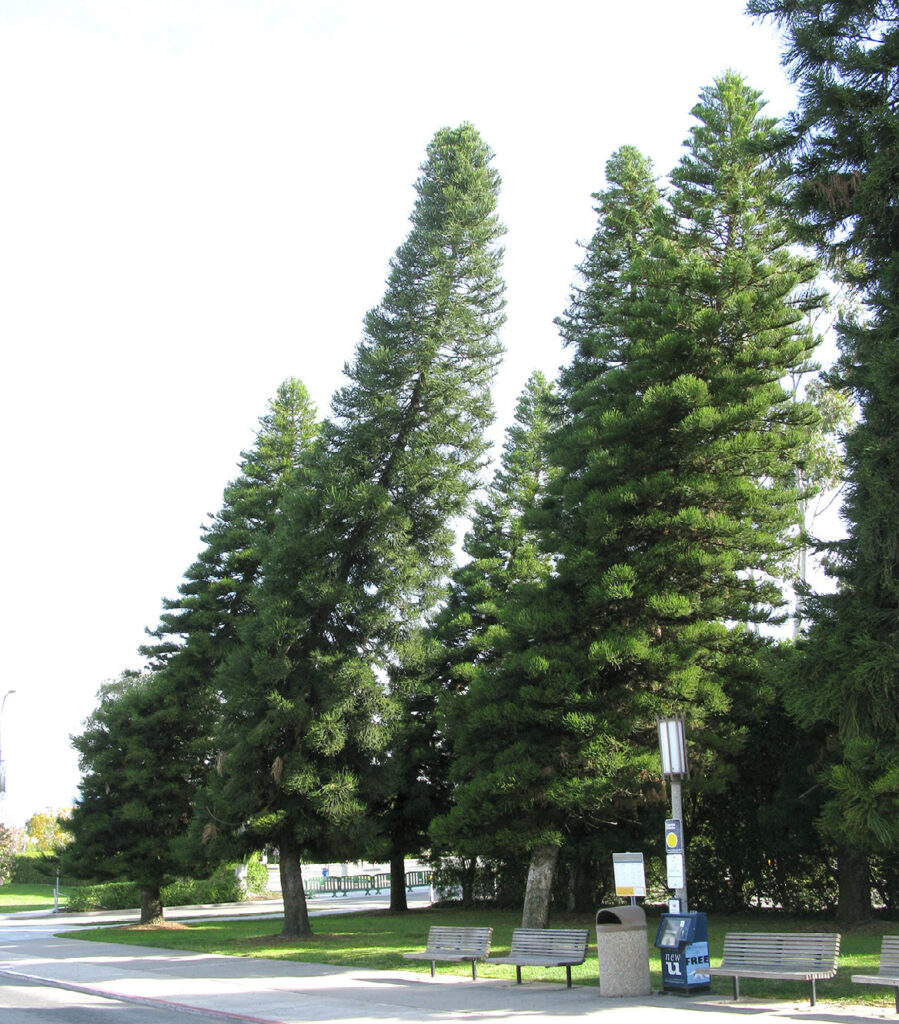
The pattern was first spotted by Matt Ritter, a biology professor at California Polytechnic State University in San Luis Obispo, while he was researching trees for a book on California’s urban forests. He noticed that Cook pines around campus all leaned the same way — toward the south. Curious whether this held true elsewhere, he reached out to a colleague in Australia, who reported the opposite: the trees there leaned north.
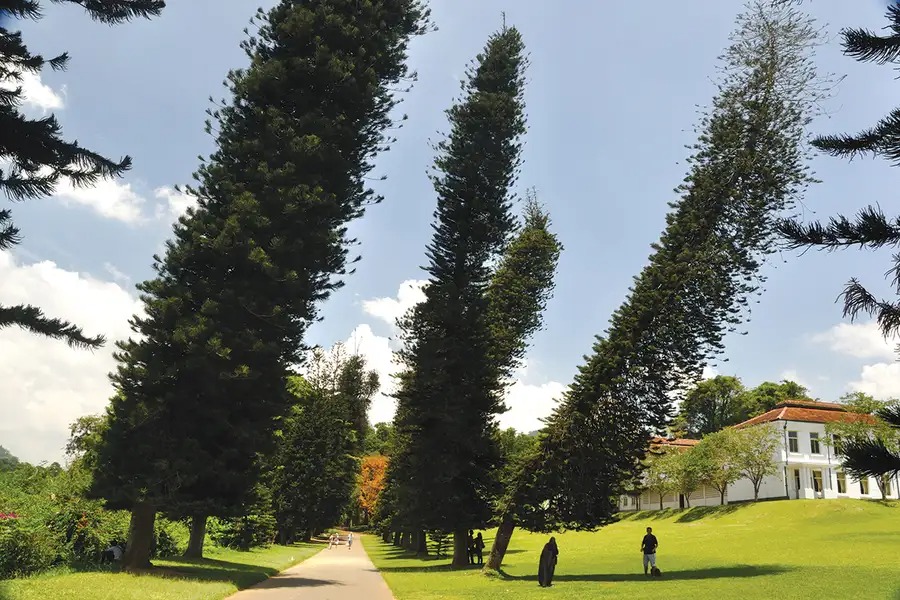
Both directions, it turned out, pointed toward the same place: the equator.
Testing the Pattern Worldwide
Intrigued, Ritter teamed up with fellow researchers Jenn Yost, Jason Johns, and others to investigate more rigorously. Between them, they measured 256 Cook pine trees across 18 regions on five continents, spanning latitudes from roughly 7° to 35° north and 12° to 42° south. To keep the data clean, they excluded trees whose growth might have been skewed by nearby buildings or power lines, and recorded each tree’s height, trunk diameter, and the compass direction and degree of its lean.
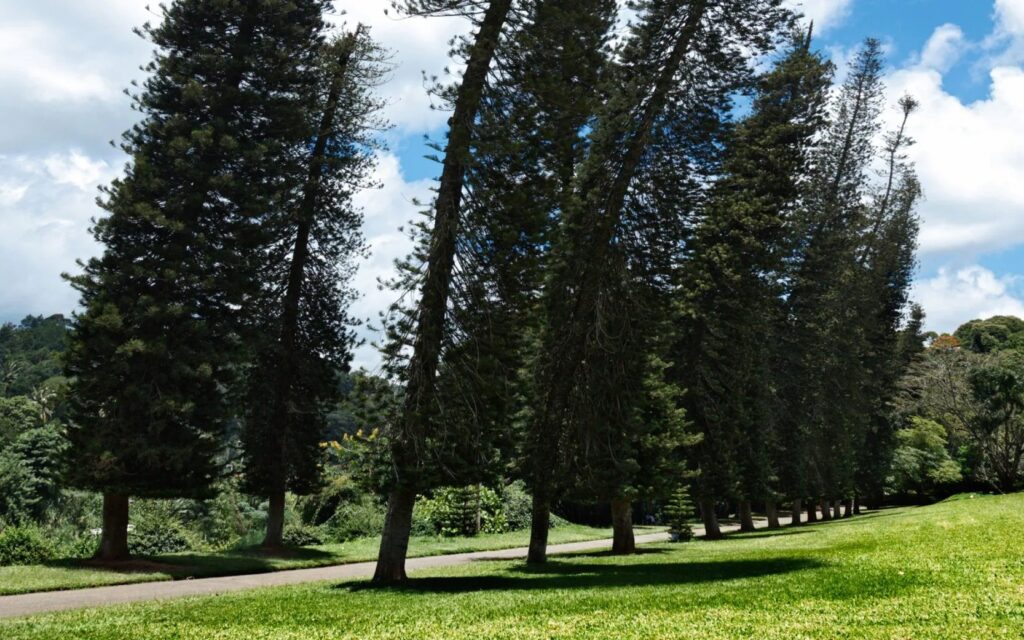
The results, published in the journal Ecology in 2017, confirmed what Ritter had suspected: Cook pines in the Northern Hemisphere consistently lean south, while those in the Southern Hemisphere lean north — in both cases, toward the equator. Fewer than 9% of the trees measured broke from this pattern.
On average, the trees tilted by roughly 8 degrees — more than double the famous lean of the Tower of Pisa. And the farther a tree grew from the equator, the more pronounced its tilt became. The most extreme example was a Cook pine in Brighton, South Australia, leaning a striking 40 degrees off vertical.
So Why Does It Happen?
Here’s the part that still puzzles researchers: nobody knows for certain.
Most trees have two competing growth responses working together — gravitropism, which keeps a trunk growing straight up against gravity, and phototropism, which bends new growth toward light. Normally, gravitropism wins out over time, straightening any lean caused by uneven sunlight. Cook pines seem to be missing that correction mechanism, or at least have a much weaker version of it.
Ritter’s leading hypothesis points to phototropism working overtime: at higher latitudes, sunlight strikes the Earth at a lower angle, and leaning toward the equator may let the tree capture more direct light. Other researchers have floated genetic explanations — the possibility that Cook pines, having evolved in a narrow equatorial range, simply never developed strong enough gravitropic correction because it was never necessary at home.
Interestingly, this isn’t entirely without precedent in the plant world. Steven Warren of the US Forest Service has noted that yucca flower stalks in the American Southwest tend to point south, likely to reduce the energy cost of transporting nutrients to their blooms, and that some cacti lean toward the sun as well. But a tree consistently orienting its entire trunk relative to its position on the globe was, by Ritter’s account, something entirely new to plant science.
A Small Mystery, Still Unsolved
Since the study’s publication, Ritter has said he’s received theories from people all over the world — some more testable than others. One idea ties back to the species’ colonial-era spread: Captain James Cook first encountered the tree during his 1774 voyage to New Caledonia, and some of the seeds that later propagated worldwide may have carried a shared genetic trait affecting how the species senses light and gravity.
For now, the Cook pine remains one of botany’s more charming unsolved puzzles — a tree that, wherever it’s planted, seems to know exactly which way is home.
Leave a Reply