• Skip to main content
  • Skip to primary sidebar
  • Skip to footer
  • Home
  • About Us
  • Copyright Report
  • Submit Content
  • Terms
  • Privacy Policy
  • Legal Disclaimer

Hasan Jasim

Hasan Jasim is a place where you may get entertainment, viral videos, trending material, and breaking news. For a social generation, we are the largest community on the planet.

Tomorrow Island (Russia) and Yesterday Isle (USA) Are Just Three Miles Apart But There’s a 21-Hour Time Difference Between Them

by Hasan Jasim Editorial Team 7 Comments

ShareTweet

In the frigid waters of the Bering Strait, nestled between mainland Alaska and Siberia, lie the Diomede Islands—an intriguing duo separated by a mere three miles but connected by an extraordinary temporal paradox. Big Diomede, situated on the Russian side, and Little Diomede, on the U.S. side, coexist in a unique dance with time, thanks to their proximity to the International Date Line.
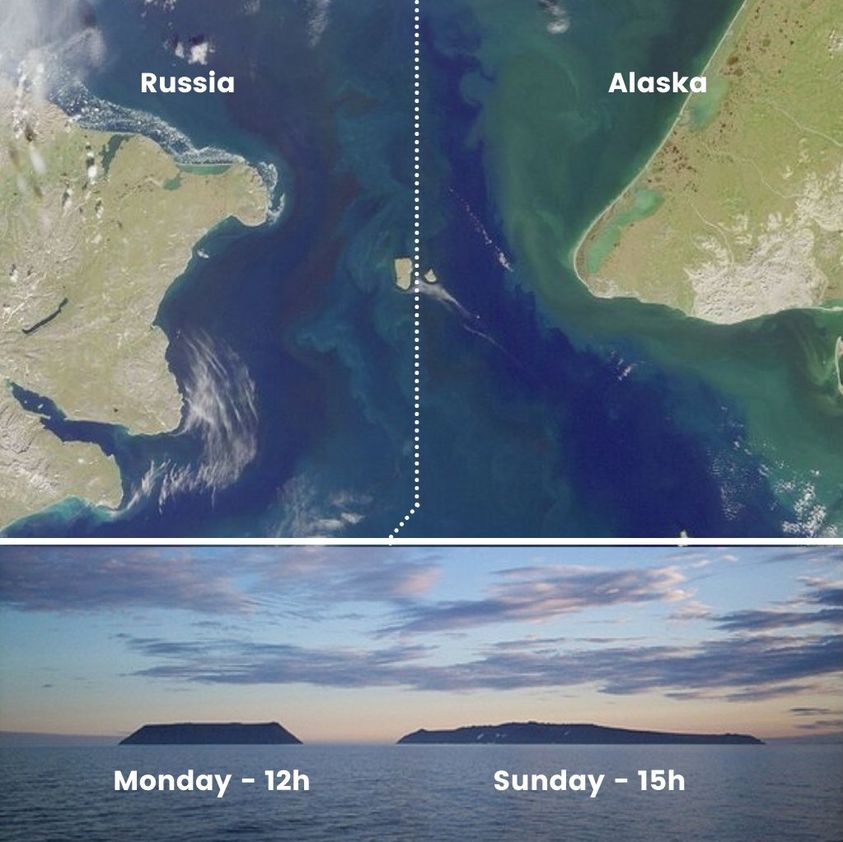

This geographical oddity has earned the islands playful monikers: Tomorrow Island for Big Diomede and Yesterday Island for Little Diomede. Despite their close proximity, a 21-hour time difference separates them, a consequence of their alignment with the International Date Line and the intricacies of locally defined time zones (20 hours in summer).
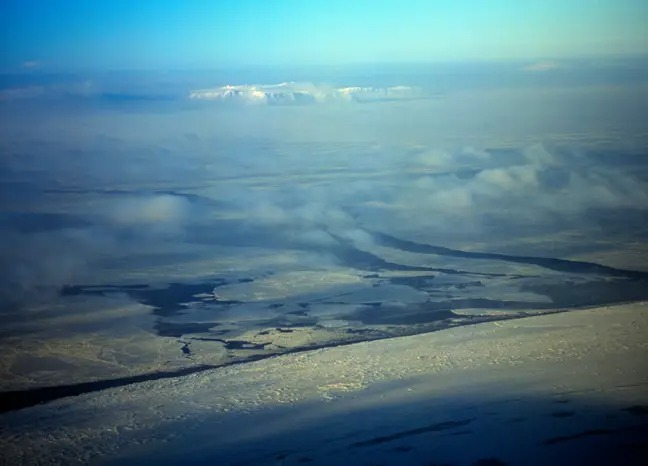
A wintry aerial shot of both Big and Little Diomede. Credit: P.A. Lawrence, LLC./Alamy Stock Photo

Ramil Gumerov, a former soldier who served on Big Diomede, describes the experience as a “real time machine,” allowing them to witness events of yesterday in real-time. The islands, though separated by a geopolitical border, offer a fascinating glimpse into the coexistence of past and future within a few miles of each other.
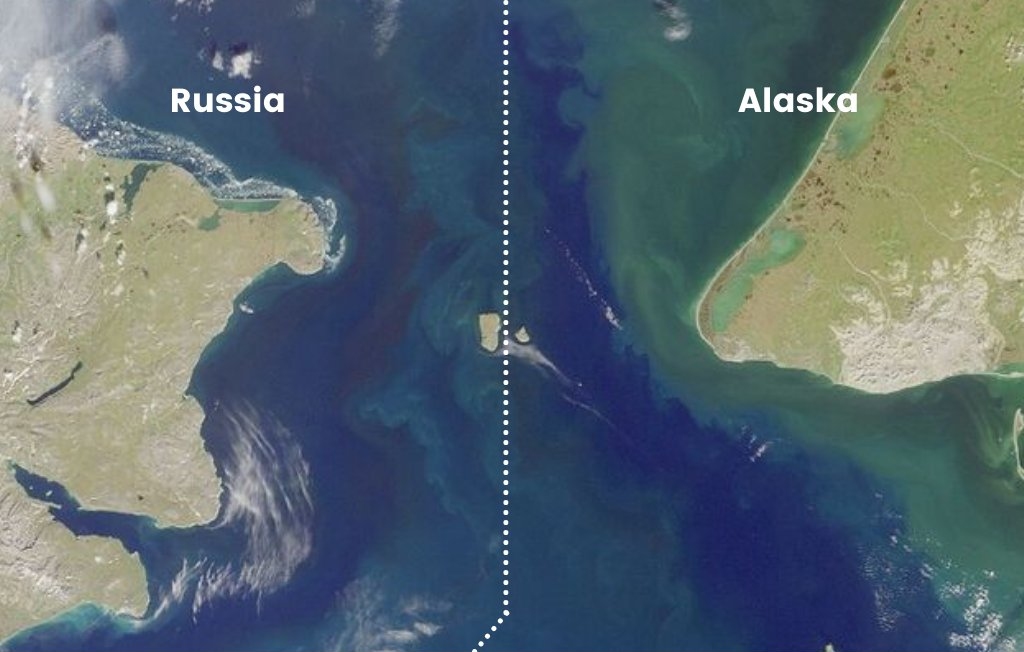
Satellite photo of the Bering Strait, with the Diomede Islands at center. Image credit: NASA

The islands, once part of the same realm during the 17th century, became divided when Russia sold Alaska to the U.S. in 1867. This division led to a peculiar situation for the indigenous inhabitants—the Eskimos—who found themselves in the same time but different dates scenario. The Eskimos were granted visa-free travel to facilitate visits between the islands, ensuring they could connect with relatives despite the temporal divergence.

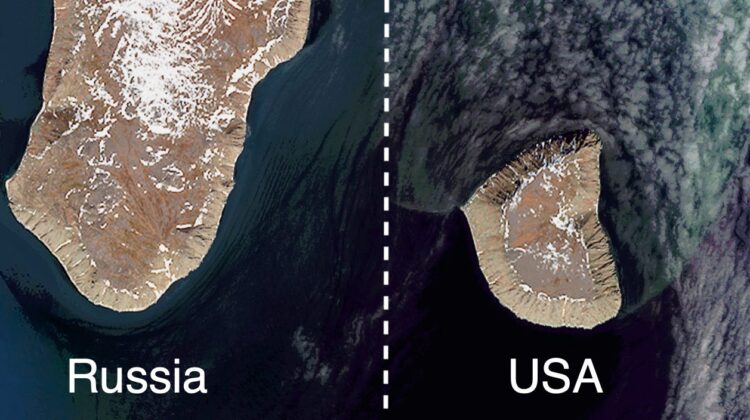
Remember, this is a US/Russia border. Credit: APFootage/Alamy Stock Photo

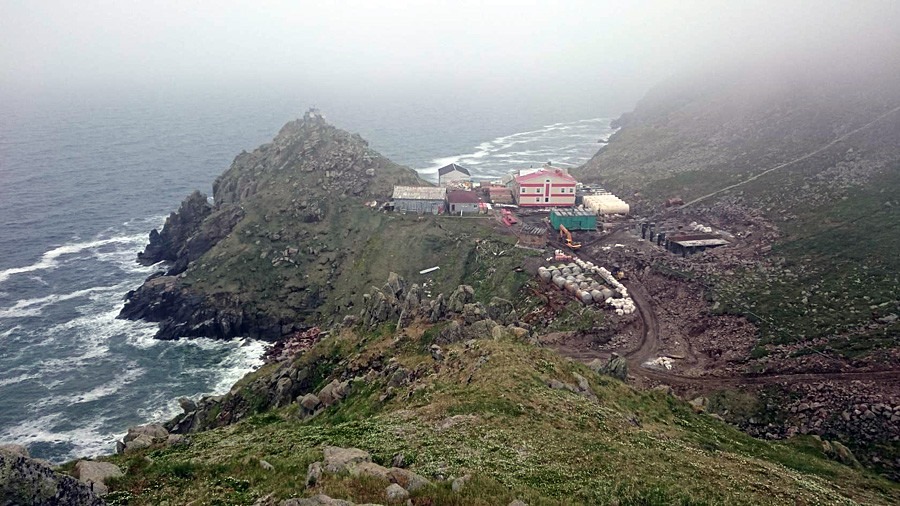
Legend has it that after the Eskimos left Big Diomede, a shaman cursed the island, and some claim that, since then, mysterious deaths have occurred. Gumerov reflects on the harsh conditions of life on the island—nine months of winter, freezing temperatures, and thick fog covering Big Diomede for 300 days a year. The island’s isolation is emphasized by infrequent helicopter flights delivering supplies and mail only once every two to four months.
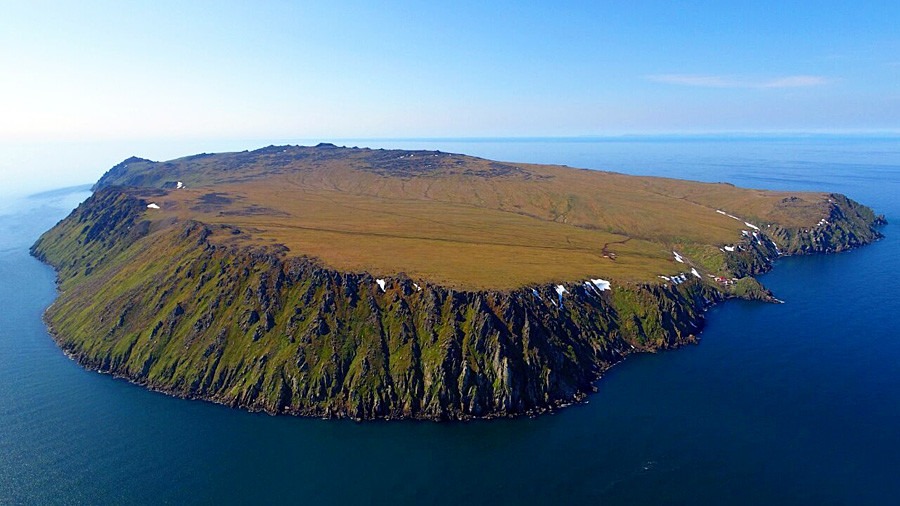
Big Diomede (Ratnamov Island) between Chukotka and Alaska. Image credit: Ramil Gumerov

During the Cold War, the border between Big and Little Diomede earned the moniker “Ice Curtain.” However, in 1987, American long-distance swimmer Lynne Cox made history by swimming from Little Diomede to Big Diomede in approximately two hours, braving the icy waters and symbolically breaking the Ice Curtain. This courageous feat was recognized by both Mikhail Gorbachev and Ronald Reagan, highlighting the power of human connection over geopolitical divides.
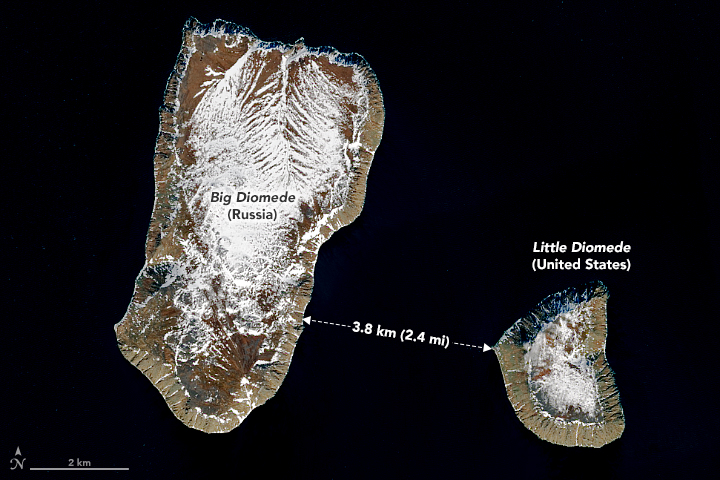
Tow islands, artificially separated in space and time. Image credit: NASA
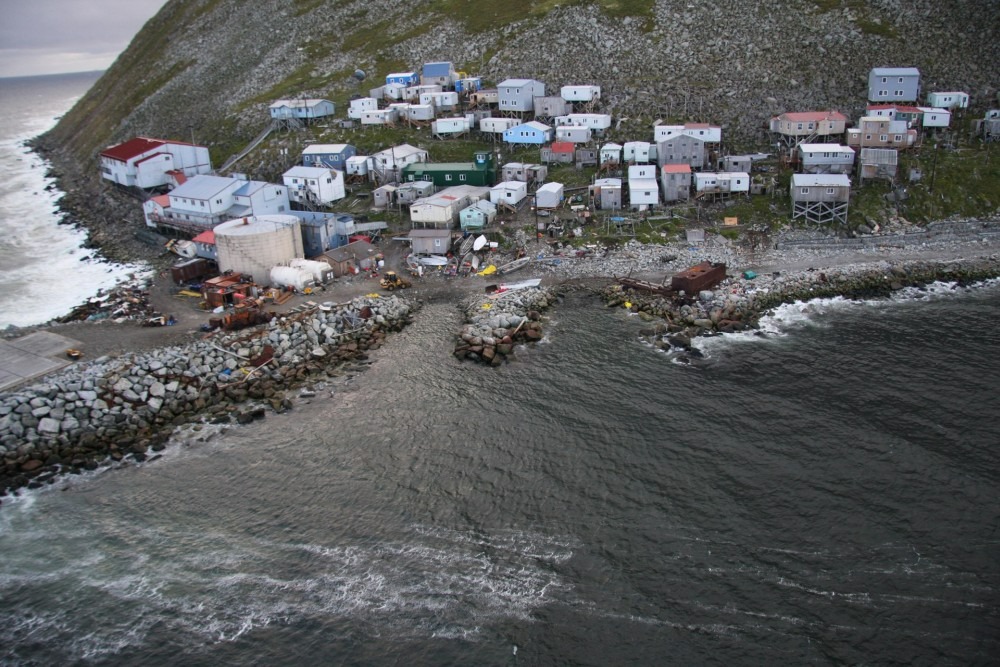
The native village of Little Diomede sits on the border of Russia and the United States. U.S. Coast Guard Photo by Petty Officer Richard Brahm
n 1941, the first border guard detachment arrived on Big Diomede. Image credit: Ramil Gumerov

As the islands continue to exist in their temporal duality, Tomorrow Island and Yesterday Island stand as a testament to the interplay of time, borders, and the enduring spirit of those who inhabit these remote corners of the world.

Filed Under: Trends Worldwide Tagged With: “nearly, 21-hour, apart,, between, difference:, entire, island, island’s, isle, just, miles, only, russia, separated, them, there’s, these, three, time, tomorrow, trends, USA, worldwide, yesterday, zones

Reader Interactions

Comments

  1. tom pisillo says

    December 27, 2022 at 12:18 pm

    the information provided in your article provides absolutely no relevant information in terms of the next thousand years when the human race will no longer be inhabiting the planet except for a few retarded monkeys formally considered less than humans who managed to escape extermination practices of the time. Due to their disinterest in procreation practices being the only entertainment worthy of their attention and the availability of suitable members of the opposite gender., sad but true. they preferred less challenging forms of entertainment. Getting in or out of bed was just beyond their intellectual abilities. much less attempting intercourse. To bad so sad.

    Reply
    • shane dillon says

      February 8, 2023 at 2:05 pm

      Eh thatmakesverylittlesense

      Reply
    • Peter Buchi says

      February 9, 2023 at 9:39 am

      “To bad”? Someone this pretentious and condescending should be more capable of spelling, or at least using the spell check on your phone.

      Otherwise, I should ask, “to bad what, so sad?”

      It is indeed unfortunate that your attempt at high-handed humor had to fall flat to the ground, burdened by your lack of attention to detail.

      Reply
    • Dave Spain says

      February 9, 2023 at 1:54 pm

      In short, you are a load your mother should have swallowed.

      Reply
    • Bart O'Kavanaugh says

      February 9, 2023 at 7:49 pm

      What?

      Reply
  2. опрессовка системы отопления цена says

    December 29, 2022 at 12:17 am

    Hello colleagues, how is all, and what you desire to say
    about this article, in my view its actually remarkable in favor of
    me.

    Reply
  3. Jay Ralston says

    February 9, 2023 at 3:34 am

    I live on Medium Diomede.

    Reply

Leave a Reply Cancel reply

Your email address will not be published. Required fields are marked *

Primary Sidebar

More to See

Humans Have Messed Up The World’s Freshwater Cycle

By Hasan Jasim Editorial Team

Following a costly trip to the clinic, the guy discovers that his limping dog was just emulating him out of pity

By Hasan Jasim Editorial Team

Monkeys Could Have Created Stone Age Tools in Brazil

By Hasan Jasim Editorial Team

Why Are Some Trees Painted White At The Bottom?

By Hasan Jasim Editorial Team

At 2,100 Years Old, Lady Dai’s Mummy Is Still In Unbelievable Shape

By Hasan Jasim Editorial Team

Scientists claim our dreams are real in another dimension

By Hasan Jasim Editorial Team

Man develops ‘pork worms’ after years of one specific cooking habit

By Hasan Jasim Editorial Team

Footer

ABOUT HASANJASIM.ONLINE

Hasanjasim.online is a digital platform dedicated to publishing well-researched articles about the animal kingdom, nature, and the environment. Our editorial team works to source stories from credible outlets, scientific research, and verified reports, aiming to inform as much as we entertain. From wildlife conservation and animal behavior to natural wonders and environmental science, we cover the topics that help readers better understand and appreciate the natural world. Whether you're a lifelong nature lover or simply curious about the planet we share, Hasanjasim.online aims to be a trustworthy destination for stories worth reading — and worth citing.

Recent

  • Scientists Found Ancient Americans Living Where No Humans Should Have Been
  • This African Bird Wears Sunflowers Around Its Eyes — Meet the White-Crested Helmetshrike
  • 25 Animals You’ve Probably Never Heard Of — From a Cuban Land Snail to a Marsupial That Mates Itself to Death
  • Woman finds cow’s tooth in takeout taco. The chain says it can happen
  • Healthy Senior Dog Spared After Family Asked Veterinarians to Euthanize Her, Georgia Rescue Says
  • How People Around the World Write Laughter Online
  • The Disturbing Story Behind This Award-Winning Photojournalism Image

Search