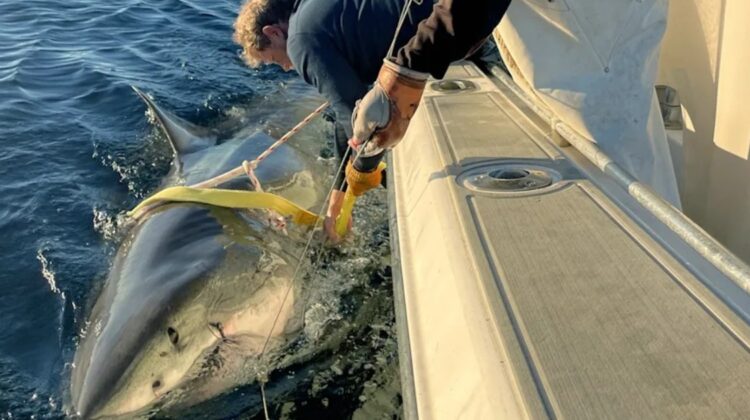
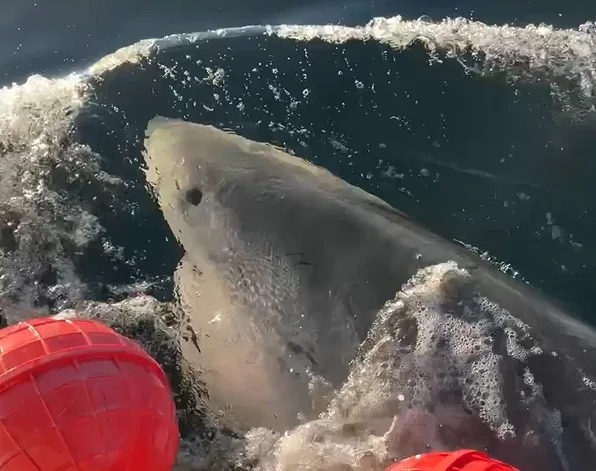
Contender, the largest male great white shark ever tagged in the Atlantic, has just pushed into territory no OCEARCH-tracked shark has reached before — and scientists are paying close attention to why.
Meet Contender
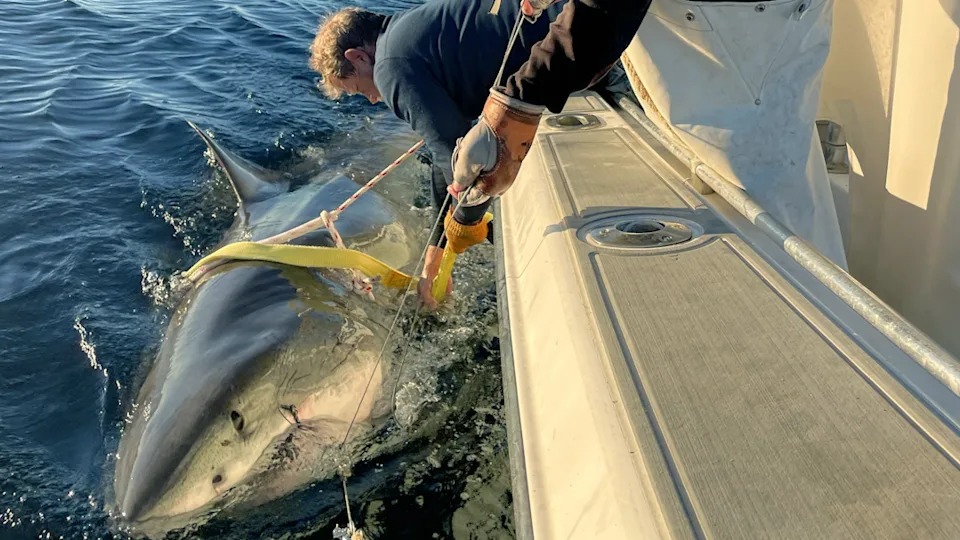
Contender was tagged by the ocean research nonprofit OCEARCH on January 17, 2025, roughly 45 miles off the Florida–Georgia coast. At the time, he measured about 13.8 feet long and weighed an estimated 1,653 pounds, making him the largest male white shark OCEARCH has ever tagged in the Western North Atlantic. Believed to be around 32 years old, Contender carries a SPOT satellite tag capable of transmitting his location for roughly five years, giving researchers an unusually long window into his movements.
A Route Into Uncharted Territory
According to OCEARCH, Contender recently passed through the Strait of Belle Isle — the narrow passage separating the northern tip of Newfoundland from Labrador — before continuing into open waters farther north than any previously tracked OCEARCH shark has gone.
“Contender is taking us somewhere we haven’t seen another OCEARCH-tagged white shark go before,” the organization said in a Facebook post announcing the milestone.
This isn’t Contender’s first trip to the region. OCEARCH has noted that around this same time last year, he was recorded in the Gulf of St. Lawrence before heading south for the winter, and more recently he’s been tracked off Nova Scotia’s Cape Breton Island. His repeated return to Atlantic Canada’s far-northern waters is exactly what has researchers intrigued.
Why This Matters To Scientists
John Tyminski, OCEARCH’s senior data scientist, said Contender’s pattern of returning to these far-north waters hints at something researchers hadn’t fully appreciated before.
“His repeated return tells us something important: this far-north habitat may be more important to white sharks than we once realized,” Tyminski said. “One shark’s journey can reveal an entire network of habitats that we might otherwise never know was being used.”
Tyminski has also described the Strait of Belle Isle as an “ecological gateway” — a nutrient-rich passage that likely draws prey, and in turn predators like Contender, despite water temperatures there running far colder than what white sharks typically favor. Great whites are able to tolerate that sharp temperature swing, according to OCEARCH.
Part Of A Bigger Migration Picture
Contender’s journey adds to a growing body of tracking data showing just how tightly connected the Western North Atlantic’s white shark population is, from the southeastern United States all the way to Atlantic Canada. OCEARCH has previously reported that roughly 88% of white sharks tagged in the U.S. Southeast have gone on to travel to Atlantic Canada at some point, underscoring how far individual sharks routinely roam.
Since his tagging, Contender has surfaced repeatedly along the Atlantic coast, including sightings off the Outer Banks of North Carolina, off Massachusetts, near Quebec’s Gaspé Peninsula, and even off Atlantic City, New Jersey — giving researchers an unusually detailed picture of one shark’s year-round movements.
What Comes Next
With Contender now in previously undocumented waters, OCEARCH says the milestone should help researchers better understand the environmental factors shaping white shark movement in the region — and potentially reveal habitats that hadn’t been on scientists’ radar at all. His movements, along with those of hundreds of other tagged sharks, whales, and sea turtles, can be followed in near real time through OCEARCH’s free Global Shark Tracker app.
Frequently Asked Questions
How big is Contender the great white shark? Contender measured about 13.8 feet long and weighed an estimated 1,653 pounds when he was tagged, making him the largest male white shark OCEARCH has ever tagged in the Western North Atlantic.
Where was Contender tagged, and how is he tracked? He was tagged by OCEARCH on January 17, 2025, about 45 miles off the Florida–Georgia coast. He carries a SPOT satellite tag that transmits his location whenever his dorsal fin breaks the surface within range of a satellite, with an expected battery life of around five years.
Why is Contender’s trip north significant? He has traveled farther north than any other OCEARCH-tagged white shark on record, suggesting that far-northern Atlantic Canadian waters may be a more important habitat for white sharks than previously understood.
Is it dangerous that a great white shark is this far north? No — Contender’s movements are a normal part of white shark migration patterns. Tracking data like his helps researchers, and by extension coastal communities, better understand where and when white sharks are present in a given area.
How can I track Contender’s location myself? OCEARCH offers a free Global Shark Tracker app that shows near real-time locations for Contender and hundreds of other tagged sharks, whales, and sea turtles.
Sources: FOX Weather, OCEARCH official press materials, and additional Atlantic coast news coverage of Contender’s tracking history, cited above.
Leave a Reply