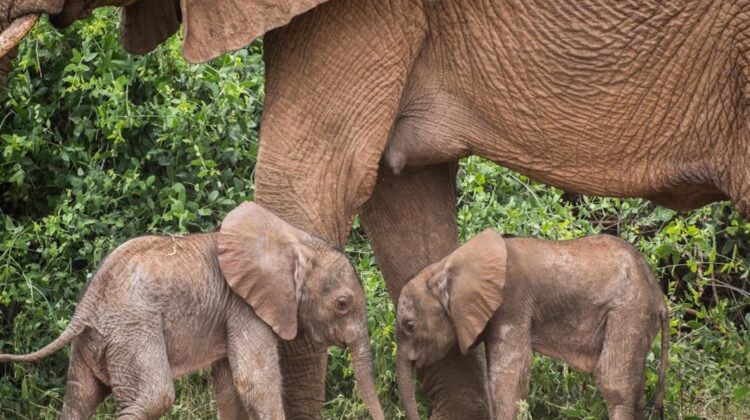
In Northern Kenya’s Samburu National Reserve, a pair of exceptionally uncommon twin African elephants have been born. The newborn elephants were spotted by Elephant Watch Camp guides who had been trained by Save the Elephants (STE), a UK organisation headquartered in Kenya, to distinguish individual elephants and elephant families in the reserve, according to a news statement from STE. STE researchers confirmed that there was one female and one male calf after being alerted by the guides.
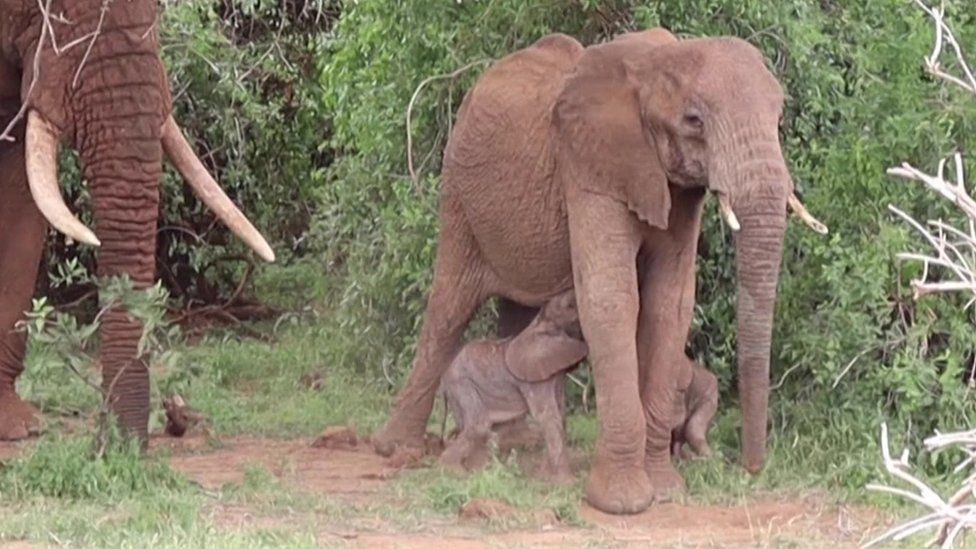
“Twins are uncommon in elephant herds, accounting for just around 1% of births. Mothers frequently do not have enough milk to raise two calves. In reality, the birth of twins in Samburu has only been documented once before, in 2006. “Unfortunately, both calves perished soon after delivery in Shaba National Reserve,” according to the STE news statement. “The new twins’ survival is up in the air for the next several days, but we’re all crossing our fingers.”
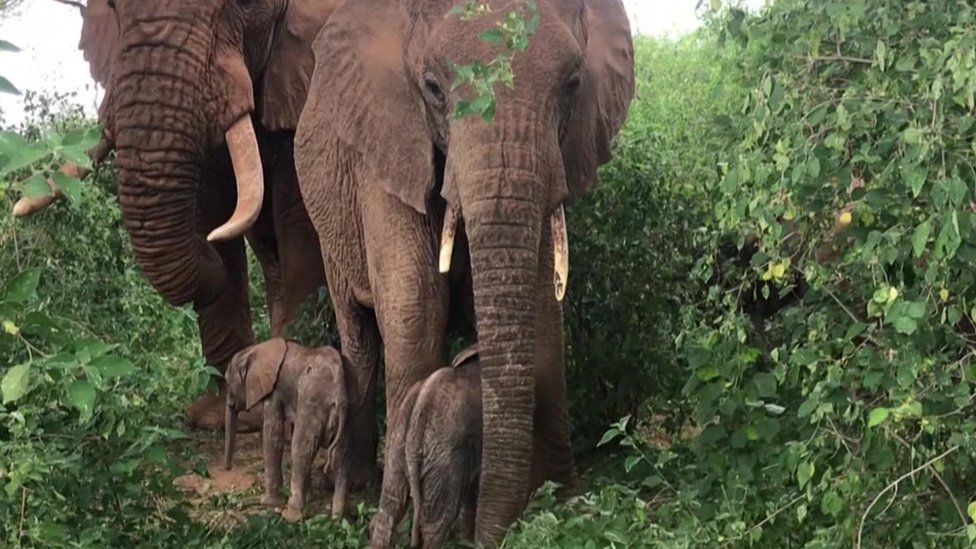
The twins are the offspring of a female elephant named Bora, who comes from the Winds II elephant family. Her elder calf was born in 2017 and was recently seen with its mother and twins in the same place.
“I’ve seen twins a few times in my career, and it’s always a major occasion for us… the last time we had twins, it wasn’t a nice outcome.” They can, however, survive. When they are born, it always creates quite a fuss,” STE creator Iain Douglas-Hamilton told Newsweek.
Elephants in Africa have the longest gestation period of any animal, at roughly 22 months, and give birth every four years. The STE researchers will keep an eye on the twin young elephants on a regular basis, according to Newsweek. For decades, STE has been keeping an eye on the Winds II family.
According to BBC News, African elephants are on the International Union for Conservation of Nature’s Red List of Threatened Species because of poaching and habitat destruction. According to Reuters, Kenya’s tourist ministry claimed in 2020 that the country’s elephant population has more than quadrupled from 16,000 in 1989 to 34,000 in 2018, thanks to stronger efforts to combat poaching.
According to Down to Earth, Kenya’s elephant population climbed by roughly 12% to 36,280 during the country’s first wildlife census in 2021.
According to Douglas-Hamilton, the new twin elephants appeared to be healthy, albeit a little undersized, according to Newsweek.
“The twins’ survival is very much dependent on the quality of the grass and foliage, as well as the matriarch’s experience,” Douglas-Hamilton told Newsweek. “This mother has successfully raised a calf previously, and the fact that it has just rained [means] that the grass in Samburu is green, giving the young twins a better chance of survival… We’ll cross our fingers, but we’re cautiously optimistic.”