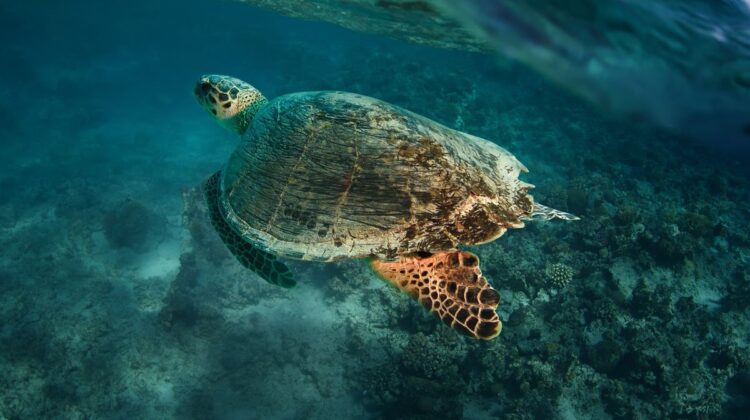
Growing old is an inevitable part of life – unless you’re a turtle. Evidence from two new studies suggests that several turtle species experience very little senescence, or the physical aging of our bodies. Turtles appear to be immune to the ravages of aging.
Testudines, the reptile order that includes turtles, terrapins, and tortoises, have shown the ability to slow down and even turn off senescence. Jonathan, the world’s oldest living land animal, is one famous example. At 190 years old, he is still having sex with his male and female companions, showing no signs of age.
The team used data from several long-term field studies that focused on 77 species from 107 wild populations in one of the new studies, which was published in the journal Science. Not only turtles and tortoises were included, but also amphibians, snakes, and crocodilians.
These cold-blooded animals showed a greater diversity of aging rates compared to birds and mammals, and they believe that in the case of the turtles their bony shell and slow pace of life (following the first reproduction) can help explain why they age so slowly – or not at all.
“Because they are not eaten by other animals, these various protective mechanisms can reduce animal mortality rates.” As a result, they are more likely to live longer lives, which puts pressure on them to age more slowly. Turtles provided the most evidence for the protective phenotype hypothesis. “Once again, this demonstrates that turtles as a group are unique,” said lead author Beth Reinke, an assistant professor of biology at Northeastern Illinois University.
While being cold-blooded does not guarantee a lack of aging, the researchers discovered at least one species with little to no senescence in each group, including frogs and toads, crocodilians, and, of course, turtles.
“It sounds dramatic to say they don’t age at all, but once they’re past reproduction, their likelihood of dying does not change with age,” Reinke explained.
Better environmental conditions, according to the second study, also published in Science, equate to even slower aging. They examined 52 zoo populations of turtle, terrapin, and tortoise species and discovered that 80 percent age slower than modern humans – and 75 percent have slow or negligible senescence.
“Contrary to popular aging theories, we show that many species of turtles and tortoises have discovered a way to slow down or even turn off senescence.” This means that senescence is not inevitable for all organisms,” said lead author Rita da Silva, who was at the University of Southern Denmark at the time of the study.
Humans have a 1 in 1,000 chance of dying before their next birthday in their 30s, which increases as they get older – but not these animals, whose risk of death does not change. They can still die from diseases, accidents, or predators, but the chances are the same whether they are 10 or 130. In the case of the Black Marsh turtle, the likelihood of death decreases with age.
There are studies being conducted to see if it is possible to slow down senescence in humans, with promising results in mice.
Leave a Reply