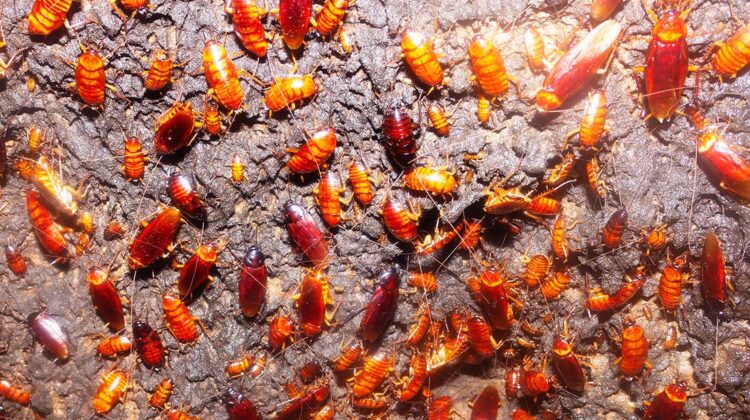
During the Cold War, you were probably warmed by the thought that “yes, I’m a goner, but at least the cockroaches will live on and develop their own society” while you learned your gloomy drills about cowering beneath a chair to try to avoid a nuclear blast.
Roaches, like Twinkies, have a reputation for being unstoppable. Although it’s unclear why Twinkies have such a tough reputation (they last about as long as any other cake), cockroaches are undeniably tough. They are one of the few organisms that can live without their heads, for example.
For most creatures, being without a head means the end of the road. Rarely do you come across a story about someone who was beheaded but “lived a full life well into their seventies.” If the blood loss didn’t kill you, and you didn’t lose control of your heartbeat and lungs (which both would), you’d quickly find it impossible to eat enough to stay alive.
Cockroaches may live for several weeks after being decapitated, as scientists have discovered with worrying regularity. They coagulate at the neck and survive decapitation. Their breathing is done through spiracles, which are little apertures in their body that are not controlled by the brain. They require less food than warm-blooded snowflakes like us because they are cold-blooded, and can survive for weeks on a meal eaten before decapitation day.
Furthermore, they have ganglia all over their body, allowing them to respond to stimuli like a scientist prodding them with a pen. Surprisingly, they can still stand and move around without their heads.
Meanwhile, the head can continue to live despite the fact that it has been severed from its body for several hours. They can live much longer if given nourishment, albeit they aren’t the same without the feedback from their bodies.
“It’s useless,” neuroscientist and arthropod learning expert Nick Strausfeld told Scientific American, “when we’ve tried to educate them when they’ve had pieces of them missing.” “We have to preserve their bodies as whole as possible.”
To be fair, they’re tough little beasts. Can they, however, withstand nuclear explosions? Would they be the only ones to inherit the Earth after a nuclear war?
Yes, sort of, is the simple response to the first question. They were discovered among the ruins after the 1945 nuclear bombings on Hiroshima and Nagasaki, though it should be mentioned that humans were also discovered alive, albeit many of them died of radiation sickness later. However, there is no record of anyone monitoring the cockroaches’ health after their survival; naturally, they were preoccupied with other matters at the time.
Humans, including the Mythbusters team, have tested their radiation tolerance before and after those nuclear bombs.
They exposed separate groups of cockroaches, fruit flies, and flour beetles to 1,000, 10,000, and 100,000 rads (a unit of absorbed radiation exposure) over the course of a month. After the trauma, 10% of the roaches in the 10,000 rad group remained alive, which is ten times the human deadly dose. None of them, however, made it through 100,000 rads.
The flour beetles, on the other hand, did. The ten percent that survived 100,000 rads for the entire 30 days of the experiment proved to be far more resilient than the long-dead cockroaches.
The investigation, however, did not check into whether the radiation cockroaches and flour beetles could have viable offspring. It’s possible that the insects survive the blast and radiation, but are unable to maintain the species long enough to deal with the problem, resulting in the extinction of the entire food chain.
In any case, it appears that cockroaches would do worse than many other insects in the event of a nuclear war.
“There is some evidence that they appear to be quite immune to gamma rays,” evolutionary researcher Mark Elgar told EarthSky. “However, they are not necessarily the most resistant across insects.” “Some ants, particularly those that build deep nests into the ground, might be more likely to survive an apocalypse than cockroaches,” says the author.
To address the second question, it appears that cockroaches will not be inheriting the Earth.