• Skip to main content
  • Skip to primary sidebar
  • Skip to footer
  • Home
  • About Us
  • Copyright Report
  • Submit Content
  • Terms
  • Privacy Policy
  • Legal Disclaimer

Hasan Jasim

Hasan Jasim is a place where you may get entertainment, viral videos, trending material, and breaking news. For a social generation, we are the largest community on the planet.

NASA’s DSCOVR Satellite Captures Unique View of Moon Crossing Earth’s Face

by Stephen King Leave a Comment

ShareTweet

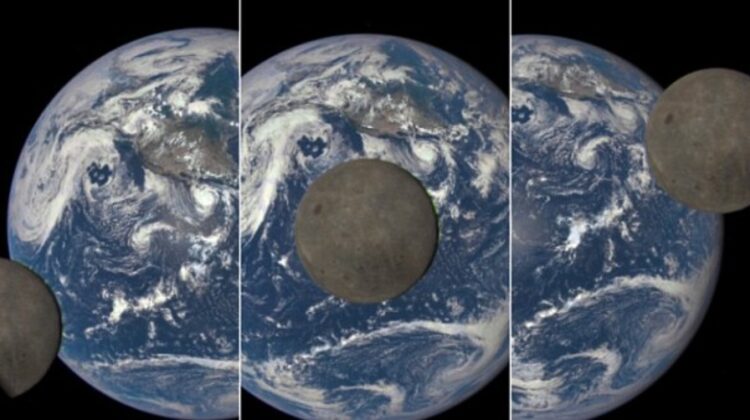
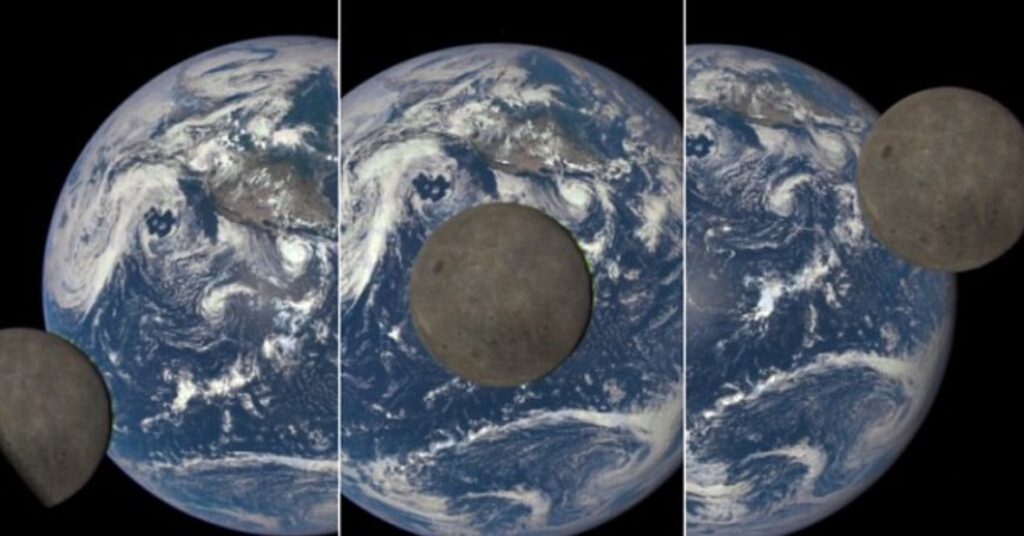
In August 2015, a remarkable image was captured by NASA’s Earth Polychromatic Imaging Camera (EPIC) aboard the Deep Space Climate Observatory (DSCOVR) satellite. It showed the moon moving in front of the sunlit side of Earth from a distance of 1 million miles.

EPIC is a four-megapixel CCD camera and telescope that constantly views the fully illuminated Earth as it rotates, providing scientific observations of various atmospheric phenomena. Once it begins regular observations, the camera will provide daily images of Earth, showcasing its daily variations over the entire globe.
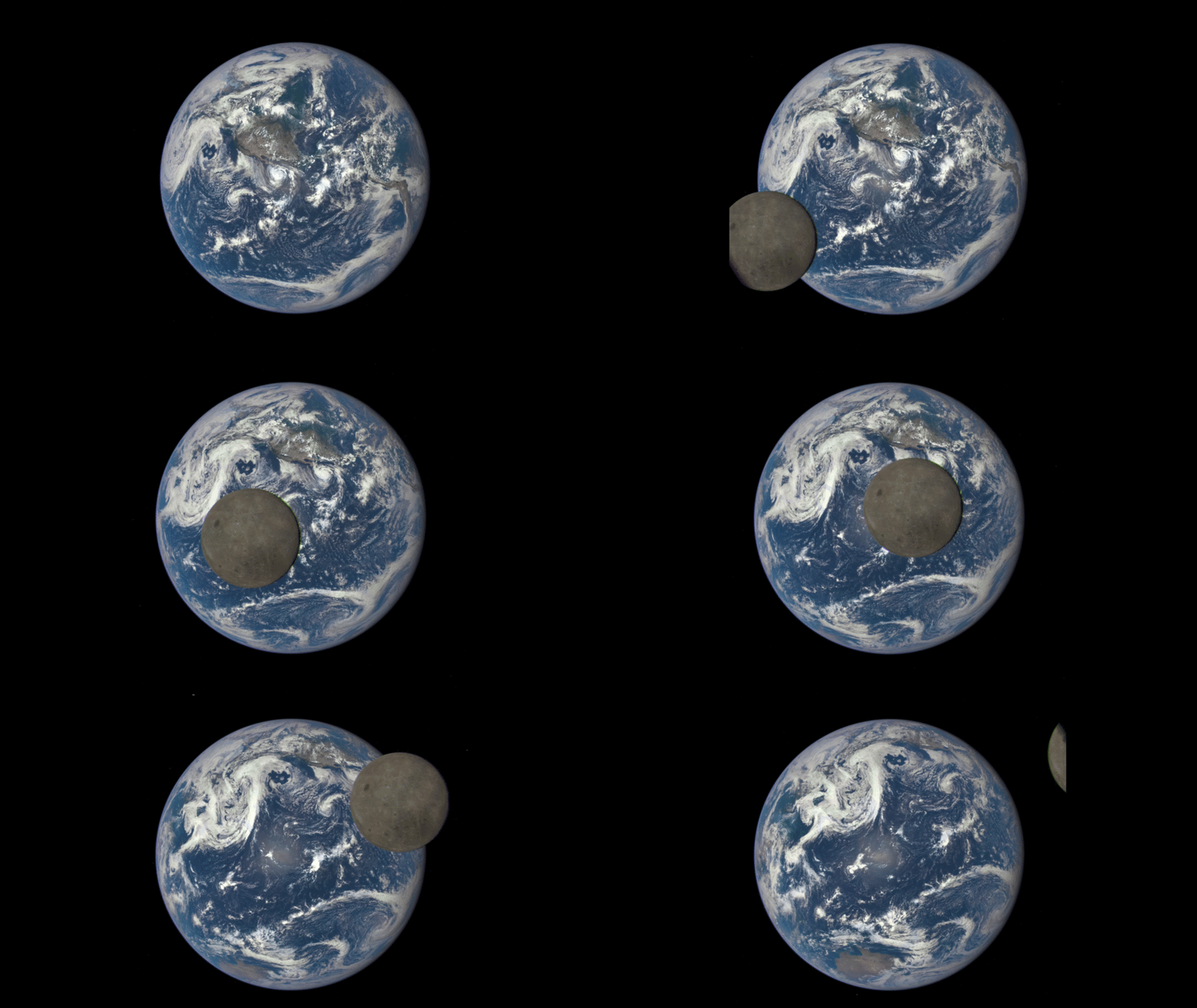
This animation features actual satellite images of the far side of the moon, illuminated by the sun, as it crosses between the DSCOVR spacecraft’s Earth Polychromatic Imaging Camera (EPIC) and telescope, and the Earth – one million miles away.
Credits: NASA/NOAA

The moon and Earth are captured together twice a year as the orbit of DSCOVR crosses the orbital plane of the moon. These images were taken between 3:50 p.m. and 8:45 p.m. EDT on July 16, showing the moon moving over the Pacific Ocean near North America. The North Pole is in the upper left corner of the image, which is in the original orientation as taken by the spacecraft.

The far side of the moon is not visible from Earth and was not seen until 1959 when the Soviet Luna 3 spacecraft returned the first images. Since then, several NASA missions have imaged the lunar far side in great detail. The same side of the moon always faces an earthbound observer because the moon is tidally locked to Earth. That means its orbital period is the same as its rotation around its axis.
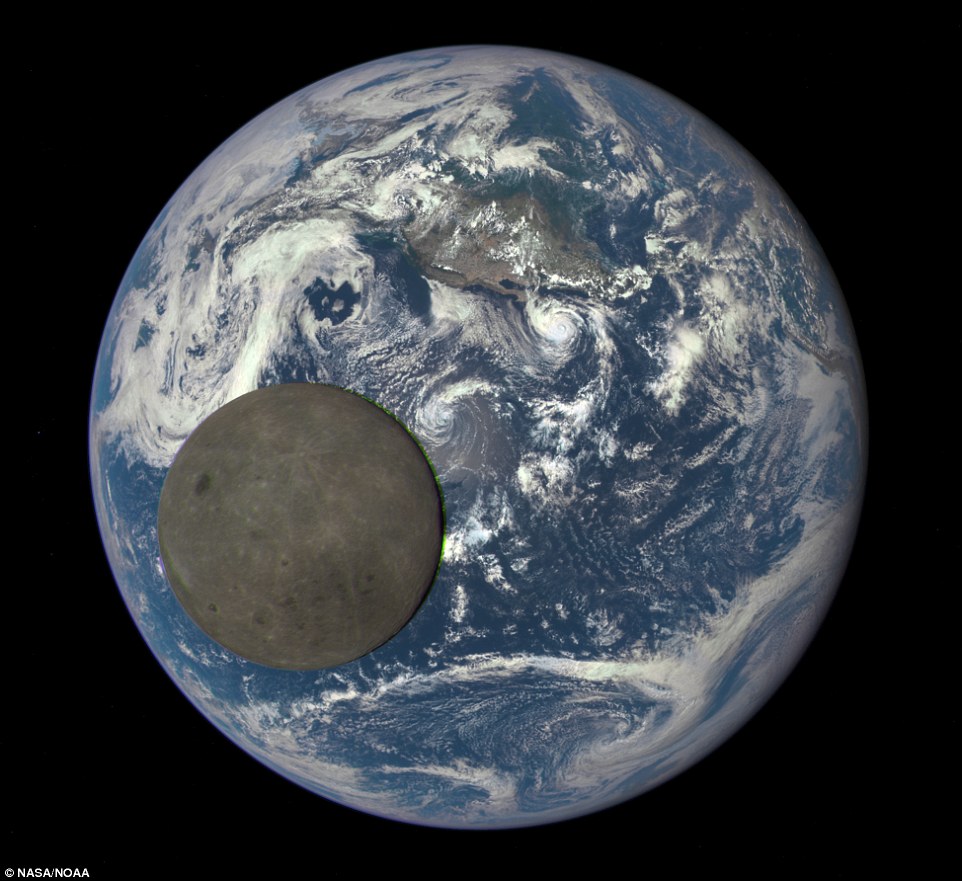
Thus image was taken between 3:50 p.m. and 8:45 p.m. EDT on July 16, showing the moon moving over the Pacific Ocean near North America. The North Pole is in the upper left corner of the image, reflecting the orbital tilt of Earth from the vantage point of the spacecraft

The EPIC’s “natural color” images of Earth are generated by combining three separate monochrome exposures taken by the camera in quick succession. EPIC takes a series of 10 images using different narrowband spectral filters, from ultraviolet to near-infrared, to produce various scientific products. The red, green, and blue channel images are used to produce color images.

Combining three images taken about 30 seconds apart as the moon moves produces a slight but noticeable camera artifact on the right side of the moon. The natural lunar movement produces a slight red and blue offset on the left side of the moon in these unaltered images.
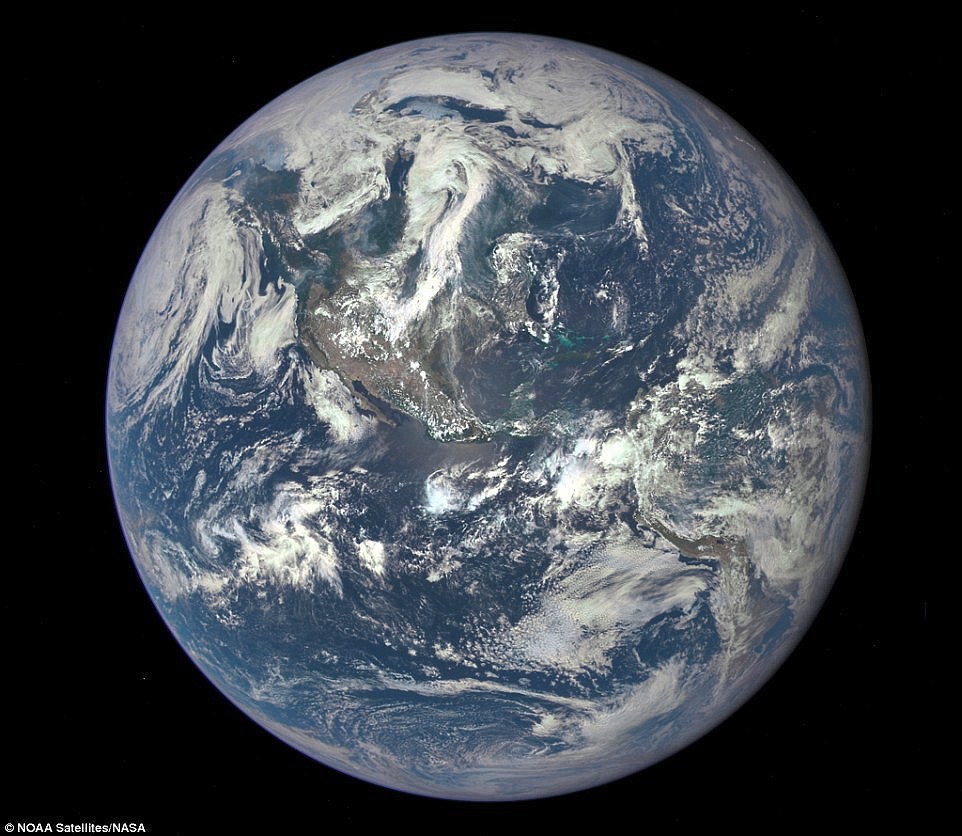
It comes just a month after Nasa revealed a new view of Earth using Epic, showing our planet from a million miles away. The stunning image, which focuses on America, was the satellite’s first view of the entire sunlit side of our planet

“It is surprising how much brighter Earth is than the moon,” said Adam Szabo, DSCOVR project scientist at NASA’s Goddard Space Flight Center in Greenbelt, Maryland. “Our planet is a truly brilliant object in dark space compared to the lunar surface.”

EPIC will provide daily color images of Earth once it begins regular observations, showing different views of the planet as it rotates through the day. These images will be available on a dedicated public website 12 to 36 hours after they are acquired.
DSCOVR is a partnership between NASA, the National Oceanic and Atmospheric Administration (NOAA), and the U.S. Air Force. Its primary mission is to maintain real-time solar wind monitoring capabilities, which are critical to the accuracy and lead time of space weather alerts and forecasts from NOAA.

Filed Under: Trends Worldwide Tagged With: Astronomy news, captures, crossing, Deep Space Climate Observatory, dscovr, DSCOVR mission, DSCOVR satellite data, Earth Polychromatic Imaging Camera, earth’s, face, High-definition Earth images, Lunar exploration 2024, Lunar far side images, Moon crossing Earth image, moon,, NASA Earth images 2024, NASA EPIC Camera, NASA satellite images, nasa’s, satellite, Solar wind monitoring, Space exploration images, Space weather data, Space weather monitoring

Reader Interactions

Leave a Reply Cancel reply

Your email address will not be published. Required fields are marked *

Primary Sidebar

More to See

McDonald’s Legend: Retiring Employee with Down Syndrome Inspires After 32 Years of Service

By Stephen King

After dog is hit and killed by car, family’s brutal sign has the whole neighborhood talking

By Stephen King

Giraffe Fights Off Pride Of Lions To Win Epic 5-Hour Struggle

By Stephen King

With their heartwarming narrative, a blind dog and his emotional support cat win everyone’s heart

By Stephen King

Woman Protects Best Friend From Devastating Floods Using Plastic Container

By Stephen King

The Konark Sun Temple Located in India: An Iconography on a Grand Scale

By Stephen King

Man Seeds Hope: Skydiver Sows 100 Million Seeds Over Amazon Rainforest

By Stephen King

Footer

About hasanjasim.online

Hasanjasim.online is a digital platform dedicated to publishing diverse articles and content, with a strong focus on topics related to the animal kingdom, nature, and the environment. The website offers engaging stories and visual content aimed at raising awareness about animal welfare and showcasing the wonders of the natural world, making it a great destination for nature lovers and curious readers alike.

Recent

  • People are freaking out as mom posts scenic rock photo and ask people to ‘find her daughter’
  • Scientists Discover Orcas Deliberately Smashing Giant Sunfish Until They Explode
  • This Rare Turtle Can Breathe Through Its Rear — And Scientists Say It’s One of Earth’s Most Extraordinary Reptiles
  • Do Whales Have Hair? The Surprising Truth About These Giant Ocean Mammals
  • Scientists Think They’ve Finally Worked Out Why This Image Freaks You Out
  • Tragic update on story of bear stuck on top of telephone pole
  • Royal Mail Worker Accused of Kicking Blind Dog Sparks Outrage as Fellow Postal Staff Defend His Actions

Search