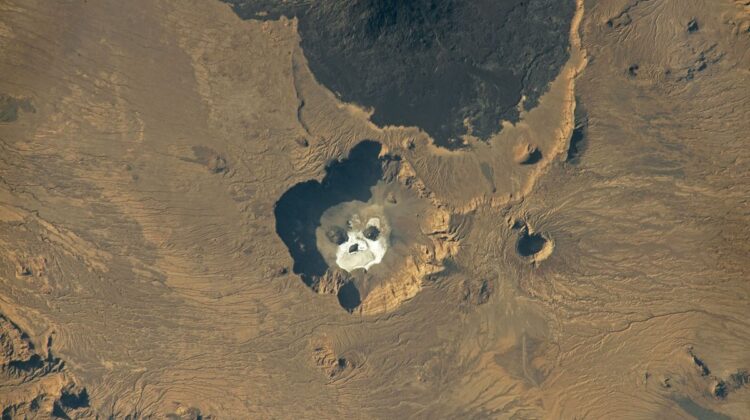
When you look down at the Sahara desert and the Sahara desert looks back.
Imagine gazing down at the vast expanse of the Sahara desert from the International Space Station (ISS) and suddenly, an eerie sight meets your eyes. You spot a colossal, ghostly skull seemingly peering back at you from the Earth’s surface. While it may sound like the stuff of legends and folklore, this unusual phenomenon is far from supernatural. Instead, it’s a remarkable geological feature that has captured the attention of astronauts orbiting high above.
This curious apparition is none other than the Trou au Natron, nestled in the northern reaches of Chad. This geological wonder is a volcanic caldera that descends to a staggering depth of 1,000 meters (3,300 feet) and boasts an irregular diameter spanning 6 to 8 kilometers (4 to 5 miles). However, the most striking aspect of this natural spectacle is the ghostly white expanse that blankets most of the caldera’s floor. This white layer is known as natron, a concoction of sodium carbonate, sodium bicarbonate, sodium chloride, and sodium sulfate.

As we inspect this peculiar caldera more closely, it becomes evident that the so-called “eyes” and “nose” of the giant skull are not the work of some cosmic artist. They are, in fact, towering cinder cones that have formed around volcanic vents. These dark pits create a visual illusion that adds to the skull-like appearance when seen from high above the Earth’s orbit.
The Trou au Natron is ensconced within the Tibesti Mountains, a range that claims the title of the Sahara’s highest mountain massif. Rising to an elevation of 2,450 meters (8,040 feet), these mountains hold a reputation for being one of the most remote and isolated regions on the planet. The Tibesti Mountains exude an aura of mystery and wonder, contrasting sharply with the unforgiving environment they inhabit.
Surprisingly, despite the harsh and seemingly desolate surroundings, the Tibesti Mountains harbor a fascinating array of biodiversity. Among the rugged terrain, you can find elusive creatures like golden jackals, nimble fennec foxes, graceful gazelles, African wildcats, and a variety of bird species. Moreover, these mountains have deep historical and cultural significance, serving as the ancestral homeland of the semi-nomadic Toubou people.
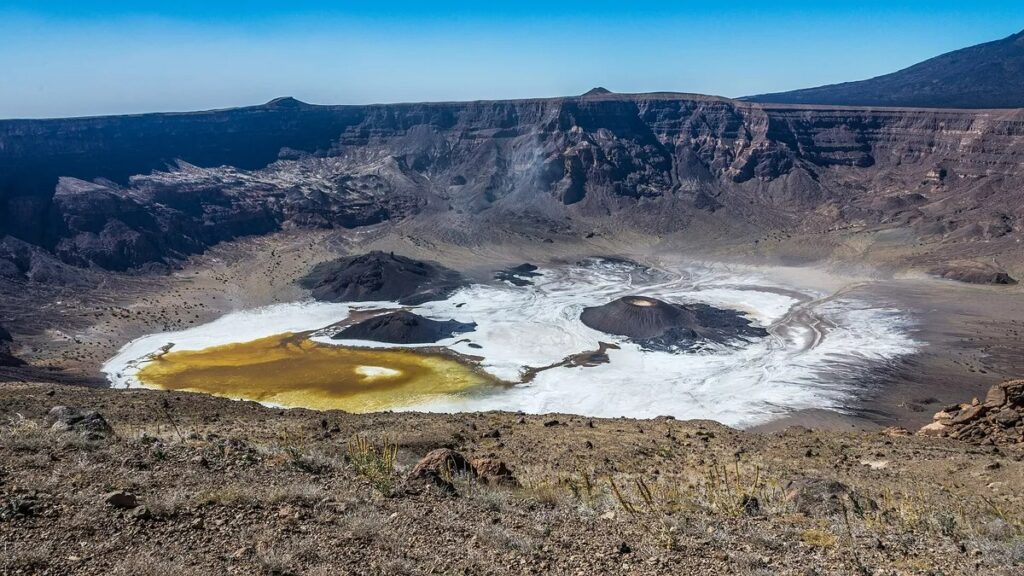
Image credit: Gerhard Holub /Wikimedia Commons (CC BY-SA 4.0)
However, the Trou au Natron remains a subject of intrigue and mystery for scientists. Its remote location, coupled with the challenging geopolitical environment surrounding it, has made comprehensive research a formidable task. The exact origins of this geological marvel and the timeline of its formation are shrouded in uncertainty. While the volcano is considered extinct, the last time it erupted remains an enigma. What is known is that some 14,000 years ago, this striking feature was a frigid glacial lake, a stark contrast to the arid beauty it presents today.
The Trou au Natron is a testament to the Earth’s captivating and enigmatic geological history. And when viewed from the vantage point of an astronaut aboard the ISS, it can take on the appearance of a colossal skull, reminding us of the countless mysteries that still await discovery on our planet.
Leave a Reply