The asteroid is so dense, physicists say it could contain elements not yet seen on Earth.
A group of physicists hailing from The University of Arizona has embarked on a groundbreaking journey to investigate the possibility of Compact Ultradense Objects (CUDOs) lurking within the cosmos. These enigmatic objects are believed to possess a mass density greater than that of Osmium, the densest naturally occurring and stable element, characterized by its 76 protons.

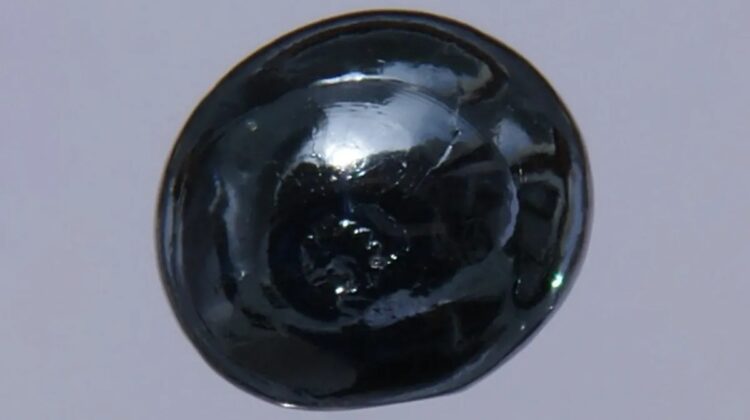
Image credit: Images of elements (CC by 3.0).
In their recent study, the team reveals their intriguing motivation for this cosmic exploration. They highlight that certain observed asteroids surpass the established mass density threshold, with one celestial body in particular garnering significant attention: asteroid 33 Polyhymnia. The researchers express that, “since the mass density of asteroid 33 Polyhymnia is far greater than the maximum mass density of familiar atomic matter, it can be classified as a CUDO with an unknown composition.”
This bold endeavor led the scientists to delve into the realm of potential elements with atomic numbers (Z) that surpass even the highest values found in the existing periodic table. While Osmium reigns as the densest of stable elements, the annals of experimental science have borne witness to the creation of elements with higher atomic numbers.
Enter Oganesson, the densest element on the periodic table, with an atomic number of 118. First synthesized in 2002 by colliding californium-249 with calcium-48 atoms, Oganesson is a heavyweight contender. Nonetheless, elements at the upper echelons of the periodic table often tread the line between stability and volatility, marked by radioactivity and incredibly brief half-lives.
This quest for the unknown extends to elements that exist beyond the confines of the periodic table, and physicists have endeavored to model their potential properties. The team from Arizona employed the relativistic Thomas-Fermi model of the atom in an attempt to estimate the mass density of elements bearing atomic numbers greater than 110.
The results of their investigation, when limited to elements found within the periodic table, left them wanting. Existing elements couldn’t account for the high mass density exhibited by asteroid 33 Polyhymnia, even if they were stable enough to be considered as candidates.
However, the Arizona researchers ventured into the theoretical island of nuclear stability near Z = 164, a region they predicted could yield elements with mass density values ranging from 36.0 to 68.4 g/cm³. It’s within this theoretical realm that plausible candidates emerged, suggesting that a portion of asteroid 33 Polyhymnia might consist of these superheavy metals, potentially aligning with the experimentally measured mass density.
The implications of this research are nothing short of captivating. The findings give rise to the tantalizing hypothesis that superheavy elements, if endowed with sufficient stability, might indeed find a home deep within the cores of dense celestial bodies like asteroid 33 Polyhymnia.
While the study remains in its preliminary stages, the implications are far-reaching and exhilarating for an array of enthusiasts, from those with a casual fascination with physics to enterprising tech visionaries with ambitions of space mining.
Jan Rafelski, one of the paper’s authors, summed up the excitement surrounding this endeavor aptly, stating, “All super-heavy elements – those that are highly unstable as well as those that are simply unobserved – have been lumped together as ‘unobtainium.’ The idea that some of these might be stable enough to be obtained from within our Solar System is an exciting one.” The cosmos, it seems, continues to reveal its secrets, one element at a time.
Leave a Reply